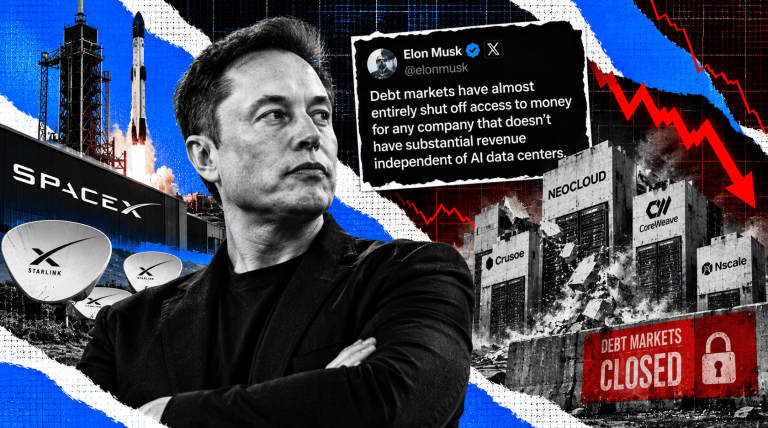

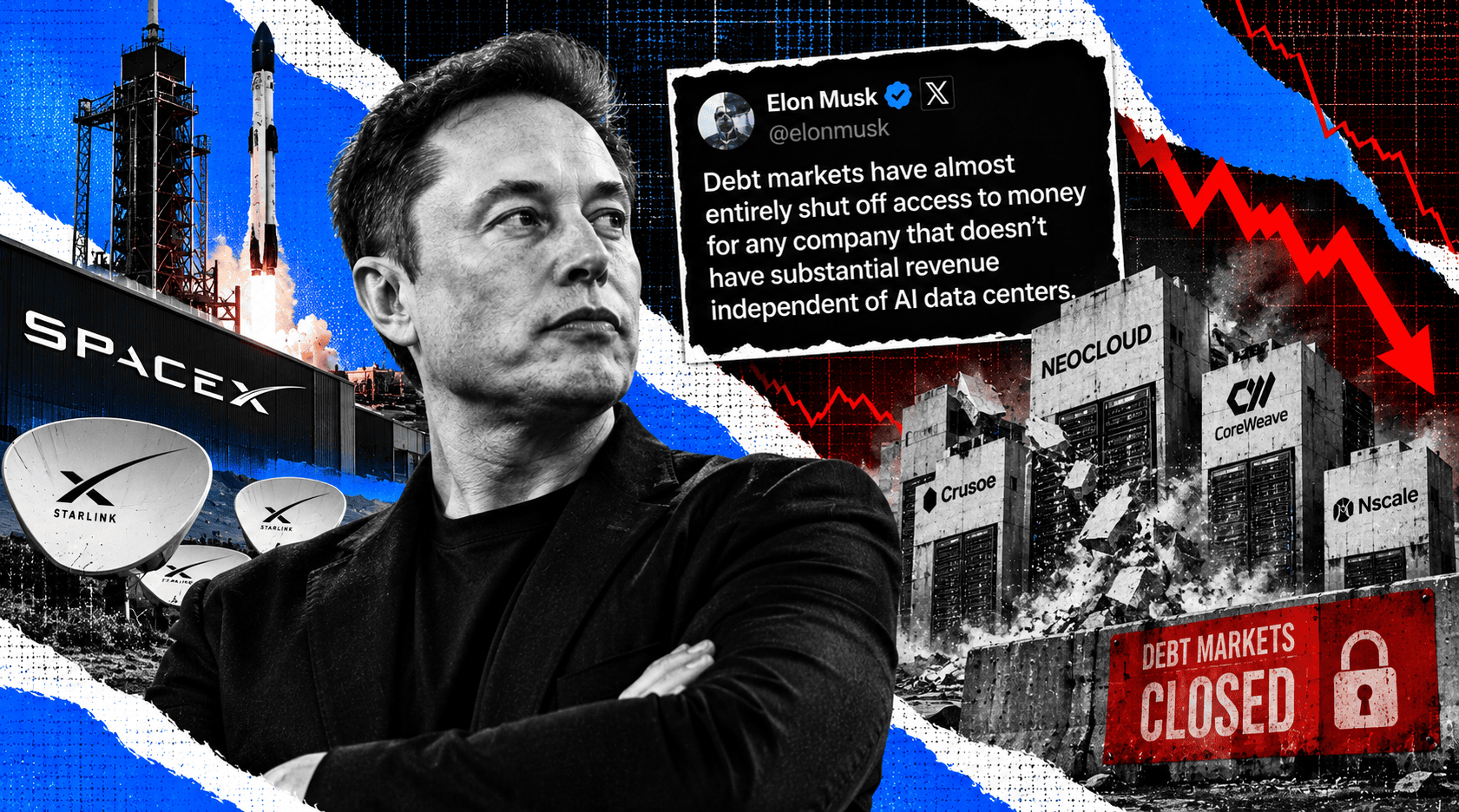
Elon Musk wrote on October 25 that debt markets have “almost entirely shut off access to money for any company that doesn’t have substantial revenue independent of AI data centers.”
SpaceX, he wrote, has closed $40 billion of debt to buy GPUs. The financing is available to the company because it is investment-grade and generates revenue from Starlink and rocket launches. The same access, he argued, is no longer open to pure-play AI infrastructure providers.
“That means the 200+ neoclouds are going to see guppy-level death and consolidation,” Musk wrote. “Some will make it through, but not many.” He later wrote that SpaceX has no interest in buying any of them, calling such a move “pointless.”
AI Debt Markets Shut for Pure-Play Data Center Companies
Musk made the comments on X in reply to a post about AI infrastructure financing. He described the SpaceX package as primarily callable debt for GPU purchases expected to arrive in the first and second quarters of 2027. He said the financing would not be a major factor for the company in the current quarter.
The claim that the deal is already closed sits against reporting that pricing discussions were still underway. SpaceX has not issued a separate announcement confirming the details.
SpaceX’s Starlink Revenue Lets It Borrow When Others Cannot
The distinction Musk draws is between companies that have cash flow outside AI data centers and those that do not. SpaceX’s Starlink and launch businesses supply the independent revenue that supports an investment-grade rating. Most neocloud providers, which rent out AI computing capacity, do not have equivalent non-AI revenue streams.
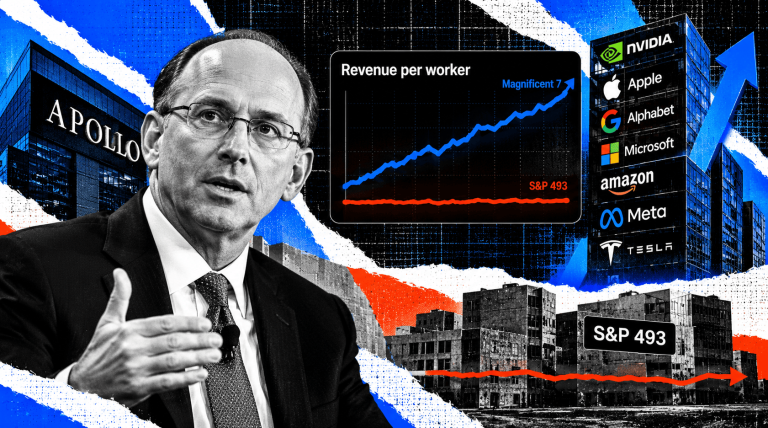
That split maps onto the concentration already visible in token spending. Apollo’s Torsten Slok noted last week that the top 1% of AI spenders are heavily venture-backed and that mainstream companies are treating token outlays as a cost rather than a growth driver. The same narrow set of buyers is now facing tighter access to debt.
What Tighter AI Debt Access Means for Capex and Neoclouds
A rapid reduction in available debt for pure AI infrastructure would change the assumptions behind the current capacity build. TrendForce has estimated $957 billion of capital expenditure by the largest cloud providers in 2026, with AI systems accounting for the large majority. Morgan Stanley has projected roughly $1.58 trillion of AI-related compute investment in 2027 across hyperscalers and neoclouds.
Much of the near-term contracted demand supporting those figures has come from venture-backed buyers rather than from a broad base of customers generating operating cash flow. If debt markets remain closed to companies without independent revenue, the portion of that pipeline that can still be financed shrinks.
Gartner has estimated that more than $3.5 trillion of AI infrastructure spending could face impairment risk by 2030 if related revenue fails to justify the outlay. A financing environment in which only firms with non-AI cash flow can continue to borrow accelerates the test of that scenario.
Open Questions on the $40 Billion SpaceX Deal and Neocloud Survival
Musk’s posts describe a market that has already moved. Whether the $40 billion SpaceX facility closes on the terms he described, and how many of the 200-plus neoclouds can still raise capital, will show how far the shift has gone.
The comments do not settle the broader question of AI productivity or revenue gains outside the largest technology companies. They do indicate that the credit side of the build-out is now distinguishing between firms that can fund it from existing cash flow and those that cannot.
Author: Andy Samu
See Also:
AI Payoff Is Still Confined to Big Tech, Apollo’s Slok Says – MRKT3.0