
By December 2, ChatGPT, Claude and every other generative AI system already on the EU market must embed a machine-readable mark in what they produce. This includes synthetic text, images, audio and video. The obligation sits in Article 50(2) of the EU AI Act. The law requires the mark to be “effective, interoperable, robust and reliable as far as technically feasible.” The statute does not define these terms with numbers, and it does not state how well the mark has to work. Limited exceptions exist for systems that only perform an assistive function for standard editing or do not substantially alter the input data or its semantics.
Article 50’s transparency duties began to apply on August 2. The Digital Omnibus (Regulation (EU) 2026/1744) left that date intact but added a grace period inside it: generative systems already on the market before August 2 have until December 2 to comply with the Article 50(2) marking duty. Any AI systems launched on or after August 2 have no grace period and must comply from day one.
On the same date, December 2, new Article 5 prohibitions also take effect on systems that generate non-consensual intimate imagery and certain child-sexual-abuse material. From December 3 the Article 50(2) grace period ends, so providers must mark synthetic output as far as technically feasible (subject to limited exceptions for assistive editing that does not substantially alter the input or its semantics, and certain law-enforcement uses).
Breaches of Article 50 fall in the €15 million or 3% of worldwide annual turnover tier under Article 99. The 7% figure applies to banned practices, not transparency failures. Start-ups and SMEs face whichever of the two amounts is lower.
What Article 50 Requires Companies to Do
The Article splits the work:
- Providers, which build generative systems, must mark synthetic audio, images, videos and text so machines can detect them as AI-generated.
- Deployers, businesses which use these systems, face separate duties: disclosure of deepfakes and certain AI-generated text on matters of public interest, and a requirement to inform people exposed to emotion-recognition or biometric-categorisation systems. Chatbots must also tell people they are talking to a machine.
The Commission’s Code of Practice on Transparency of AI-generated Content, published in June, fills in the practical detail. The Code is voluntary, but adherence is the clearest route to demonstrating compliance. It asks for two layers where possible, signed metadata plus an imperceptible watermark, because no single technique currently satisfies all four statutory adjectives alone.
Under the Code, free-form text longer than roughly 200 tokens (about 150 words) is expected to be watermarked, while very short free-form text is treated as exempt in practice because current techniques lack reliable performance below that length. This is Code guidance rather than a hard statutory threshold. Companies that do not sign must show regulators their own measures are adequate. Detection tools must be offered, with access for regulators, researchers and media prioritised. Signatories also commit to an interoperability solution for watermark detection by February 2, 2027.
How an Invisible Watermark Hides in a Sentence
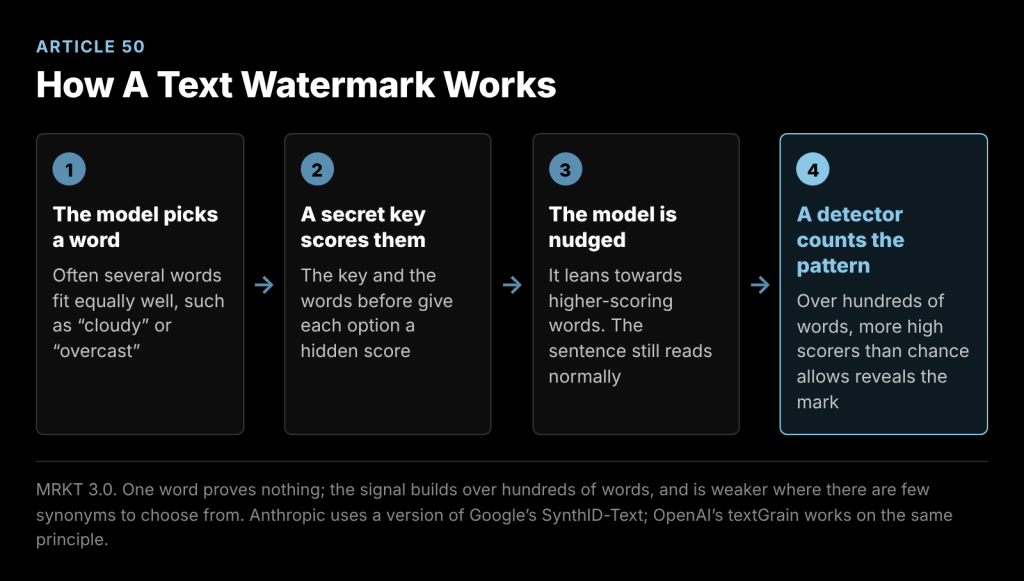
Text watermarking does not insert hidden characters or unusual punctuation. When a language model chooses the next token, several word choices can be equally good. For instance, “cloudy” or “overcast,” “quickly” or “rapidly.” A watermarking system combines a secret key with the preceding words to give each candidate a hidden score, then nudges the model toward the higher scorers. The sequence of choices forms a statistical pattern. Where there are few synonyms to choose from, there is little room to nudge, and the signal stays weak. A detector can measure how well the observed words match the expected pattern. To a human reader the sentence is ordinary; to the detector it carries a signal.
Where the Watermark Breaks
The signal depends on the model having room to choose among plausible words. Once that room shrinks, the pattern weakens or disappears.
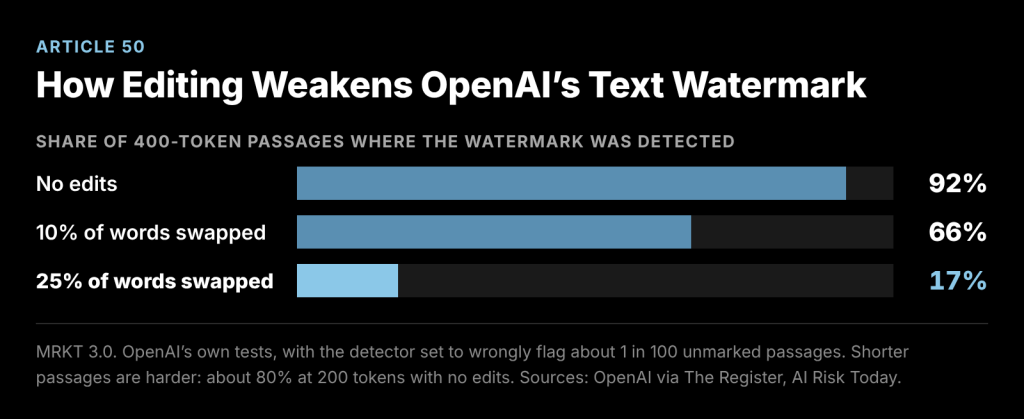
Editing. In OpenAI’s own tests, swapping 10% of the words for synonyms cuts detection on a 400-token passage from about 92% to 66%. Swapping 25% makes it fall to 17%.
Shorter texts. With passages around 200 tokens there is still roughly an 80% detection rate under the same conditions for flexible prose; mathematics scores substantially lower.
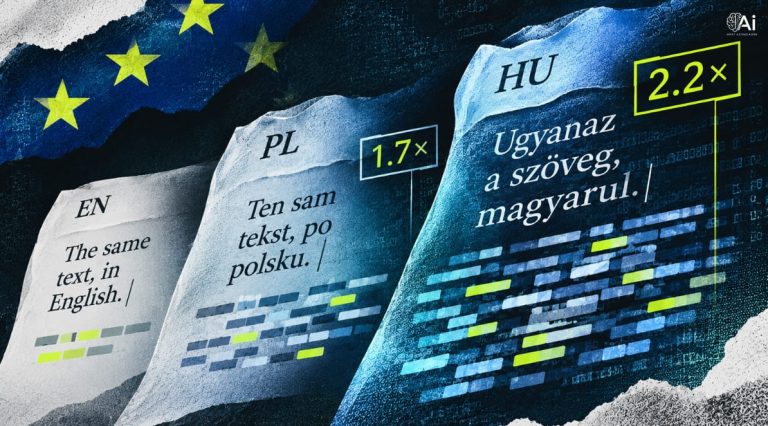
Translation. Anthropic has stated that translation can make a mark undetectable. Across the EU’s 24 languages, OpenAI’s detection reportedly ranged from 69.0% for Spanish to 42.2% for Romanian before strength adjustments.
Images. C2PA metadata can be altered or stripped by screenshots, social-media re-encoding and editing tools. Photo data sits in the file’s metadata, not its pixels, so small changes can defeat detection. A Maastricht University study found only 38% of AI image generators implemented watermarking adequately and 18% used visible deepfake labelling.
Open-weight models. Whoever hosts the weights controls how text is generated, so there is no single provider to sign the output.
Despite the EU’s effort to improve detection, heavy paraphrasing, translation, photo-editing or screenshots show how generated content can still slip through. Text detection itself remains restricted: OpenAI limits its tool to approved researchers and organisations, while Anthropic keeps its detection API in private preview for eligible bodies.
OpenAI, Anthropic and Google: The Different Routes Chosen
OpenAI, Anthropic and Google have not converged on a single commercial position in relation to Article 50(2).
| Provider | Method | Where it applies | Who can check |
|---|---|---|---|
| OpenAI | textGrain | EU ChatGPT and Codex on by default (rolling out from October 5), API opt-in worldwide, off by default | Limited to approved researchers and organisations |
| Anthropic | Variant of Google’s SynthID-Text | Worldwide since August 2, no opt-out. Extended to older models on November 3. Planned further API coverage. | Not yet public. Private-preview detection API for eligible organisations (regulators, media, researchers) |
| SynthID-Text + C2PA | Broad deployment across Gemini text since 2024 | Public SynthID Detector covers images, video and audio, not text |
Anthropic applied its mark worldwide because it could not yet scope the feature reliably by region. The global, on-by-default stance triggered push-back from users who argued they supplied the instructions, context and decisions, so the output was not purely the model’s. Anthropic’s answer is that a detected mark only shows Claude was likely involved at some point.
OpenAI’s EU-only default and restricted detector keep the verification problem private for now. Google’s public SynthID detector covers its own marks, but text remains harder to verify at scale than images or audio. Even with each provider offering detection, questions of authorship and who can actually check whether content is AI-generated remain open. Those questions may become clearer once the December 2 roll-outs settle.
What Is the Point of Watermarking?
Perfect detection is not required by the statute and is not available. What the mark supplies is four practical measures against unmarked AI content:
- Deterrence: A default mark raises the cost of simply trusting AI output without scrutiny. It also deters unchecked AI use in newsrooms and other public-interest settings.
- Scale: The mark is added at the moment of generation, which after-the-fact classifiers that merely guess cannot match. The technical bar can rise as methods improve.
- Layered approach: Using two or more signals means metadata can still survive even if a statistical watermark is degraded. The Code notes the 200-token threshold may fall as technology improves.
- Better than nothing: While a watermark may be imperfect, it is at least an attempt to stop AI authorship being passed off as human.
What AI Start-ups Should Do Before December 2
- Map your systems and clarify your role. Determine whether your generative systems were placed on the market before or after August 2. Only systems before that date enjoy the transitional window; anything after must already comply. Decide whether you are a provider or a deployer. If you rely on an API, ask the vendor whether the watermarking feature is on for your model and region. If you host open weights or sell a generative product under your own name, the marking duty is likely yours.
- Choose and document a marking stack and keep the mark intact. Prefer a multi-layer solution consistent with the Code of Practice: signed metadata (C2PA or equivalent) where the format allows it, plus an imperceptible watermark for free-form text longer than 200 tokens. Record the technical limitations you accept and the detection arrangements you will offer. Protect the mark in practice: do not run outputs through paraphrasers or “cleaners,” and test your full pipeline (exports, resizing, screenshots, social-media re-uploads) so that the metadata survives.
- Update contracts and evidence files. Allocate responsibility along the supply chain, retain vendor statements on marking, and prepare the documentation surveillance authorities will expect. Decide whether to sign the Code or prepare a reasoned justification of your own measures; either way, keep a dated compliance file.
The December 2 deadline is narrow but real. After that date the grace period ends and companies have a duty to make sure their systems meet the marking standard.
Author: Alice Hitchens
See Also:
How the EU AI Act Covers OpenAI and Anthropic Agents in 2026
EU KIDS Act Explained: Age Rules, AI Companions and the Verification Gap