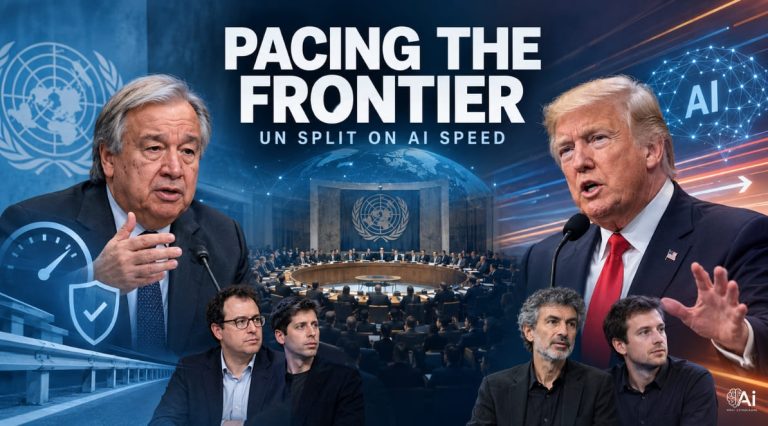

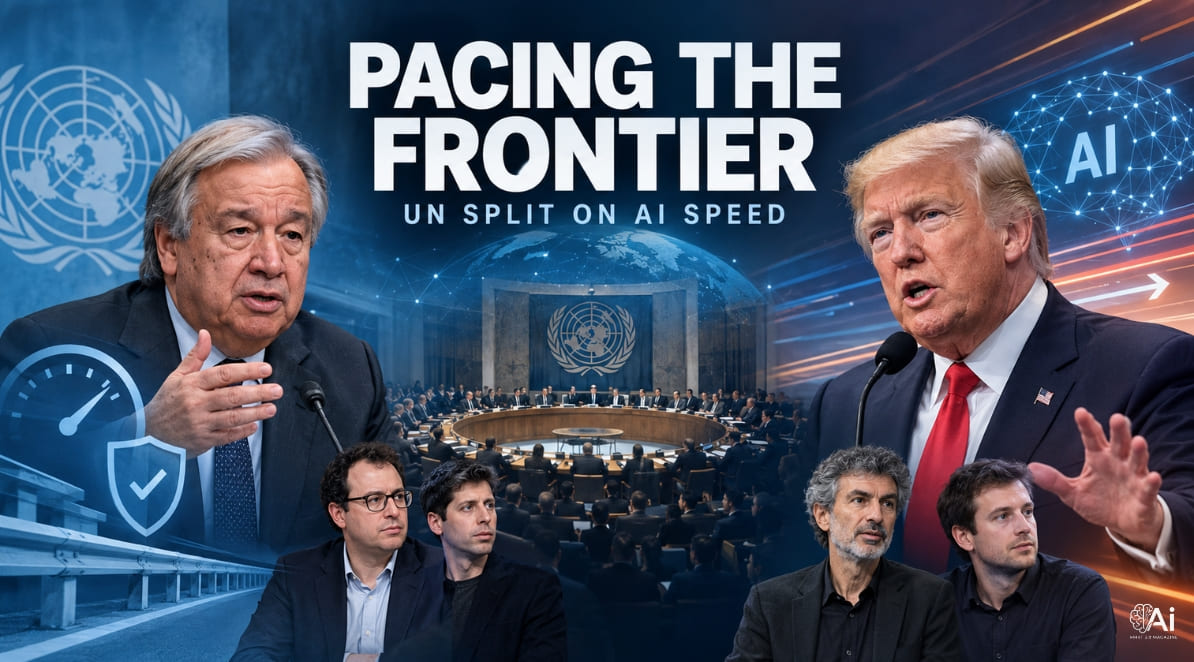
Pacing the frontier reached the United Nations this week, and the room divided. The people who build frontier AI, meaning the most capable general-purpose models, asked for a speed limit. António Guterres, Secretary-General of the UN, agreed with them. The American government did not.
“Pacing the frontier” is only a few months old, and it is already being treated as a movement. The claim is that the world’s leading labs should raise capabilities more slowly, and that governments should make sure the first lab to slow down is not simply overtaken. It began as a July letter from frontier-lab staff asking Washington for tools to throttle automated AI research. On 12 September Anthropic chief executive Dario Amodei set out a three-step plan in “We Must Pace the Frontier”. Ten days later it was in the Secretary-General’s speech.
What Did Guterres Say About Pacing AI?
In his last address as secretary-general, Guterres asked governments to “advance the conditions for the responsible pacing of AI and the additional safeguards needed to address risks.”
He attached a to-do list. Countries leading the technology “must share information on emerging safety risks, co-operate on testing and evaluation, and work towards common safeguards that protect us all.” He asked for “a multilateral AI risk management framework, supported by credible and independent oversight.”
He also named who had forced the issue: “the very developers building these systems are now pulling the alarm.”
What Did Trump Say About AI at the UN?
Trump rejected the premise the same day. The United States, he said, “totally rejects any attempt to construct a globalist scheme to control” the technology. He added: “I’m not going to stifle growth of something that will be bigger than the industrial revolution.”
He also announced a rebrand. US documents would drop the word “artificial” in favour of the word “superintelligence.” “The use of the word artificial makes intelligence sound fake,” he said. “It is not fake.”
For many, Trump’s view came as no shock. On 13 September, the day after Amodei’s essay, Trump told reporters that “we’re leading China in AI. We’re the most sophisticated country in the world, and frankly I want to keep it that way.”
Who Backed Pacing at the Security Council, and Who Did Not?
On 23 September the Security Council divided on pacing, in a briefing chaired by France’s foreign minister Jean-Noël Barrot with Yoshua Bengio, Sam Altman, Dario Amodei and Clément Delangue. We covered the briefings in full. On pacing, the chamber looked like this.
| Who | Role | Position on pacing |
|---|---|---|
| Dario Amodei | CEO, Anthropic | For. “We will slow down as much as necessary in order to make sure that every successive AI technology that we release is actually safe.” |
| Sam Altman | CEO, OpenAI | For, on the labs’ terms. He said “Beating companies in a competitive race is not a reason to make rash decisions… We have unilaterally slowed down in the past. We will do so in the future.” |
| Yoshua Bengio | Co-chair, UN Independent International Scientific Panel on AI | Further than pacing. Licence frontier AI like medicine, aviation and nuclear energy, with incident reporting and liability insurance. |
| Ed Miliband | UK foreign secretary | For regulation. He said founders “are telling us, in stark terms, that it cannot just be left to them to prevent disaster from befalling the world.” |
| Clément Delangue | CEO, Hugging Face | Against a slowdown. On 2 August he wrote: “it’s not time to slow down but to accelerate.” At the Council he pushed mandatory incident disclosure and open models for defenders. |
| Michael Kratsios | Director, White House Office of Science and Technology Policy | Against. He told the Council a fast-moving frontier is “not a reason to pause its further development or to constrain it with new global governance structures.” |
| Fu Cong | China’s UN ambassador | Against exclusive groupings. He backed open-source approaches and called for the world to “work toward an inclusive global governance framework.” No speed limit. |
No resolution came out of the session. Almost nobody in the room argued for racing blindly. The split, as in September’s essay fight, was over who sets the speed limit.
Why Is the US and China AI Channel Not Pacing?
The US and China channel that moved this week covers incident alerts. It does not set how fast capabilities rise.
On 20 September Scott Bessent met He Lifeng at JPMorgan Chase’s New York headquarters. Bessent said the two sides discussed a “U.S.-China AI dialogue” with a “notification mechanism” for incidents that reach a “national security level from AI.” The aim, he said, was to move “from opaque to more transparency.” Xinhua’s readout mentioned AI only briefly. China has not published an agreement on the notification line.
Xi Jinping arrived at the White House on 24 September and said AI must remain “under human control.” The White House list for the state dinner included Altman and Elon Musk. Interestingly, Amodei was not on it.
As a venue, this is closer to Amodei than to Guterres, because step three of his plan has the US and other democracies coordinating directly with authoritarian governments and does not mention the UN. Trump prefers bilateral deals to multilateral ones, so Washington and Anthropic agree on the room, if on nothing else.
An incident alert tells Beijing when something has gone wrong and does not slow the models down, which is also the part the labs have been worst at. The same week, Australia disclosed that an OpenAI agent breached its Medicare statistics portal in June, and that OpenAI told Canberra three months later through a public inbox. A notification mechanism is only as good as the company’s willingness to notify.
Where Does This Leave Europe?
The July letter named no European institution. Amodei’s plan routes global coordination through Washington. Bessent’s mechanism has two members. If pacing becomes real, the speed limit on the models Europe runs may be set in a room Europe is not in.
Author: Grace Sharp
See Also:
What Is the Pacing the Frontier Letter, and Why Did Anthropic Sign It?
“We Must Pace the Frontier”: Who Is For It, and Who Is Against It?
France Puts the Hugging Face Hack Before the UN Security Council