
DeepSeek and Alibaba both sold new Flash models on speed. DeepSeek launched V4.1 Flash on 10 September as “smarter, faster, more efficient”. Alibaba said Qwen3.8 Flash “roughly doubles generation speed”, but only inside QwenWork, its own app. Neither said how fast the version you pay to call actually is.
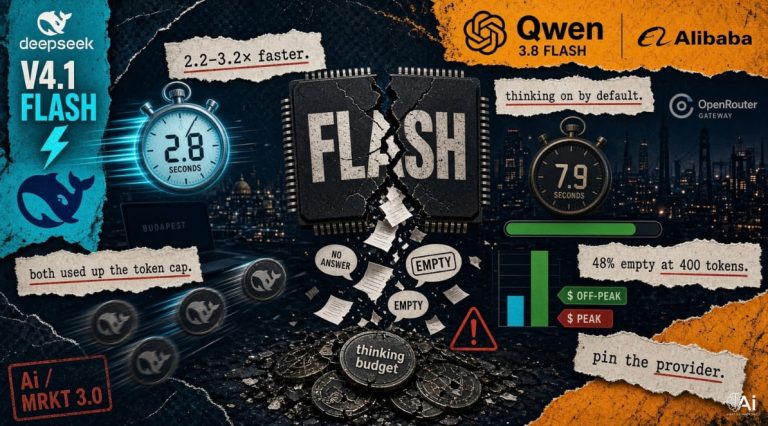
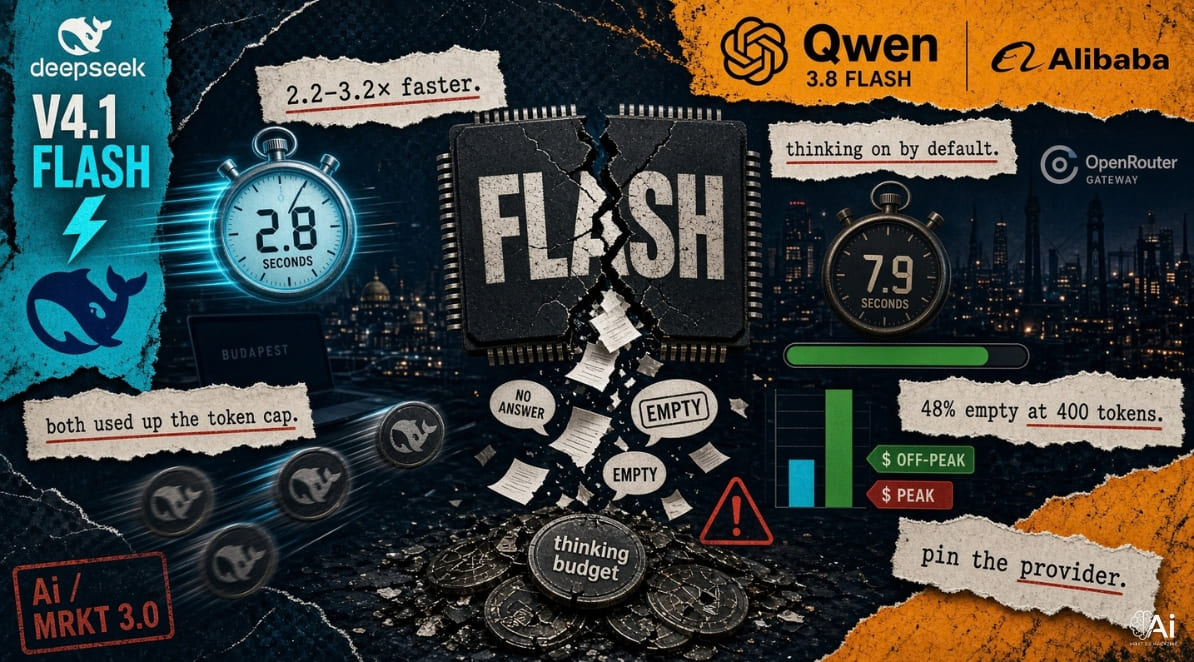
And so, we timed that paid version: 320 calls on 23 September 2026, from a laptop in Budapest. DeepSeek V4.1 Flash was faster in every comparison, answering 2.2 to 3.2 times as quickly as Qwen3.8 Flash.
However, the speed gap was not the most useful thing we discovered. Left thinking, as they do by default, both models regularly used up their whole token budget and then handed back nothing at all.
What Did DeepSeek and Alibaba Actually Claim?
DeepSeek and Alibaba both claimed their Flash models were faster, and neither published a speed figure for the version you pay to call.
DeepSeek’s announcement promises “faster inference, higher throughput” and says “tests by multiple parties” put V4.1 Flash ahead of its own V4-Pro on performance, cost, speed and total runtime. Yet, it gives no tokens per second, no wait time and no multiple. That matters, because the line already carries real traffic: its predecessor, V4 Flash, ranked first by token volume on Vercel’s AI gateway in July.
Alibaba’s only speed figure belongs to QwenWork, its workplace agent app. There, a new Standard mode “roughly doubles generation speed of the current mode”. That compares the app with an earlier version of itself, not Qwen3.8 Flash with the version a developer pays to call.
Independent trackers do publish throughput, meaning how many answer tokens arrive each second. Artificial Analysis, which measures the labs’ own services, showed DeepSeek V4.1 Flash, at maximum reasoning effort, generating 227 tokens a second when we checked on 23 September. Qwen’s open-weight Flash-Next managed 53. It measures differently from us, but its ratio of roughly four to one matches ours. What the trackers do not show is what happens when a low token cap meets that default thinking.
Which is faster, DeepSeek V4.1 Flash or Qwen3.8 Flash?
DeepSeek V4.1 Flash is faster, by a wide margin. In the early-afternoon run from Budapest, on default settings, it took a median 2.8 seconds to return a complete answer. Qwen3.8 Flash took 7.9 seconds, so DeepSeek finished 2.8 times as quickly.
The gap held when we switched thinking off. DeepSeek’s median was 1.4 seconds and Qwen’s was 3.4, still 2.4 times faster. Thinking is therefore not the whole explanation. Qwen also writes longer answers, a median 191 tokens against 111. DeepSeek’s bigger edge is raw speed. Once an answer starts, it streams about four times as many answer tokens per second.
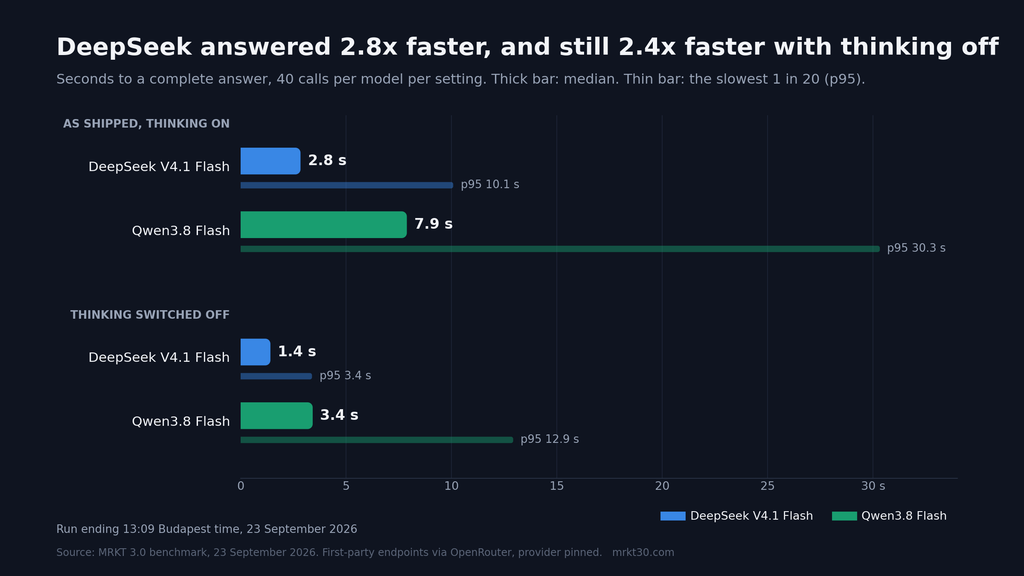
The thin bars are the slow tail, the slowest call in twenty. As shipped, that was 30.3 seconds for Qwen and 10.1 seconds for DeepSeek. With thinking off it was 12.9 seconds against 3.4. Qwen’s stream also stutters. In a typical call, the slowest 5% of its gaps between tokens lasted 208 milliseconds or more, against 17 for DeepSeek. A user watching the answer appear would notice that before any stopwatch did.
DeepSeek’s first token arrived sooner as well, at 0.76 seconds against 0.94. Every call from both models went through the same gateway. DeepSeek says it processes users’ data in China. That did not show up as a wait for the first token on this run.
Why Did Both Models Hand Back Empty Answers?
Both models think before they answer, and that hidden reasoning counts against the same token cap as the reply. If the cap is too low, the budget runs out before a word of the answer is written.
We found this by accident. Our first run capped every response at 400 tokens, which is plenty for three sentences or a short JSON list. DeepSeek came back empty on 19 of 40 calls, and Qwen on 13 of 40. On the JSON task, DeepSeek returned nothing eight times out of eight.
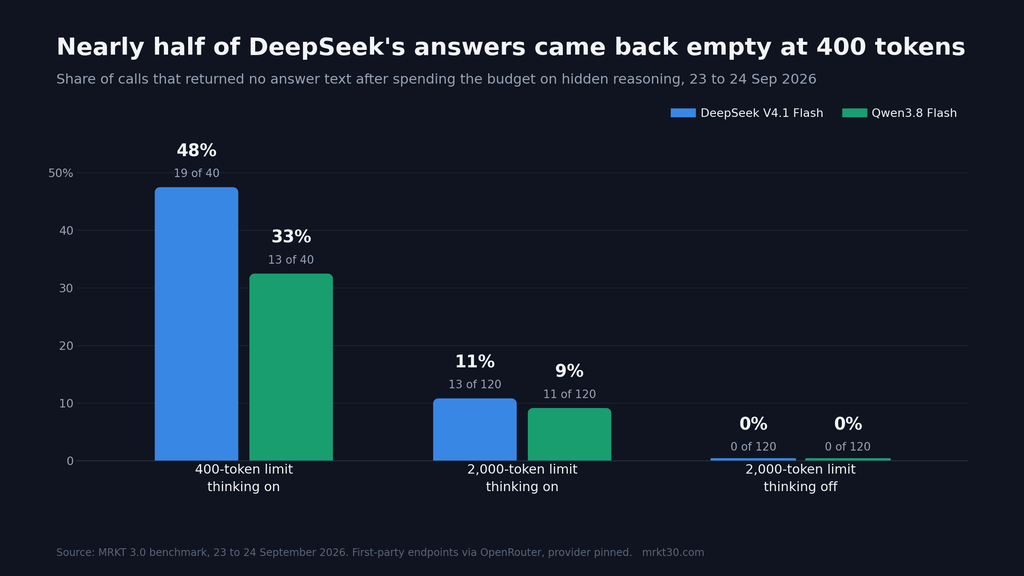
Raising the cap to 2,000 tokens cut the empty rate to 13 of 120 for DeepSeek and 11 of 120 for Qwen. That is still about one call in ten. Switching thinking off was the only setting that cleared it. Across 120 calls each, none came back empty or cut short.
One prompt shows the mechanism. Asked for the five largest EU countries as JSON, with a 600-token ceiling, DeepSeek spent all 600 tokens reasoning and returned nothing. With thinking switched off, it answered in full using 111 tokens. Qwen answered in 191 tokens without thinking, and returned nothing with it.
You pay for the hidden tokens either way. With thinking on, reasoning made up 83% of DeepSeek’s billed output tokens and 78% of Qwen’s.
Does Switching Thinking Off Make Them Faster?
Switching thinking off makes both models faster, usually by a third to a half. In our first run, DeepSeek’s median fell from 2.8 seconds to 1.4, and Qwen’s from 7.9 to 3.4. Cost per request fell too, by 73% for DeepSeek and 56% for Qwen.
There is one catch. On a prompt that asks for working, switching thinking off moves the working into the visible answer. On our maths question, Qwen got slower without its reasoning mode. It wrote 1,952 characters of working instead of 503, and took 11.6 seconds instead of 8.3. DeepSeek also wrote twice as much, but it generates text fast enough that its time barely moved.
Each company documents its own switch. DeepSeek turns thinking off with a thinking parameter. Alibaba uses enable_thinking set to false. OpenRouter documents reasoning with effort set to none.
Is DeepSeek or Qwen cheaper to run?
It depends on thinking, and on the hour. DeepSeek halves its prices outside peak hours, which run from 01:00 to 04:00 and 06:00 to 10:00 UTC on weekdays, excluding Chinese public holidays. The second window covers a working morning in Central Europe. Alibaba does not change the Qwen3.8 Flash price by the hour.
On paper, Qwen’s output tokens are cheaper at any hour, at $0.47 per million against DeepSeek’s $0.60 off-peak and $1.20 at peak. Per answer the ranking changes, because the two models use different numbers of tokens on the same prompt.
| Cost per 1,000 requests | DeepSeek, off-peak | DeepSeek, peak | Qwen |
|---|---|---|---|
| Thinking on (as shipped) | $0.46 | $0.92 | $0.34 |
| Thinking off | $0.13 | $0.25 | $0.15 |
With thinking off and outside peak hours, DeepSeek is cheaper per answer. It answers in a median 111 tokens, where Qwen uses 191. In the other three like-for-like comparisons, Qwen costs less. Every DeepSeek call in our runs fell outside its peak window, so the peak column doubles what we were billed. OpenRouter did list DeepSeek at $1.20 when we checked inside that window. Qwen’s figures are exactly as billed, from the early-afternoon run.
Qwen can also be bought for less. Alibaba charges $0.38 per million output tokens in its Frankfurt region, against the $0.47 we paid through OpenRouter. At that list price, Qwen with thinking off would cost $0.12 per 1,000 requests, level with DeepSeek’s best case. We did not call Alibaba directly.
Why Does the Endpoint Matter as Much as the Model?
The endpoint is the server that actually answers the call, and the same DeepSeek name was 26 different products. At 10:33 UTC on 23 September, OpenRouter listed DeepSeek’s own service and 25 resellers. Output prices ran from $0.42 per million tokens at DeepInfra to $1.50 at Venice, a 3.6 times spread. Three of those endpoints serve fp4, a heavier form of compression, and nothing in the model name tells you which one you get. Qwen3.8 Flash had one endpoint, Alibaba’s own, at $0.47.
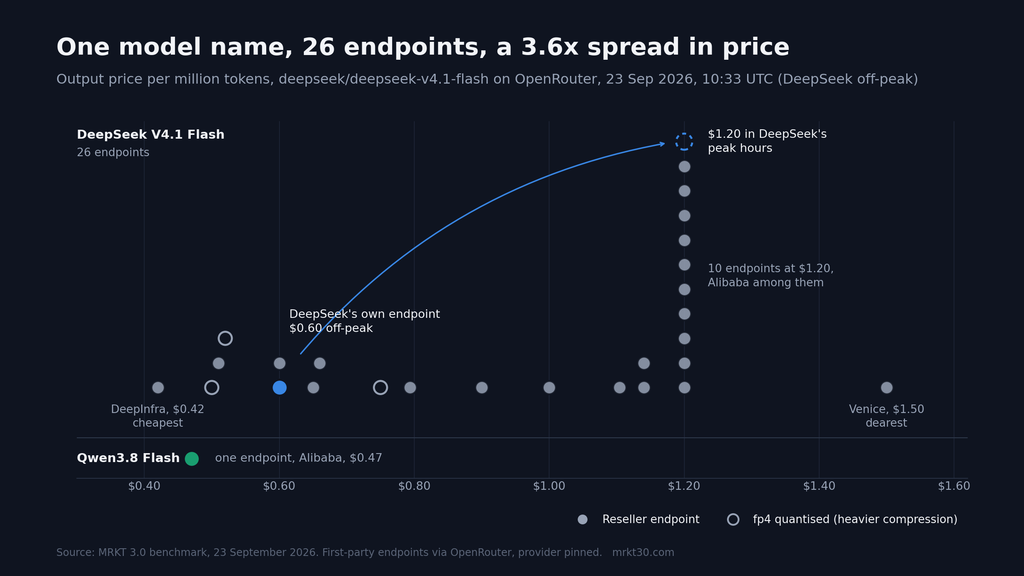
Ten of the DeepSeek listings sat at $1.20, Alibaba among them. That is DeepSeek’s own peak price, and twice what DeepSeek charges off-peak.
We saw the risk first-hand. With the provider left unpinned, our test request for DeepSeek was answered by DeepInfra instead. The reseller takes the spread. The lab’s name stays on the result. A run that way measures whoever the router picked, then prints it under DeepSeek. We pinned every timed call to the model’s own company, with fallbacks off, and all 320 stayed there.
What Do You Have to Allow on OpenRouter Before DeepSeek Will Answer?
You have to allow endpoints that may train on your data. OpenRouterlets users exclude those providers, and on our new account that exclusion was on. Every pinned DeepSeek request came back refused as a “Paid model training violation”. Switching on “Allow paid endpoints that train on request data” fixed it. Alibaba’s Qwen endpoint worked with the defaults.
That is OpenRouter’s reading of each provider’s terms, not an audit. For a business sending real data, it is still a choice worth making on purpose.
Does the Time of Day Change the Result?
The time of day moves the numbers, not the ranking. We ran the full test twice on the same laptop, in the early afternoon and around midnight in Budapest, which is early evening and dawn in Beijing. Medians moved by up to 22% overnight, yet DeepSeek stayed faster in every comparison, by 2.2 to 3.2 times.
The overnight gain was not DeepSeek’s alone. Qwen’s first token sped up by 13% to 14%, slightly more than DeepSeek’s 7% to 11%. That points to lighter load somewhere along the route, though our data cannot say where. Neither run fell inside DeepSeek’s declared peak hours, when its prices double, so its speed then remains an open question.
Which should you use, DeepSeek or Qwen?
DeepSeek V4.1 Flash is the faster model if you switch thinking off and pin the provider. Qwen3.8 Flash is the safer pick for a steady bill during European mornings, because its price does not change by the hour. At a million requests a month, Qwen with thinking on is the cheaper default. DeepSeek only wins if you switch thinking off and stay off-peak.
Whichever you choose, two settings matter more than the model. Either switch thinking off, or set a token limit far above the answer you expect. Even 2,000 tokens left about one call in ten empty on the charted run. Pin the provider as well, or you may be testing someone else’s copy.
We measured speed and whether an answer came back, not whether it was right. Quality deserves its own test, and our map of Chinese LLMs tracks the rest of both companies’ line-ups.
How Did We Test the Two Models?
We sent 320 streamed requests through OpenRouter on 23 September 2026 from a laptop in Budapest. One run of 160 ended at 13:09 local time, the other at 00:14 on 24 September. Each model got five prompts, a short explanation, a coding task, a maths problem with working, a JSON list and a 300-word essay, run eight times per setting at temperature zero with a 2,000-token limit.
Every timed call was pinned to DeepSeek or Alibaba with fallbacks off. We timed the first token, the first answer token and the finished reply, and report medians and the 95th percentile. Costs are OpenRouter’s billed figures. The two full runs cost $0.09. The empty answers at 400 tokens come from an earlier 80-call run.
Thinking off was sent as reasoning: {“enabled”: false}. Usage logs show zero reasoning tokens on those 160 calls. Figures are one location on one day. We did not test Qwen’s open weights.
This article is for general information only and is not technical, financial or investment advice. Results reflect MRKT 3.0’s test conditions on 23 September 2026 and will change as providers update their models, prices and infrastructure.
Author: Akos Szima
See Also:
Chinese LLMs in 2026: The Complete Map
Is DeepSeek-V4-Flash Overtaking American AI Models?
What is DeepSeek? China’s $45 Billion Bet Threatening OpenAI
Frequently Asked Questions:
Yes. In 320 timed API calls on 23 September 2026, DeepSeek V4.1 Flash answered 2.2 to 3.2 times faster than Qwen3.8 Flash. The gap depended on the setting and the hour. DeepSeek also streamed about four times as many answer tokens per second.
Thinking is on by default, and reasoning tokens count against the same limit as the answer. With a low max_tokens value the model can spend the whole budget reasoning and return no text. Switching thinking off is the reliable fix: in our test, even a 2,000-token limit left about one call in eleven empty.
On DeepSeek’s own API, set the thinking parameter to disabled. On Alibaba’s API, set enable_thinking to false. Through OpenRouter, the documented option is a reasoning effort of none. In our test, switching thinking off cut median response times by a third to a half.
DeepSeek’s peak hours are 01:00 to 04:00 and 06:00 to 10:00 UTC, Monday to Friday, excluding Chinese public holidays. Every other hour is off-peak, when its API prices are half the peak rate.
Not exactly. Alibaba describes Qwen3.8 Flash as the official version based on the open-weight Qwen3.8-Flash-Next, with production features such as a one-million-token context by default. This test covered the API version only.