

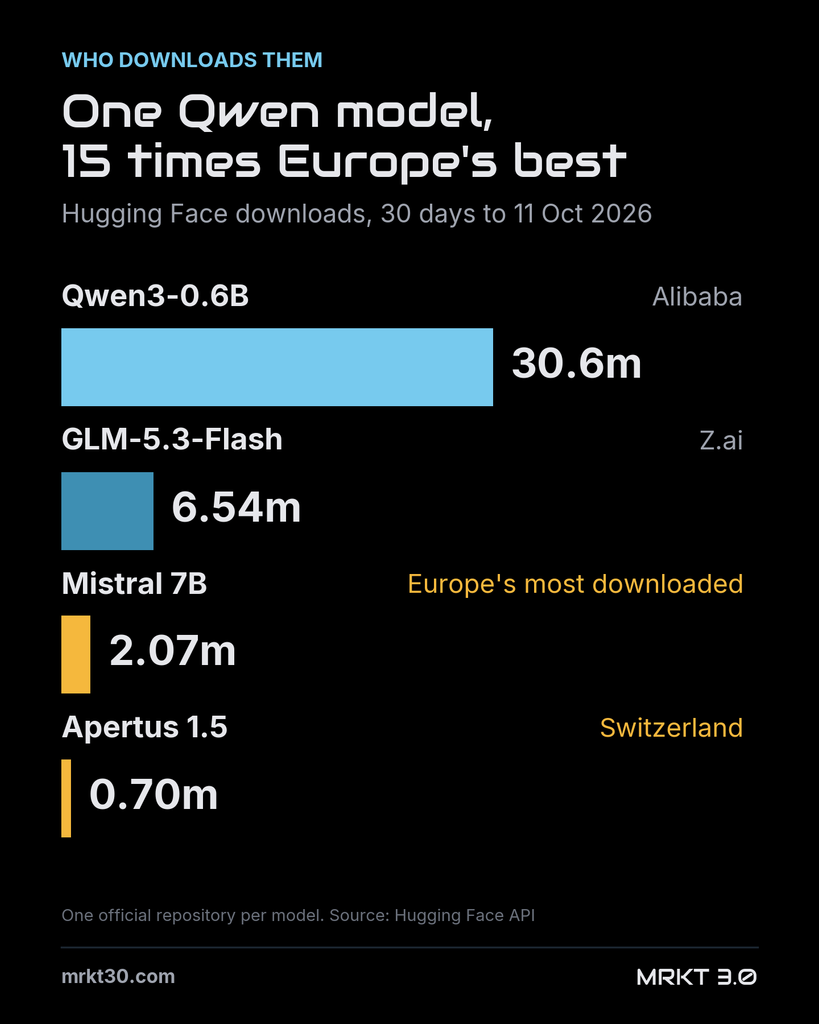
Europe’s most downloaded open LLM is a 7B that Mistral released in May 2024, and it pulled 2.1 million downloads in the last 30 days. A single Qwen model pulled 30.6 million.
This is the full map of Chinese large language models in 2026: who builds them, who owns them, what the licences actually permit and who downloads them. It is the companion piece to our European LLM map. Updated 11 October 2026.
Why This Map Follows the Listing
The European map follows money that runs out: most European projects end when a grant finishes. In China, the money went public.
Z.ai, formerly Zhipu, listed in Hong Kong on 8 January 2026, and MiniMax followed the next day and doubled on debut. Both are now going back for second listings on Shanghai’s STAR Market, Z.ai to raise about $2.2bn. Moonshot, the maker of Kimi, filed confidentially in Hong Kong on 3 September and is reported to be targeting the first quarter of 2027 at a $50bn valuation. DeepSeek has hired CITIC Securities for a STAR Market listing and is reported to be raising 80bn to 100bn yuan first. StepFun is preparing a Hong Kong float.
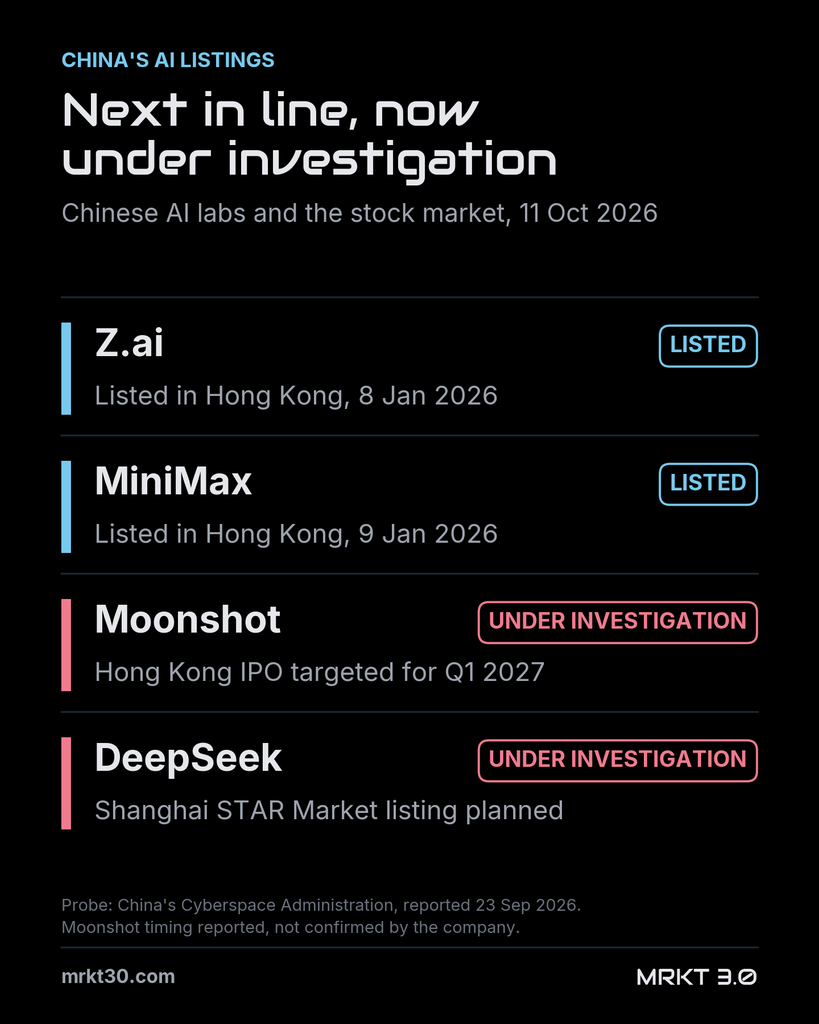
Public money brings public scrutiny. On 23 September China’s Cyberspace Administration opened an investigation into DeepSeek and Moonshot over user data that may have reached Anthropic’s servers, after an Anthropic report named seven Chinese companies. No penalties yet, and these are the two labs closest to listing.
Listing also means publishing the numbers: in the first half of 2026 Z.ai reported a 2 billion yuan net loss on 953.9 million yuan of revenue, MiniMax a $358m loss on $116.6m. Shareholders are a harder master than a grant, but they keep paying, which is why the cadence has not slowed.
The Full List of Chinese LLMs in 2026
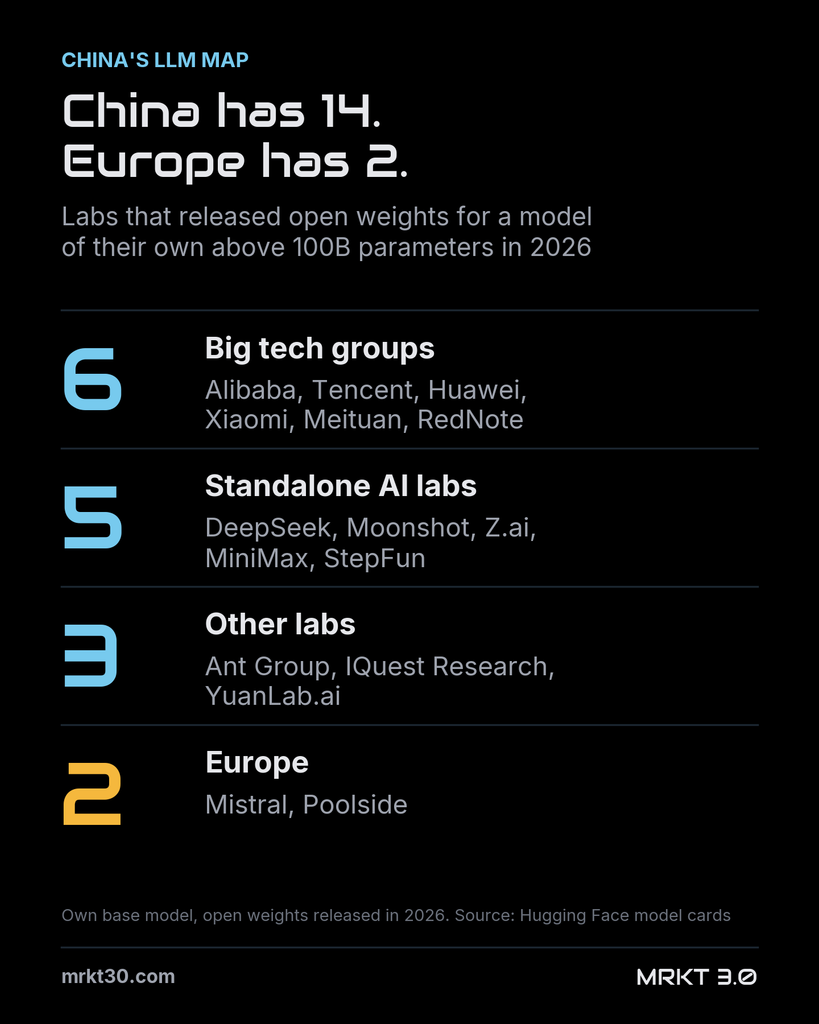
Our test is simple and checkable: in 2026, the lab released open weights for a model of its own above 100 billion parameters. Fourteen Chinese labs pass it. The column to watch is the licence, which most coverage gets wrong both ways.
| Lab | Backing | Latest open model | Licence | Money behind it |
|---|---|---|---|---|
| Alibaba / Qwen | Alibaba | Qwen3.8-2.4T-A95B (2.4T); Flash-Next (125B); 27B | Apache 2.0 on 27B; custom licences on the 2.4T and Flash-Next | Alibaba balance sheet |
| DeepSeek | High-Flyer | V4.1-Flash (552B), 10 Sep; V4-Pro (1.6T) | MIT | Raising 80bn to 100bn yuan, reported; STAR listing planned |
| Moonshot AI / Kimi | Alibaba-backed | Kimi K3 (2.8T, 104B active) | Kimi K3 License (custom) | Reported $50bn valuation; Hong Kong listing targeted for Q1 2027 |
| Z.ai (Zhipu) | Meituan, Tencent, Ant Group | GLM-5.3 (753B); Flash (320B) | Custom on GLM-5.3; MIT on Flash | Listed in Hong Kong 8 Jan 26; STAR Market listing planned |
| MiniMax | Alibaba, MiHoYo | M3 (428B); H3 video model | Custom on M3; H3 excludes the EU | Listed in Hong Kong 9 Jan 26; A-share listing filed |
| Xiaomi | Xiaomi | MiMo-V2.6-Pro (1T, 42B active), 21 Sep; V2.6-Flash (311B) | MIT | Xiaomi balance sheet |
| Tencent | Tencent | Hy4-preview (770B), 28 Aug; Hy3 (295B) | Apache 2.0 | Tencent balance sheet |
| Huawei | Huawei | openPangu-2.0-Pro (505B), July, on Ascend chips | openPangu licence, which excludes the EU | Huawei balance sheet |
| Meituan | Meituan | LongCat-2.0 (1.6T), trained on Chinese chips | MIT | Meituan balance sheet |
| RedNote (Xiaohongshu) | Xiaohongshu | dots3-note preview (280B), August | Apache 2.0 | Xiaohongshu balance sheet |
| StepFun | Tencent-backed | Step-3.7-Flash (198B) | Apache 2.0 | Nearly $2.5bn raised, May 2026 |
| Ant Group | Ant Group | Ling-3.0-flash (124B) | MIT | Ant Group balance sheet |
| IQuest Research | Not disclosed | IQuest-Q1 (320B, 15B active), 28 Sep | Modified MIT, attribution required | Not disclosed |
| YuanLab.ai | Enterprise lab | Yuan3.0 Ultra (1T), March | Yuan 3.0 licence, commercial use allowed | Not disclosed |
Xiaomi’s MiMo-V2.6-Pro entered Artificial Analysis’ open-weights index in first place out of 114 models on release day. Shanghai AI Laboratory misses our test only because its large models sit on other labs’ foundations: Intern-S2-397B on Qwen3.5, Atria Dawn on GLM-5.2, and the 1 trillion parameter Intern-S1-Pro on a Qwen3 base.
Who Stopped Shipping Open Weights?
Four well-known names have released no open general-purpose model this year; their old weights still pull real numbers.
| Lab | Last open general model | Since then |
|---|---|---|
| ByteDance Seed | Seed-OSS-36B, August 2025 | Only small research and coding models. UI-TARS-1.5-7B still pulls 385,712 a month |
| Baidu | ERNIE 4.5, June 2025 | Its ERNIE 5 flagship launched as a proprietary model |
| 01.AI (Yi) | Yi-1.5, 2024 | Nothing new. Yi-6B-Chat still pulls 30,754 a month |
| Baichuan | Baichuan2, 2023 | Moved to medical models |
Can You Use Chinese AI Models in Europe?
Mostly, yes. DeepSeek, Xiaomi, Meituan and Ant Group ship under MIT, and Tencent, StepFun, RedNote and Alibaba’s Qwen3.8-27B under Apache 2.0. Neither limits where you use the model, which makes them more permissive than several European models sold as sovereign.
The largest releases now come with conditions for companies that sell model access. Moonshot’s Kimi K3 License requires a separate agreement from any Model as a Service business above $20m of revenue, Alibaba’s Qwen3.8-Max License sets that bar at $50m, Z.ai’s GLM-5.3 License asks operators above $10bn for a security review, and the Qwen Community License 1.0 on Flash-Next demands one from every such business at any size. MiniMax’s M3 asks for attribution; IQuest asks only that you display its name.
Three Chinese licences exclude Europe outright. Huawei’s openPangu licence makes users warrant that they will not download, run or otherwise use the model “within the European Union”. Tencent’s older Hunyuan licence, still on HunyuanOCR, “DOES NOT APPLY IN THE EUROPEAN UNION, UNITED KINGDOM AND SOUTH KOREA”. MiniMax’s H3 video licence adds the United States, although its own Q&A calls that “not yet”, not “not ever”.
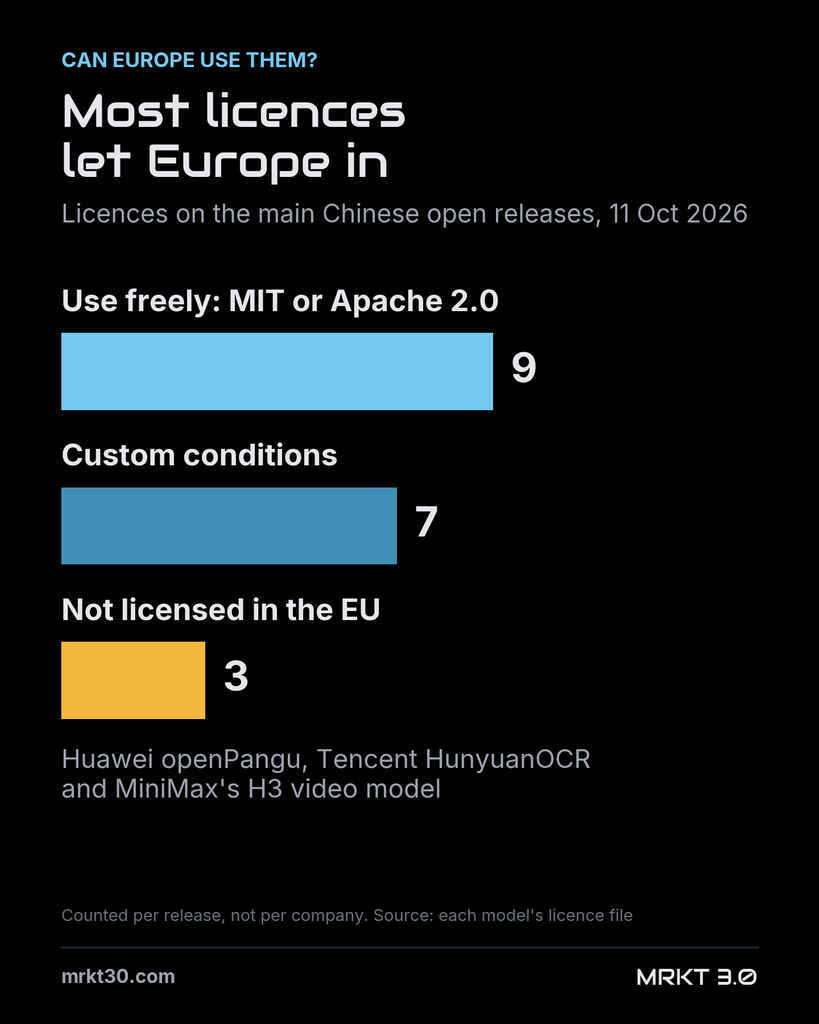
The licence travels with the release, not the company. Read it every time.
Who Actually Downloads These Models?
We pulled 30-day download counts from the Hugging Face API on 11 October 2026, one headline repository per model.
| Model | Lab | Downloads, last 30 days |
|---|---|---|
| Qwen3-0.6B | Alibaba | 30,575,964 |
| Qwen3-VL-8B-Instruct | Alibaba | 8,752,198 |
| Qwen3.8-27B | Alibaba | 6,843,108 |
| GLM-5.3-Flash | Z.ai | 6,539,199 |
| DeepSeek-V4-Flash-0731 | DeepSeek | 4,442,840 |
| MiniMax-H3 (video) | MiniMax | 3,607,946 |
| Mistral-7B-Instruct-v0.3 (Europe, for contrast) | Mistral AI | 2,069,650 |
| GLM-OCR | Z.ai | 1,785,895 |
| Unlimited-OCR | Baidu | 1,222,995 |
| Kimi-K3 | Moonshot | 1,130,271 |
| Apertus-v1.5-8B (Europe, for contrast) | EPFL / ETH Zurich / CSCS | 698,867 |
| MiMo-V2.6-Pro | Xiaomi | 95,740 |
The two European rows are the story. Mistral’s 2024 7B pulls about a fifteenth of what Qwen3-0.6B does, and a single Alibaba edge model out-pulls Switzerland’s Apertus 1.5 forty-four to one.
How Reliable Are These Download Numbers?
- Downloads are not usage. API traffic does not appear, and every lab here sells API access.
- Small models dominate. Qwen3-0.6B leads because it fits on a phone, not because it is the best model here.
- Document and video models inflate the top. Three of the ten largest Chinese numbers are OCR or video models.
- Hugging Face restates the counts. Qwen3-VL-8B-Instruct read 17,436,747 in September and 8,752,198 now: treat every figure as a snapshot.
None of that changes the shape. The gap between Chinese and European open-weight adoption is close to an order of magnitude.
How Do Chinese AI Models Compare to Europe’s?
Apply the same test to our European map and two pass: Mistral, with Small 4 and Medium 3.5, and the Franco-American Poolside, with Laguna M.1 and S 2.1. China has fourteen.
The difference is not talent, and not even compute. It is capital that does not run out: a European national model lasts until its programme closes, while a Chinese lab on the Hong Kong exchange answers to shareholders who keep funding it. Mistral raised €3bn at a €21bn valuation in September, about a third of what DeepSeek is reported to be raising now.
Chinese labs still make Europe’s best argument, open licensing, more convincingly than European ones do. Mistral’s Large 4, announced on 6 October with weights due 27 October, is the first European answer at this scale.
What to Watch for the Rest of 2026
- What the Cyberspace Administration does next. The two labs closest to a listing are the two under investigation. Penalties, or none, will show how badly Beijing wants them public.
- Whether DeepSeek stays on MIT. Moonshot, Alibaba and Z.ai all added Model as a Service conditions this summer. DeepSeek’s 10 September release was MIT again.
- Whether Huawei and MiniMax let Europe back in. It would show whether the AI Act keeps Chinese open weights out of Europe or only delays them.
- What licence Mistral Large 4 carries. Europe’s answer arrives on 27 October under terms nobody has seen.
Author: Akos Szima
This article is for information only and is not financial or legal advice. First published 26 August 2026 and updated 15 September and 11 October 2026. Download counts are 30-day figures from the Hugging Face API on 11 October 2026; they are a snapshot and Hugging Face restates them. Licence summaries are ours: read the licence file for the exact repository before you deploy. Reported valuations and filings are flagged as such.
See Also:
European LLMs in 2026: The Complete Map
What Is the Best Open-Source LLM in 2026?
Is DeepSeek-V4-Flash Overtaking American AI Models?
Frequently Asked Questions
Under OSI-approved licences, DeepSeek, Xiaomi’s MiMo, Meituan’s LongCat, Ant Group’s Ling and Z.ai’s GLM-5.3-Flash ship under MIT, and Alibaba’s Qwen3.8-27B, Tencent’s Hy3 and Hy4-preview, StepFun’s Step-3.7-Flash and RedNote’s dots3-note under Apache 2.0. Moonshot’s Kimi K3, Z.ai’s GLM-5.3, MiniMax M3, Huawei’s openPangu and Alibaba’s largest Qwen3.8 models use custom licences, so open weights there are not open source.
Z.ai, formerly Zhipu, and MiniMax listed in Hong Kong in January 2026, joining Alibaba, Tencent, Baidu, Xiaomi and Meituan, and both have since gone back for second listings on Shanghai’s STAR Market. Moonshot filed confidentially in Hong Kong on 3 September 2026 and is reported to be targeting the first quarter of 2027. DeepSeek has hired CITIC Securities, and StepFun is preparing a Hong Kong IPO.
Most of them, yes. MIT and Apache 2.0 carry no territorial limit, which covers DeepSeek, Qwen3.8-27B, Tencent’s Hy3 and Hy4-preview, Xiaomi and Meituan. Huawei’s openPangu licence, Tencent’s Hunyuan licence on HunyuanOCR, and MiniMax’s H3 video licence exclude the EU outright. Read the licence for each release, not each company.
On adoption the gap is close to an order of magnitude. Alibaba’s Qwen3-0.6B pulled 30.6 million downloads in the 30 days to 11 October 2026, against 2.1 million for Mistral’s 7B, Europe’s most downloaded open LLM. By our count, fourteen Chinese labs released open weights for a model of their own above 100 billion parameters in 2026; among the labs in our European map, two did.