
Apertus 1.5, the Swiss model from ETH Zurich and EPFL, is the best local LLM we tested. It is also the one you still cannot properly run.
This piece is part of our ongoing series on Europe’s best open models.
On an M4 MacBook Air it was the only model that wrote correct Romansh every time and named its own licence correctly every time. The 2025 model it replaced is still downloaded sixty-four times as often.
You can load a text-only conversion. You cannot run the official 1.5 (the one with image and audio) from Ollama, LM Studio or the rest of the usual tools. Here is what we measured, and what to run instead until that changes.
The Short Version:
| Question | Answer | Why |
| The best model here | Apertus 1.5, but not yet | The only model that wrote correct Romansh in all three attempts and knew its own licence every time. Every local build strips out the image and audio, and you wait 15x longer for each answer. |
| What to run today | Apertus 1.0 8B | The fastest 8B we measured, 21.5 tok/s in 4.7 GB, training data and code published, and it named its own licence correctly three times out of three. |
| The best writer on a small machine | Gemma 3 4B | Clearly the strongest Hungarian in the test. It also told us three times that it is MIT licensed, which is false, so check the terms yourself. |
| Strict formatted output | Qwen3 4B | The only model that came close on a hard formatting rule. Apertus is the weakest here by a distance. |
| Legal or factual dates | None of them | Eighteen attempts at two documented EU AI Act dates produced no correct pair. |
Why Apertus Exists
Apertus comes from ETH Zurich, EPFL and the Swiss National Supercomputing Centre. What separates it from Llama, Qwen and Gemma is not the architecture. The weights, the training data, the training code and the intermediate checkpoints were all published together under Apache 2.0. Most models called open ship weights and a licence and nothing else.
That matters to one kind of buyer: an organisation that has to document where its software came from. That is why other public projects have used it as a base. Estonia’s EstLLM project at the University of Tartu and EPFL’s Meditron medical group both publish models built on Apertus weights. There are not many bases you are allowed to audit.
Three versions are live and the naming trips people up:
- Apertus 1.0 is the September 2025 text model. On Hugging Face: swiss-ai/Apertus-8B-Instruct-2509.
- The May 2026 release, Apertus v1.1, is a family of small edge models. The 4B we ran is swiss-ai/Apertus-v1.1-4B.
- The newest is Apertus 1.5 from July 2026, with image and audio input, a 262,144-token context window and a reasoning mode. Official weights: swiss-ai/Apertus-v1.5-8B.
The 1.5 speed and quality figures below are from a community text-only conversion of that repo, not from the official multimodal checkpoint.
Why Nobody Runs the Newer Version
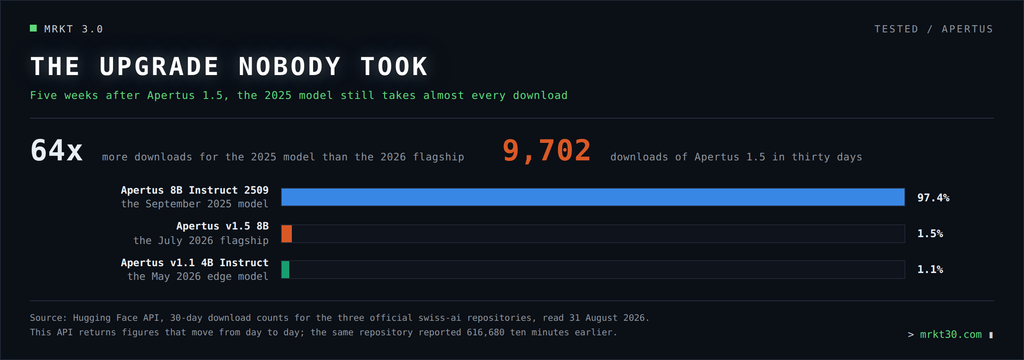
On 31 August 2026, Hugging Face reported 623,818 downloads over thirty days for the official Apertus 8B Instruct model from September 2025. The official Apertus 1.5 8B repository reported 9,702. The 2025 model is being downloaded sixty-four times more often than the 2026 flagship. Treat both as snapshots: the same repository reported 616,680 when we checked ten minutes earlier.
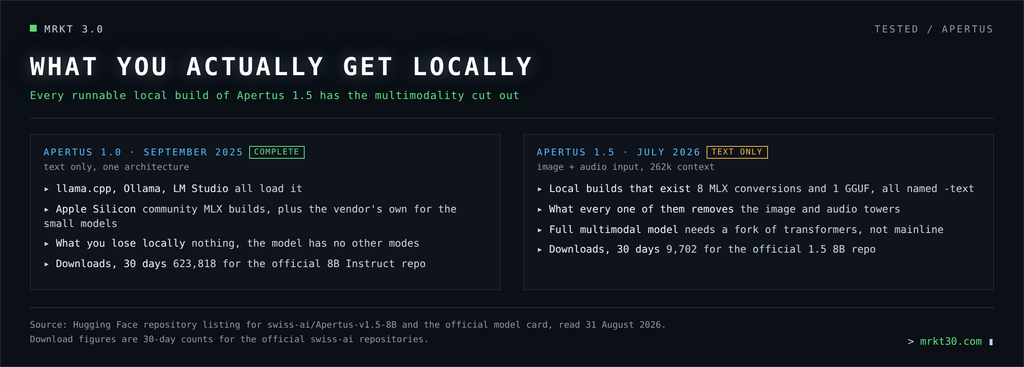
The local builds of Apertus 1.5 we found (eight MLX conversions for Apple Silicon and one GGUF) all carry the suffix –text. The image and audio towers, which are the reason 1.5 exists, have been cut out. The full multimodal model needs a fork of the transformers library pinned to a specific commit, not the mainline release everyone has installed. So the honest statement is not that you cannot run Apertus 1.5 locally. It is that you can only run it by discarding what makes it 1.5.
A second wall caught us. On the system Python bundled with this Mac, neither 2026 Apertus build loaded at all, including Switzerland’s own MLX build of the 4B model. Both ran without complaint on Python 3.12. A five-minute fix if you know it, a dead end if you do not.
Can You Run the Best Local LLM on a Normal Laptop?
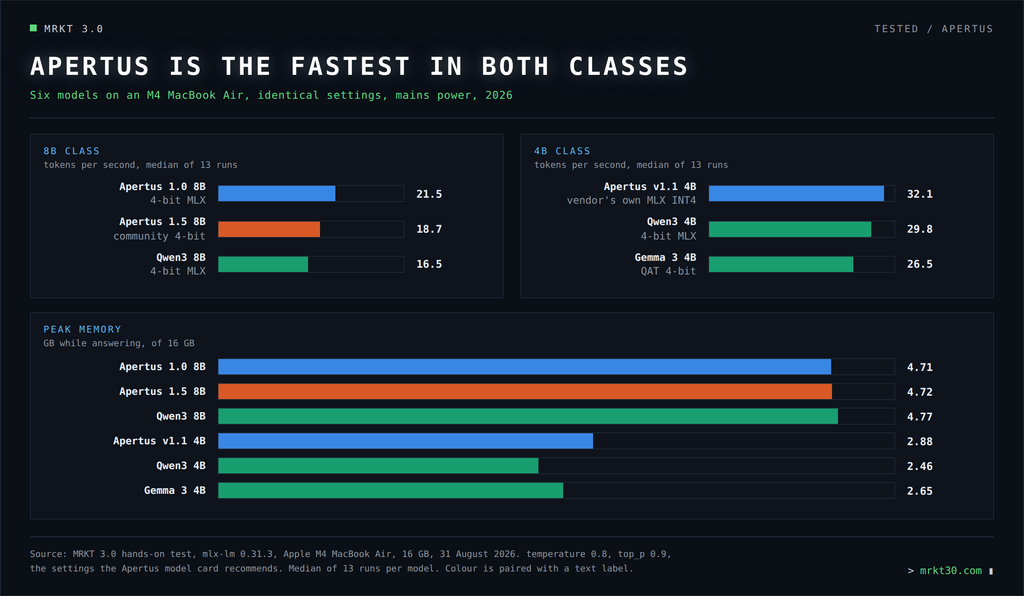
Yes, comfortably, and Apertus leads both weight classes. Medians of thirteen runs each on an M4 MacBook Air with 16 GB, on mains power, at the temperature and top_p the Apertus model card recommends.
| Model | Class | Speed | Peak memory |
| Apertus 1.0 8B | 8B | 21.5 tok/s | 4.71 GB |
| Apertus 1.5 8B (community build) | 8B | 18.7 tok/s | 4.72 GB |
| Qwen3 8B | 8B | 16.5 tok/s | 4.77 GB |
| Apertus v1.1 4B (Swiss build) | 4B | 32.1 tok/s | 2.88 GB |
| Qwen3 4B | 4B | 29.8 tok/s | 2.46 GB |
| Gemma 3 4B | 4B | 26.5 tok/s | 2.65 GB |
Nothing here fills a 16 GB laptop. Apertus 1.0 8B is 30% faster than Qwen3 8B on the same machine. The community text-only build of Apertus 1.5 is slower than 1.0, at 18.7 tokens a second against 21.5. Switzerland’s own 4B build is the fastest model we tested at any size.
What Does It Actually Cost to Run?
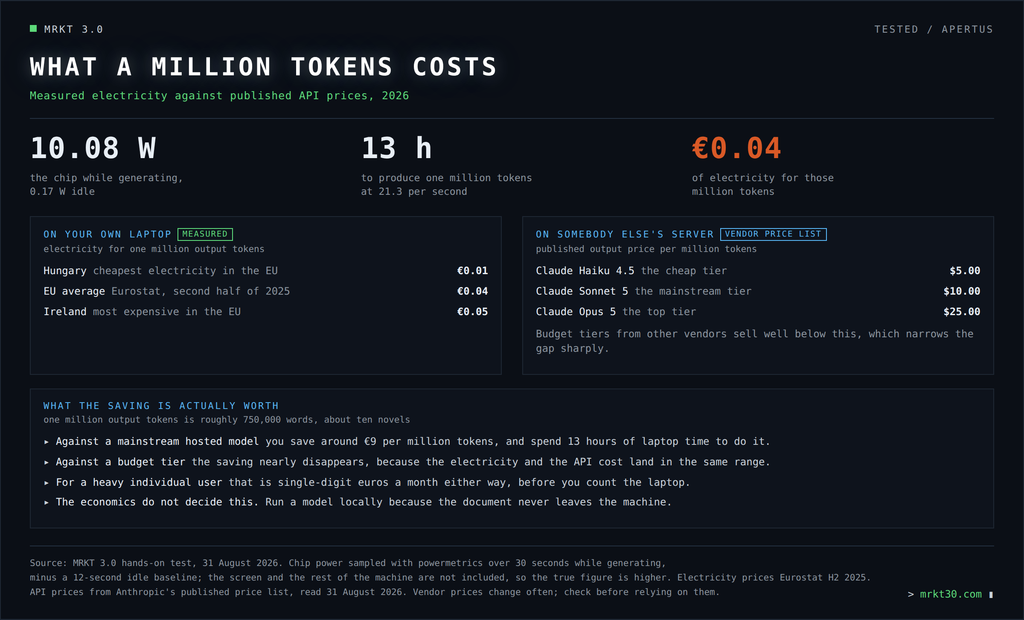
Free to download is not the same as free to run, so we measured it. While Apertus 1.0 was generating, the chip drew 10.08 watts. Sitting idle it drew 0.17. That makes the model itself responsible for 9.91 watts, almost all of it on the GPU.
That run produced 21.3 tokens a second, close to the 21.5 median in the table above. At that rate one million output tokens takes 13 hours and 0.13 kilowatt hours. At the EU average household electricity price of 28.96 cents per kilowatt hour, that is four eurocents per million tokens. One cent in Hungary, which has the cheapest electricity in the union, five in Ireland, which has the most expensive. A million output tokens is roughly 750,000 words.
Is it Cheaper than an API?
For comparison, Anthropic’s published output prices on the day we checked were 5 dollars per million tokens for its cheap tier, 10 for its mainstream tier and 25 for its top tier. Budget models from other vendors sell well below that, which narrows the gap sharply. So the honest range is this: against a mainstream hosted model you save around nine euros per million tokens, and against a budget tier you save almost nothing, because the electricity and the API land in the same neighbourhood.
Either way you are arguing over single-digit euros a month, before you count the laptop, and you are paying for it with 13 hours of laptop time per million tokens. The economics do not decide this question. The reason to run Apertus locally is that the document never leaves the machine. Two caveats on our number: we measured chip power, not what the laptop pulls from the wall, so the screen and the rest of the machine push the real figure higher, and vendor prices change often enough that you should check them yourself.
The Thinking Tax
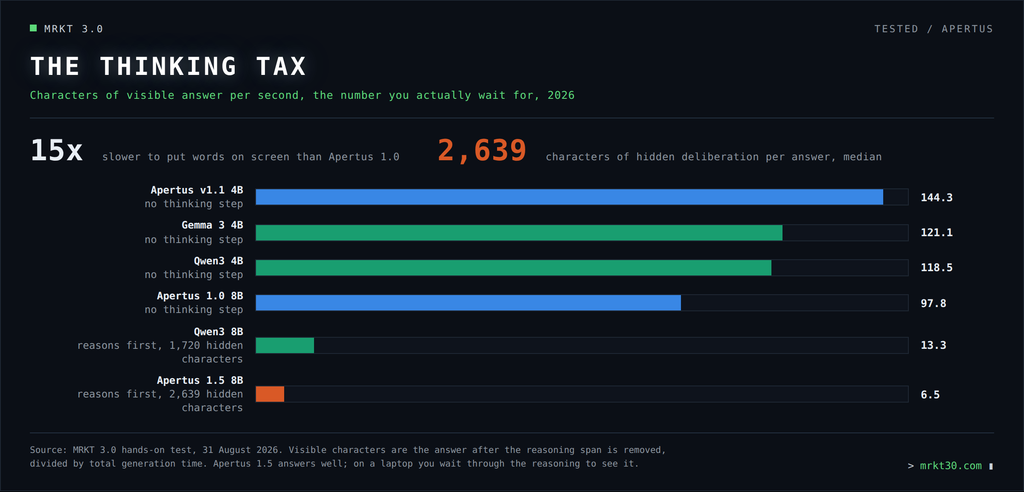
Tokens per second hides something. Apertus 1.5 is a reasoning model: it works through the problem between two marker tokens before writing the answer, and the model card says those markers are left in deliberately for the application to strip out. Nothing in the standard local toolchain strips them.
So we measured the number you actually wait for, characters of finished answer per second. Apertus 1.0 delivers 97.8. Apertus 1.5 delivers 6.5, because it generates a median 2,639 characters of deliberation before every answer. That is the whole reason 1.5 feels unusable on a laptop even when it is working correctly.
The Same Question, Three Times
One answer from a language model proves nothing, so every claim here was run three times with different seeds. Several results we would have published from a single run did not survive three.
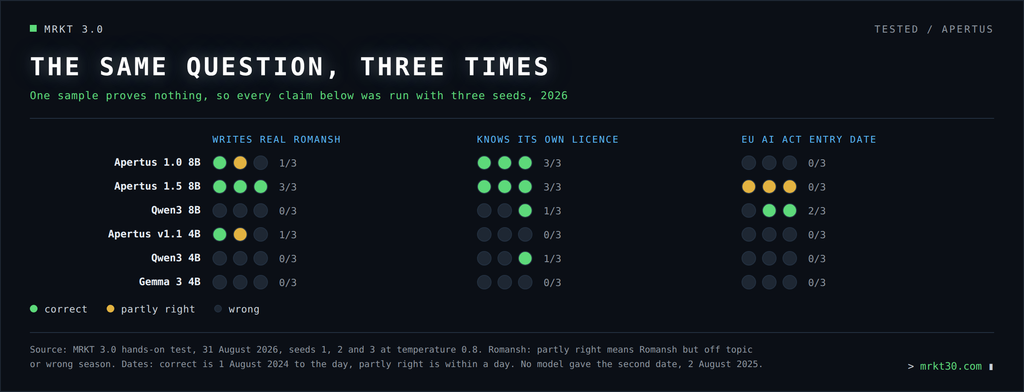
Romansh is where Apertus earns its existence. Asked in Rumantsch Grischun for two sentences on Swiss autumn weather, Apertus 1.5 delivered clean, on-topic Romansh three times out of three. Apertus 1.0 managed it once, collapsed into a repetition loop once and rambled once. None of the three non-Swiss models produced Romansh at all: Qwen3 8B decided the request was for Swiss German, Qwen3 4B degenerated into a loop, and Gemma 3 answered in Italian, then Swiss German, then Spanish, labelling each as Romansh.
Only the two large Apertus models know their own licence. Both answered Apache 2.0 three times out of three, correctly. Gemma 3 said MIT three times and is in fact under Google’s own terms, the error most likely to put a company in breach. Qwen3 8B once claimed a non-commercial licence forbidding exactly the commercial use it permits. If you are choosing a model for compliance reasons, that gap is the finding.
On the law and on formatting, Apertus loses. The EU AI Act entered into force on 1 August 2024, with obligations for general-purpose AI providers from 2 August 2025. No model gave both dates; Qwen3 8B got the first right twice. Asked for five bullets of exactly seven words, Qwen3 4B got three right and Apertus wrote bullets of 12 to 18 words. In Hungarian, Gemma 3 was the best writer by a clear margin. That result is from a text-only run. Gemma 3 4B can take images; we did not test that here.
How Reliable Is This Test?
One laptop, one quantisation format, seven tasks, three seeds. The 78 runs are the speed and memory suite: six models, thirteen runs each. The quality claims are separate: three seeds on each prompt. Every model ran at 4-bit, so a quality difference could be the quantisation.
The Apertus 1.5 build is a community conversion whose tokenizer loads with a known warning, so its faults may belong to the conversion. Hugging Face download counts move day to day; we watched one repository report 136,295 and then 97,938 ten minutes later.
An earlier version of this test capped generation at 700 tokens, which cut Apertus 1.5 off mid-thought and led us to report that it produced no answers. It answers fine with the budget its documentation asks for. The raw output of all 78 runs is published alongside this article, together with the manifest listing library versions, repository revision hashes and the verbatim prompts, so you can check any grade above yourself. We have also put six questions to the Apertus team, covering first-party local builds, upstreaming into mainline transformers and which Romansh idiom is in training, and we will publish their answers here.
Author: Akos Szima
See Also:
What Is the Best Open-Source LLM in 2026?
European LLMs in 2026: The Complete Map
Chinese LLMs in 2026: The Complete Map
This article is for information only and is not financial or legal advice. Download figures are 30-day counts for the official swiss-ai repositories, read from the Hugging Face API on 31 August 2026; that API returns figures that move day to day. Speed and memory were measured on an Apple M4 MacBook Air with 16 GB on mains power, using mlx-lm 0.31.3 on Python 3.12 with transformers 5.16.1, at temperature 0.8 and top_p 0.9, the settings the Apertus model card recommends, with a 2,048-token limit and three seeds on repeated tasks. Every figure is the median of 13 runs.
Power was sampled with powermetrics over 30 seconds during generation against a 12-second idle baseline, in a separate run from the 78, and covers the CPU and GPU package only. The six repositories tested, with revision hashes, are listed in the published manifest. Single-machine results, not a benchmark suite. Corrections welcome and will be published inline.
Frequently Asked Questions
Yes. On an M4 MacBook Air with 16 GB, the 8B model at 4-bit answered at 21.5 tokens a second using 4.71 GB of memory, and the 4B model reached 32.1 tokens a second in 2.88 GB. Both leave enough memory free to keep working while the model runs.
Apertus 1.5 adds image and audio input, and support for that architecture has not reached mainline tooling. The local builds we found (eight MLX and one GGUF) are all text-only conversions with the image and audio components removed.
It is the best documented origin in this size class. Apertus publishes its training data, training code and checkpoints under Apache 2.0, which no comparable model here does, and it was one of only two models that stated its own licence correctly every time. We did not test whether it leaks prompts or training data. The reason to run it locally is that the document never leaves the machine.
Apertus 1.5, on the evidence of this test. It was the only model that produced correct Rumantsch Grischun in all three attempts. Apertus 1.0 and the Swiss 4B build each managed it once in three, and none of the three non-Swiss models produced Romansh at all.