

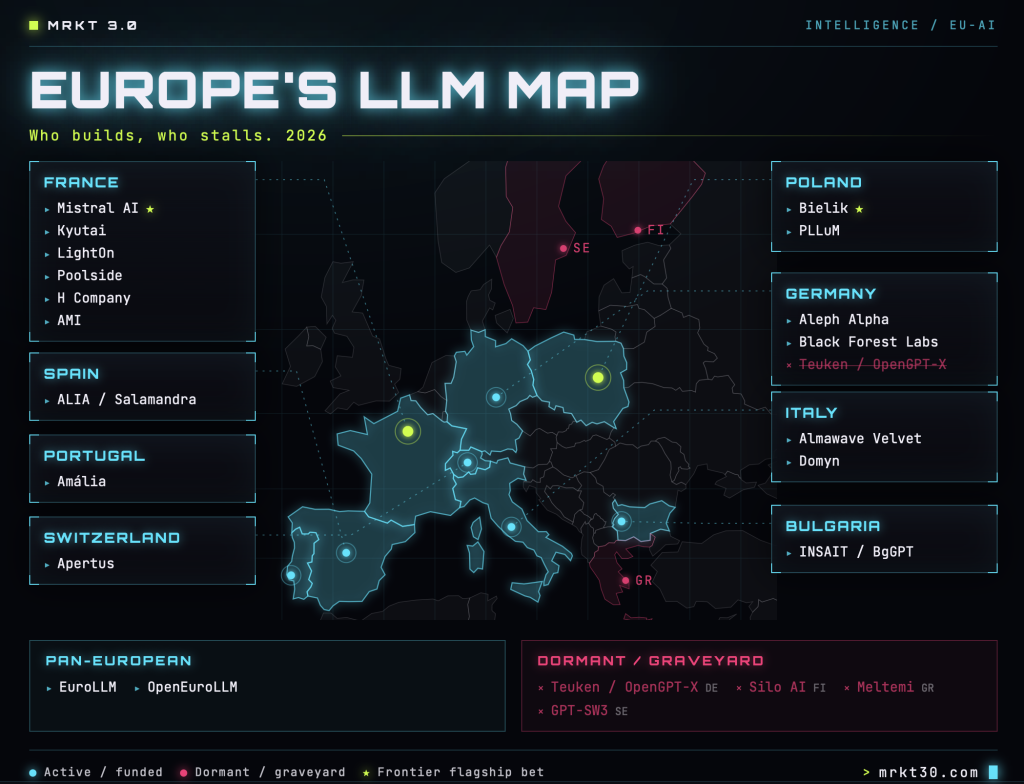
Roughly two dozen European organisations have set out to build their own AI models since 2023. Three are dead or dormant, one is being bought by a Canadian company, one is a promise rather than a product, and none cracks the top ten of the main overall boards, where the leaders are all American or Chinese.
This is the full map, and the home of our European large language model (LLM) review series. Updated 25 August 2026 with a fresh download pull.
Why This Map Follows the Money
Germany’s OpenGPT-X consortium did everything by the book. It delivered Teuken-7B, an LLM that runs in all 24 EU languages, its federal funding ran exactly to schedule, and in early 2025 the project wrapped up on time. The model is still downloadable, but nobody is training the next one.
That is how most European LLM projects end: not in failure, but in a grant that finishes. One company in Europe is trying to fund a frontier lab commercially. Everyone else runs on public grants, academic compute time, or an exit. So this map is organised by who is paying, for how long, and what happens when the money stops.
Every Active Project in One Table
Licences matter here more than parameter counts. “Open” is doing a lot of unearned work in European AI communication, so the column says what the licence actually permits. Projects that have stopped moving are in a separate table below.
| Project | Country | Latest model | Licence | Money behind it |
|---|---|---|---|---|
| Mistral AI | France | Large 3 (41B/675B MoE), Dec 2025; Shieldstral 3B safety, Aug 26; Medium 3.5 closed | Apache 2.0 (Large 3, Shieldstral); Medium API-only | €1.7bn raised; ASML ~11% ($14bn, Sep 25); €3bn round (~€20bn) reported Jun 26, unclosed |
| Aleph Alpha | Germany | PhariaAI platform | Platform | Cohere acquisition announced 24 Apr 26 ($20bn, Schwarz $600M); no completion confirmed |
| Black Forest Labs | Germany | FLUX 3 (image/video), 25 Jul 26, limited | FLUX.2 part Apache 2.0 / part “other”; no FLUX 3 weights yet | ~$300M at $3.25bn. Generative, not an LLM |
| Kyutai | France | MuScriptor, MIRA, Pocket TTS (2026) | Open science | Nonprofit, ~$300M (Niel, Schmidt, Saadé) |
| LightOn | France | Paradigm (on-prem) | Mixed | Euronext-listed; FY25 revenue €1.7M |
| Poolside | France/US | Laguna S-2.1 / XS-2.1, Jul 26 | openmdw-1.1 (custom, not OSI) | ~$2bn at $12bn, Nvidia-backed |
| H Company | France | Holo3 agents (Mar 26) | Proprietary | $220M seed May 24; 3 co-founders left that Aug |
| AMI | France/US | None yet | n/a | $1.03bn seed Mar 26, Europe’s largest, for a lab betting LLMs are the wrong path |
| Apertus | Switzerland | 1.5: 8B & 70B, multimodal, 24 Jul 26 | Apache 2.0; weights, data & code open | Swiss federal + academic |
| ALIA / Salamandra | Spain | ALIA-40B base | Apache 2.0 | ~€240M national programme |
| Bielik | Poland | 11B v3 (+1.5B, 4.5B) | Apache-family | Largely built by volunteers + public supercompute |
| PLLuM | Poland | 8B–70B family | Apache 2.0 | NASK-led state consortium |
| INSAIT / BgGPT | Bulgaria | BgGPT 3.0 (4B/12B/27B on Gemma 3), Mar 26 | Gemma Terms of Use | State-backed; INSAIT won €90M EU AI Factory |
| ILSP / Krikri | Greece | Llama-Krikri-8B-Instruct (v1.5) | Open weights | Public research funding; Meltemi’s successor, ~7x its downloads |
| Almawave Velvet | Italy | Velvet-14B | Apache 2.0 | Listed company |
| Domyn (ex-iGenius) | Italy | Italia-10B; leads EUROPA 400B (unreleased) | Promised open source | EuroHPC compute (≤2.5%/yr); backed by G42 (Abu Dhabi) |
| Amália | Portugal | Built on EuroLLM-9B, 1 Jul 26 | Open | ~€7M, government-funded |
| EuroLLM | EU | EuroLLM-22B, 16 Dec 25 | Open | EU co-funded, trained on MareNostrum 5 |
| OpenEuroLLM | EU | Reference models, no flagship | Open | Digital Europe Programme; 20 partners (AMD Silo AI, Aleph Alpha Research) |
The Graveyard: Dead or Dormant
Three projects have effectively stopped. The weights are still downloadable, but nobody is training a successor. Greece has left this table since we first published: Meltemi’s successor, Krikri, is live and pulling roughly seven times what Meltemi does.
| Project | Country | Latest model | Licence | Money behind it |
|---|---|---|---|---|
| Teuken-7B / OpenGPT-X | Germany | Teuken-7B v0.6, Aug 2025 | Open | German federal funding, ended as planned early 2025. Dormant since, though downloads have nearly tripled |
| Silo AI | Finland | Poro, Viking | Open | AMD-owned since 2024 (~$665M); no releases since |
| GPT-SW3 | Sweden | 2021–2022 vintage | Open | Effectively abandoned; effort moved into OpenEuroLLM |
Three Different Bets Under One Word
Read down that table and three separate projects are happening under one word.
The commercial bet. Mistral is the only European lab attempting a frontier model on commercial money. It released Large 3, 41 billion active parameters out of 675 billion total, under Apache 2.0 in December 2025 at $0.50 per million input tokens. That is a genuine open release at frontier scale and the strongest single thing Europe has. The catch, which Mistral’s own communication skips, is that its most capable model is Medium 3.5, and Medium 3.5 is a closed API.
The national champions. The crowded lane. Poland has two models, one volunteer-built and one state-built. Bulgaria’s INSAIT built BgGPT 3.0 on Google’s Gemma 3. Portugal shipped Amália for a reported €7M by building on EuroLLM rather than starting from scratch. Hungary’s Racka is a LoRA adaptation of Alibaba’s Qwen-3. Most national sovereign models are fine-tunes of somebody else’s base, and increasingly that base is Chinese or American. Portugal’s route is the honest version, and probably the smartest.
The EU consortia. EuroLLM released a 22B model in December 2025 and is the one shipping. OpenEuroLLM has published progress and reference models but no flagship. The Domyn-led EUROPA consortium has EuroHPC compute to build a 400 billion parameter model in all 24 EU languages within a year. That is a promise with a compute allocation attached, not a model.
Who Actually Downloads These Models?
We pulled the last-30-day download counts from the Hugging Face API on 27 July, and re-pulled the same repositories on 25 August.
| Model (headline variant) | Backing | 27 Jul | 25 Aug |
| Apertus-8B-Instruct (CH) | Swiss public | n/a | 624,507 |
| Bielik-11B-v3.0-Instruct-awq (PL) | Volunteers + public compute | n/a | 236,852 |
| Bielik-11B-v3.0-Instruct (PL) | Volunteers + public compute | 422,043 | 136,295 |
| Llama 4 Maverick FP8 (US, for contrast) | Meta | n/a | 85,863 |
| EuroLLM-9B-Instruct (EU) | EU co-funded consortium | n/a | 42,174 |
| Apertus-70B-Instruct (CH) | Swiss public | 55,105 | 34,633 |
| Salamandra-7b-instruct (ES) | ~€240M national programme | n/a | 24,916 |
| Llama 4 Maverick (US, for contrast) | Meta | 52,473 | 12,092 |
| Mistral Large 3 NVFP4 (FR) | Commercial | n/a | 10,717 |
| EuroLLM-22B-Instruct (EU) | EU co-funded consortium | 110,361 | 6,072 |
| Teuken-7B-instruct-v0.6 (DE) | Grant ended 2025 | 1,598 | 4,324 |
| Llama-Krikri-8B-Instruct (GR) | Public research | n/a | 2,864 |
| Velvet-14B (IT) | Listed company | 3,008 | 2,763 |
| Llama-PLLuM-70B-instruct (PL) | State consortium | n/a | 2,746 |
| ALIA-40b-instruct-2606 (ES) | ~€240M national programme | n/a | 2,476 |
| AMALIA-9B-DPO (PT) | ~€7M government-funded | n/a | 1,664 |
| Mistral Large 3 (official repo) | Commercial | 7,538 | 1,617 |
| BgGPT-Gemma-3-27B (BG) | State institute | 348 | 663 |
| ALIA-40b (ES) | ~€240M national programme | 231 | 485 |
| Llama-PLLuM-70B-chat (PL) | State consortium | 206 | 438 |
| Meltemi-7B-Instruct (GR) | Public research | 337 | 397 |
| Poro-34B (FI) | AMD-owned | 483 | 325 |
The August pull is wider than the July one. In July we took a single headline model per project; this time we added the sibling repositories alongside them, because that is where most of the traffic turned out to be. The rows marked n/a are the ones we were not tracking in July, and between them they hold most of the story.
Problems with This Approach
- Downloads are not usage. API and self-hosted traffic do not show up, which is why Mistral’s flagship looks small; its 3B Ministral, the one people run locally, did about 700,000 in the same window.
- Smaller models get pulled more than 70B ones, because more people can run them.
- We started from one headline repository per project and added the siblings that mattered, so family totals still run higher than any single row.
- Bulk automated pulls can inflate any number, and Hugging Face restates these counts. Treat every figure as a snapshot.
None of that softens the pattern, and two things sharpen it. Bielik and Llama 4 are gated behind the same access form, so the Polish model’s lead is not an artefact of easier access, and it has widened from eight to one in July to eleven to one now. The second we missed first time round: the build people actually pull is the quantised one. Bielik’s AWQ version out-pulls its own full-weight repository, Meta’s FP8 Maverick out-pulls the original seven to one, and Mistral’s NVFP4 build of Large 3 pulls 10,717 against 1,617. Three labs, three countries, the same behaviour.
In July we read the bottom of this table as a verdict on public money. That reading no longer holds. Europe’s most downloaded open model is Apertus 8B, built with Swiss federal and academic money at EPFL, ETH Zurich and the Swiss National Supercomputing Centre. Spain has the same shape: the Barcelona Supercomputing Centre’s small Salamandra pulls tens of thousands a month while ALIA 40B, flagship of a roughly €240M programme, is still in the hundreds. The split is not public against private. It runs through the middle of every funding model: the labs that shipped something a laptop can run are being adopted, the ones that shipped only a flagship are not. What decides adoption is not who paid for the model, but whether it fits on the hardware the reader already owns.
How Europe Compares to China
On the open-weight benchmarks the field actually watches, Chinese labs run the board. Moonshot released Kimi K3 on 17 July at 2.8 trillion parameters, the largest open-weight model anyone has shipped, and DeepSeek’s V4 has been live since April. Europe’s largest open release is 675B, and ranks, by Mistral’s own account, second among open non-reasoning models and sixth overall. Second in a category is a real achievement for a company Mistral’s size. It is also not the same as “Europe has a frontier model”, which is what a lot of European AI communication implies.
The month since we published sharpens that. Alibaba shipped Qwen3.8-Max at 2.4 trillion parameters on 20 July and another Qwen release on 2 August, and Z.AI shipped GLM-5.3 on 14 August. Europe’s most significant open release in the same four weeks was Shieldstral, a 3B safety classifier from Mistral that runs on one 16GB GPU under Apache 2.0. A useful model, and a moderation tool rather than a frontier bet.
The compute gap explains most of it. Mistral raised $830M in debt for a Paris data centre with about 13,800 Nvidia GPUs. Meta raised its 2026 capex guidance on 29 April to $125bn to $145bn. The EU’s answer, the AI Gigafactories programme and the EuroHPC AI Factories network that got Sofia its €90M, is real money that mostly arrives in 2027 and later, the wrong side of the gap it is meant to close.
What to Watch for the Rest of 2026
Two of the three things we listed in July have not moved at all, which is its own answer.
- Whether Cohere keeps Aleph Alpha’s weights open. Four months on from the 24 April announcement, the deal still awaits approval and neither company has said what happens to the open weights. That silence is the story now.
- Whether anyone upgrades. Apertus 1.5 arrived on 24 July with image and audio input and a 262,144-token context window. A month on, the older September build still pulls more than forty times what v1.5-8B does.
- Mistral’s reported €20bn round. Still talks, still unsigned. Anyone quoting €20bn as fact is quoting a negotiation.
- The EUROPA 400B model. Nothing yet. On the stated timeline it lands around mid-2027, against an open-weight leader already at 2.8 trillion.
Europe has more working models than the “no AI” line suggests, and fewer than the announcements imply. One commercial frontier attempt, a handful of national models that are actually maintained, two consortia of which one ships, and a graveyard that keeps growing. We test them one by one; the reviews linked here are where the counting gets done.
Author: Akos Szima
This article is for information only and is not financial advice. First published 29 July 2026 and updated 25 August 2026. Download counts are last-30-day figures pulled from the Hugging Face API on 25 August, using the same repositories as the original pull; they are a snapshot and Hugging Face restates them. Funding rounds described as reported but unclosed are flagged as such.
Frequently Asked Questions
Mistral Large 3, with 675 billion total parameters (41 billion active), released under Apache 2.0 in December 2025. It is Europe’s only frontier-scale open-weight model.
Fully open under OSI-approved licences: Mistral Large 3, Apertus (which also opens its training data), ALIA, Teuken-7B, Bielik, PLLuM, Velvet and EuroLLM-22B. BgGPT ships under Google’s Gemma terms and Poolside under a custom licence, neither of which is OSI open source.
Three projects, in different states: EuroLLM shipped a 22B model in December 2025, OpenEuroLLM has published reference models but no flagship, and the Domyn-led EUROPA consortium has EU compute to build a 400B model that does not yet exist.
On open-weight leaderboards, Chinese labs lead: Moonshot’s Kimi K3 (2.8 trillion parameters, open weights) and DeepSeek V4 sit well above Europe’s largest open release. Europe’s strongest card is licence quality and EU hosting, not scale.
See Also:
What Is Bielik? Poland’s Sovereign AI Model, Tested (2026)
What Happened to Le Chat? Mistral’s Vibe Rebrand, Tested (2026)