
Who actually pays for European AI? Some of the largest rounds in European AI over the past twelve months were signed by a Dutch chipmaker, a Canadian pension fund, a Singaporean sovereign fund and the French state, together with a handful of venture firms that keep showing up on the same deals.
The question continues to carry more weight year-on-year because the money itself has changed shape rapidly. European startups raised €44.1bn in the first half of 2026, a rebound on the year before, yet they did so across just over 1,740 deals, the lowest half-year count since 2020, according to figures PitchBook reported. The capital is pooling into fewer and much larger rounds, and most of it is heading to a single destination: AI. In fact, AI took 60.3% of all European venture value in the period, the first time the sector has crossed an outright majority.
As money concentrates like this, the identity of the people writing the cheques stops being trivia and starts shaping which companies get built at all. What follows is an account of who is signing those cheques, and what they are buying with them.
Who Are the VCs Backing Europe’s AI Startups?
According to reports for H1 2026, state-backed funds and accelerators dominate the top of the list, with the European Innovation Council Fund appearing in 16 tracked rounds, Antler in 14 and Germany’s High-Tech Gründerfonds in 13, followed by Balderton Capital and Index Ventures on 12 apiece, General Catalyst and Y Combinator on 11, and Seedcamp and Bpifrance on nine.
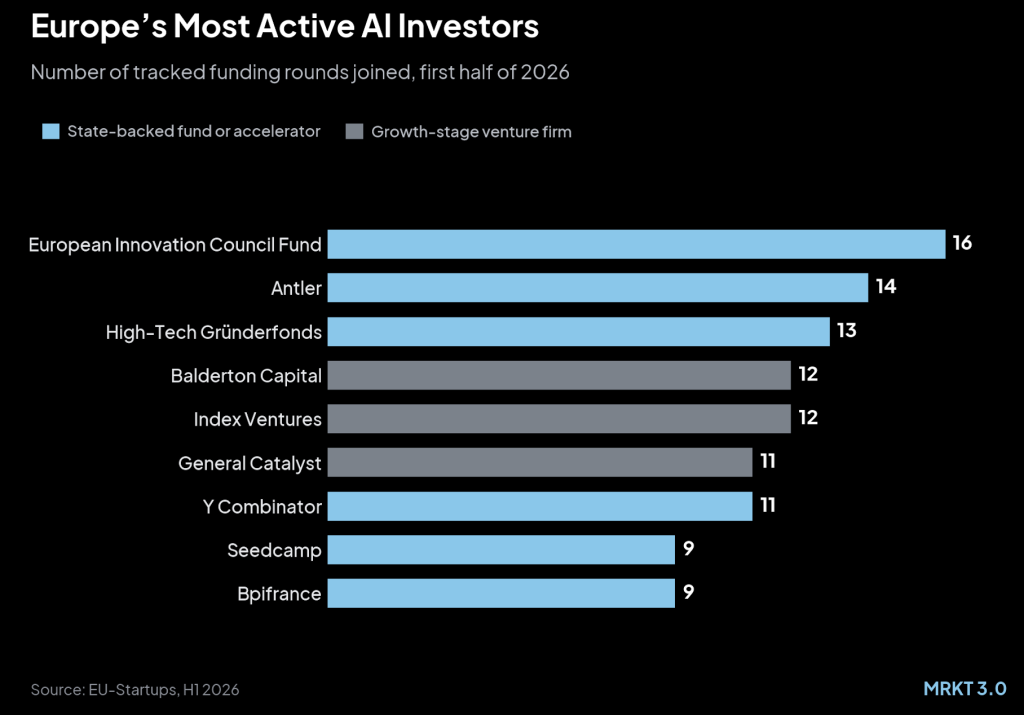
Frequency is not the same as conviction, of course, and a rather different set of names comes into view once you look at the size of the funds rather than the count of the deals.
Index Ventures raised $2bn across three funds in July, giving it $3.5bn to deploy on the back of its windfall from the Wiz sale, and Accel closed an enlarged $800m fund for Europe and Israel weeks later, its ninth for the region and up from $650m.
The shortage in European AI, in other words, is a clear view of whose capital is actually doing the work.
Which Funds Have the Deepest AI Conviction?
If you want to see conviction rather than activity, the best place to look is a single cap table. When Black Forest Labs, the German image-model lab, announced a $300m Series B in December 2025 at a $3.25bn valuation, the round was co-led by Salesforce Ventures and Anjney Midha’s AMP, and it drew in almost every serious AI backer on the continent, from a16z, NVIDIA and General Catalyst through to Northzone, Creandum, Earlybird, Air Street Capital, Temasek, Canva and Figma Ventures.
The same investor tends to recur across the flagships, and in Europe that investor is a16z, which holds positions in all three of the continent’s marquee AI product companies: Black Forest Labs, Mistral and ElevenLabs, whose $180m Series C a16z co-led with ICONIQ, as the company said at the time.
The most single-minded of the group is Air Street Capital, Nathan Benaich’s AI-only fund, which turns up early and repeatedly in exactly the rounds that later come to look obvious. Reading the same handful of names off one cap table after another is a far better guide to genuine conviction than anything a fund chooses to say in public.
Who Is Funding Europe’s Defence Boom?
Nowhere are valuations climbing faster than in defence. Helsing, the Munich AI defence company, said in July 2026 that it had raised $1.8bn at an $18bn valuation, the largest round a European defence startup has ever closed. The financing had no named lead, drawing instead on a broad syndicate that ran from Lightspeed, General Catalyst and Plural to Dragoneer, ICONIQ, Goldman Sachs Alternatives, JPMorgan and the Canada Pension Plan Investment Board, with the company taking pains to stress that it remains predominantly European-owned.
The clearest home-grown story in the sector belongs to Balderton Capital, which led the 2025 round that turned Munich drone maker Quantum Systems into a unicorn, and then held its position as the company announced a $1.2bn Series D in July 2026 at roughly $8bn, this time co-led by Blackstone, Noteus, Airbus and Advent. Running underneath the venture money is a more openly political layer of capital: Bpifrance’s retail defence fund has taken in more than €100m from around 10,000 French savers, a reminder that some of the money flowing into European AI is there for reasons that have little to do with returns.
Where Does the Foreign Money Come From?
The most consistent piece of foreign money in the market is NVIDIA, which has written cheques into Mistral, Black Forest Labs, Wayve, Synthesia and Nscale, the London infrastructure firm that reached a $14.6bn valuation on a $2bn Series C in March 2026. It has been joined by a wave of sovereign and institutional capital, from Temasek in Black Forest Labs to Canada Pension Plan Investment Board and Goldman in Helsing and SoftBank leading Wayve, the sort of investor that would rarely have bothered with a European startup a few years ago.
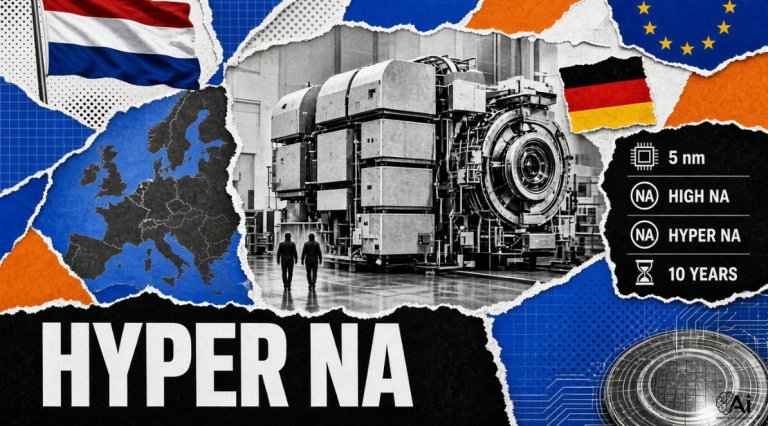
The counterweight to all of this is strategic and firmly European. ASML announced a €1.3bn investment in Mistral’s €1.7bn Series C, taking roughly 11% and becoming the lab’s largest shareholder, one of the biggest strategic cheques a European company has ever written into a European AI lab.
This captures the tension that runs through the whole beat, because the capital meant to keep a European champion independent and the capital quietly acquiring a stake in it are, more and more, the same capital.
Do the Rankings Actually Mean Anything?
There is a strong case that none of these rankings mean very much. Deal count is close to a vanity metric, since appearing in 16 rounds says nothing about whether you led any of them or how large a cheque you actually wrote, and the money that sets valuations and picks winners is concentrated at the very top, among a16z, NVIDIA, the US megafunds and the sovereign wealth players, rather than in the seed tickets that flatter the EIC Fund and the accelerators in the tables.
State money, for its part, can be slow and bureaucratic, and founders in a hurry frequently route around it. The biggest European story of the year rather proves the point: Lovable, the Swedish vibe-coding company, raised its first $200m round at a $1.8bn valuation in 2025 and has since been carried all the way to $13.3bn, in a round co-led by the American firm Menlo Ventures and the EU-backed Scaleup Europe Fund, with Balderton writing its first cheque. American growth capital arguably did as much to drive that as any European fund.
All of which is fair, and yet it rather misses why the state-backed and home-grown investors matter in the first place. Their whole significance is that Europe has decided it can no longer leave its AI champions dependent on foreign capital, and the funds that turn up quietly at seed stage are precisely the ones that decide whether the next Mistral gets off the ground before anyone in Silicon Valley has noticed it exists. The firms topping the deal-count tables are not the loudest in the room, but they are very often the first through the door.
What It Means for Founders
Look past the headlines at who actually invested, and the shape of the market becomes clear.
State backers and accelerators write the most cheques, the US megafunds and NVIDIA cluster inside the same handful of companies, defence reprices faster than anything else, and a small bench of European firms (Balderton, Index, Creandum, Northzone and Air Street) keeps turning up at the earliest stage.
For a founder weighing up whose money to take, the question worth asking is less who is most famous than who has backed companies like yours early and who is likely to still be there by Series C. For everyone else, these cap tables are the best map available of where Europe believes its technological future will be settled, and of who it is prepared to let pay for it, a contest whose leading companies we ranked earlier this year.
Author: Ákos Szima
See Also:
Y Combinator Built Sam Altman’s Empire, Now He’s Tokenmaxxing It