
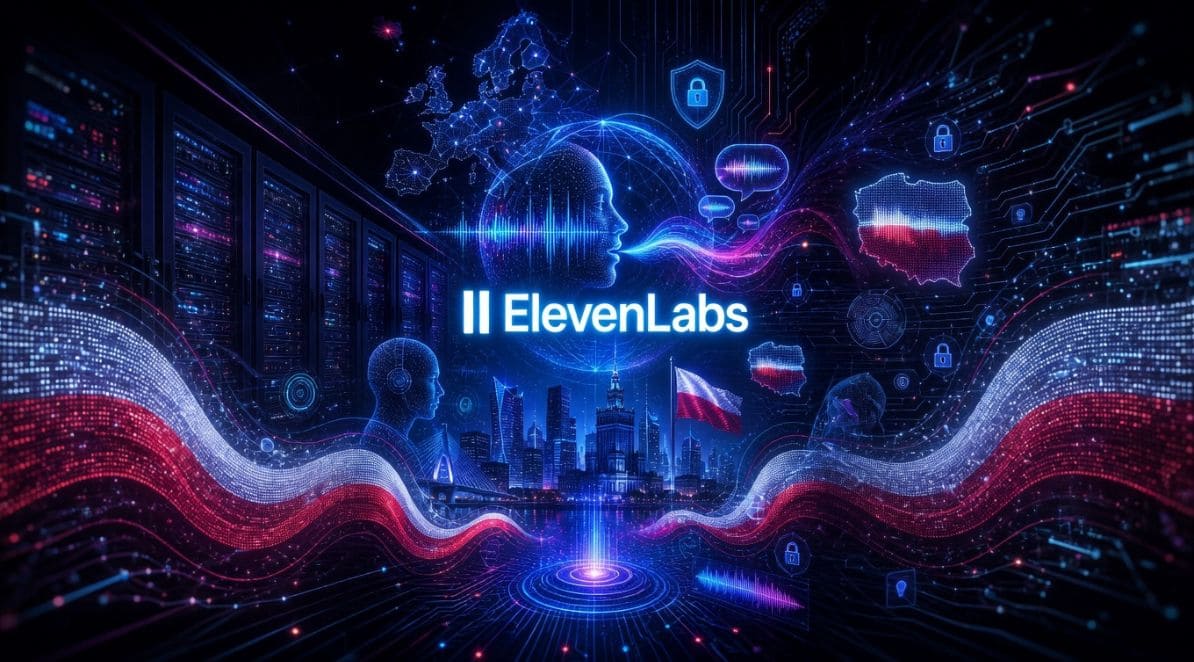
Poland’s tech scene just claimed another victory. ElevenLabs crossed $500 million in annual recurring revenue (ARR) in the first four months of 2026, according to the company’s May 5, 2026 announcement. The company ended 2025 at $350 million ARR, meaning it added $150 million in new recurring revenue in just 120 days.
That growth trajectory helped push the company’s valuation to $11 billion in its latest Series D round, more than tripling from its 2025 valuation. The financing attracted institutional investors including BlackRock, Wellington Management, D.E. Shaw, and Schroders, alongside enterprise backers NVIDIA (via NVentures), Salesforce, Santander, KPN, and Deutsche Telekom.
Celebrity investors joining the round include Jamie Foxx, Eva Longoria, and Squid Game creator Hwang Dong-hyuk.
Who Founded ElevenLabs?
Mati Staniszewski and Piotr Dąbkowski, two Polish entrepreneurs, founded ElevenLabs in 2022. Both grew up frustrated with Poland’s monotone film dubbing tradition, where a single narrator speaks over all characters regardless of emotion or context. That frustration became the catalyst for building AI-generated voices that capture natural human speech patterns, emotional range, and regional accents.
The company has since invested $11 million into a Warsaw R&D hub, maintaining its Polish roots despite headquartering in London. The Warsaw facility employs engineers focused on voice model development and language expansion.
Poland’s Growing AI Infrastructure
ElevenLabs sits within a broader Polish AI ecosystem that’s rapidly scaling. Krakow secured the Gaia AI Factory, a €70 million EuroHPC-funded supercomputer housing over 1,000 GPUs for AI research. Combined with the PIAST AI Factory in Poznan, Poland now anchors two of Europe’s 19 sovereign AI compute hubs.
The infrastructure is arriving. What remains is adoption. Polish enterprises must accelerate deployment of AI tools to match leaders like Denmark (~42%) or the Netherlands (~33%) to fully convert talent and compute into commercial advantage.
Why Institutions Are Backing Voice AI Now
The investor composition reveals institutional conviction that conversational AI will become critical business infrastructure. Rob Mazzoni, Technology Sector Lead for Late-Stage Growth at Wellington Management, stated: “Every major enterprise will communicate with its customers and audiences through AI agents. The companies that power natural, human-like interactions at scale will become critical global infrastructure.”
Enterprises are already deploying ElevenLabs across customer support, sales, hiring, and marketing operations. Deutsche Telekom, which invested through its strategic arm T.Capital, uses the platform for:
- Customer service voice agents
- Live in-network translation during phone calls
- Marketing video production
Real-World Use Case: AI Voice Agent Calls 3,000 Pubs
The technology’s reach was demonstrated over St. Patrick’s Day weekend when an AI agent named Rachel called over 3,000 Irish pubs asking for Guinness pint prices. Over 2,000 pubs answered. Almost nobody realized they were speaking to a machine. The agent was powered by ElevenLabs voice models combined with Twilio telephony and Anthropic’s Claude for transcript analysis.
From Potential to Proof
ElevenLabs crossing $500 million in annual recurring revenue in four months isn’t just a funding milestone. It’s proof that Poland can build globally competitive AI companies without relocating to Silicon Valley.
The velocity matters. Adding $150 million in recurring revenue in 120 days, backed by BlackRock and serving nearly half the Fortune 500, signals that conversational AI has moved from experimental to essential business infrastructure.
Poland’s AI story used to be about potential. ElevenLabs just turned it into performance.

See Also:
How Much Is a Pint of Guinness? AI Agent Rings 3,000 Irish Pubs and Maps Every Price
Gaia AI Factory: Why EuroHPC Chose Krakow for Europe’s Most Strategic Supercomputer