
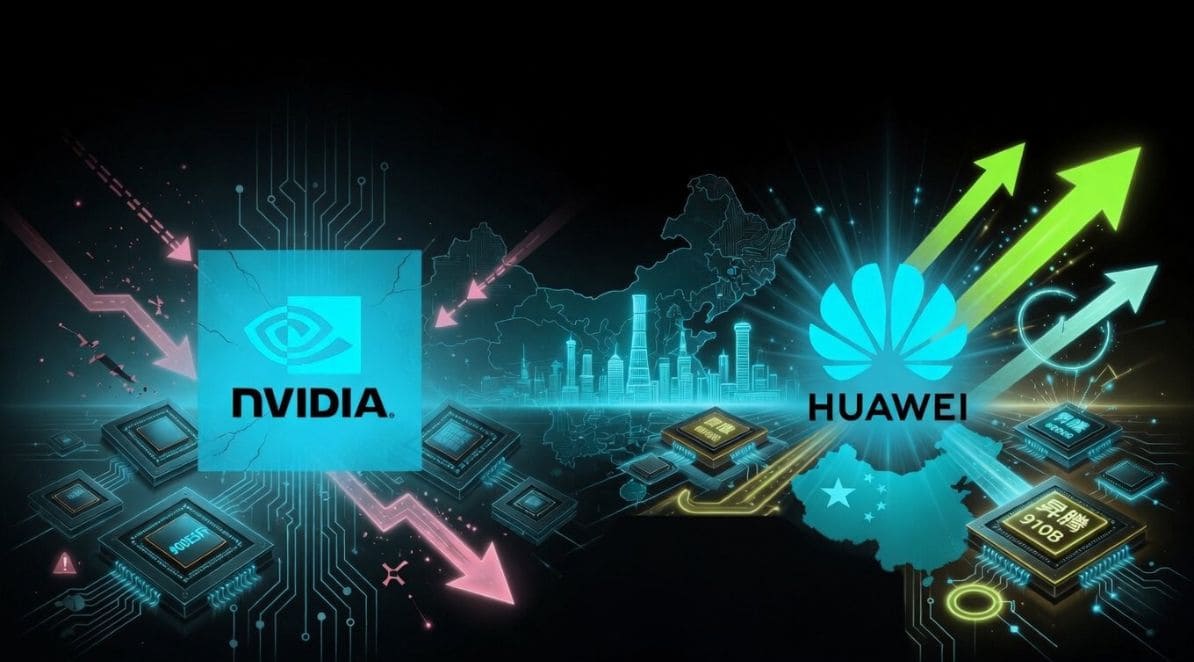
Huawei’s AI chip sales are surging in China – and NVIDIA‘s revenue in the country is falling fast. Based on figures reported on May 1, the commercial battle has already begun, and Huawei is winning it.
China’s need for NVIDIA has been dwindling for some time. Huawei’s growth, it seems, is doing the opposite. With 10,000-card AI clusters now running (built entirely without US chips) it is becoming harder to argue that China still needs American silicon at all. The latest figures make that case for themselves.
Huawei Is Targeting $12 Billion in AI Chip Revenue This Year
Huawei expects its AI chip revenue to climb 60% to roughly $12 billion in 2026, driven by large orders from Chinese tech firms for its latest Ascend processors, as US export restrictions push domestic demand toward homegrown alternatives.
That figure is a projection, not confirmed revenue. But it’s based on order volume that already exists – and the orders tell their own story.
The Ascend 950PR, Huawei’s latest processor, entered mass production in March 2026 and has already captured the majority of orders for the year. An upgraded Ascend 950DT is planned for a Q4 2026 launch, reflecting a steady release cadence aimed at narrowing the product cycle gap with NVIDIA.
This isn’t a company scrambling to catch up. It’s a company that has locked in the year’s demand and is already building for next year.
DeepSeek V4 Was the Accelerant
The orders didn’t arrive gradually. When DeepSeek V4 launched (a large language model optimised for Huawei’s Ascend hardware) Alibaba Cloud and Tencent Cloud deployed it the same day. Orders followed immediately.
The bigger point is this: when China’s most capable AI model runs best on Chinese hardware, the entire ecosystem shifts. Companies don’t need to choose Huawei over NVIDIA – the software is already making that choice for them.
NVIDIA’s China Revenue Is Already Falling
The shift is showing up in NVIDIA’s revenue.
In 2025, NVIDIA made around $17.1 billion from China. However, due to demand increasing for Huawei’s Ascend chips, NVIDIA’s China revenue is expected to fall. Even Jensen Huang, founder and CEO of NVIDIA, has acknowledged the threat.
Huawei now holds around 20% of China’s AI chip market, and that share is growing. The company is aiming to produce 750,000 Ascend 950PR units this year, but demand is already outpacing what it can make. Prices have risen around 20% as a result.
Huawei’s challenge in China right now isn’t convincing people to buy. It’s making enough chips to sell.
ByteDance Has Already Committed $5.6 Billion
The Ascend 950PR delivers 1.56 petaflops of AI inference performance. This is 2.8 times the FP4 performance of NVIDIA’s H20.
ByteDance, the Chinese tech company that owns TikTok, has committed $5.6 billion in orders, making it the single largest buyer. That’s not a pilot programme. That’s a platform decision.
The most striking trend is the projected crossover point: Huawei’s estimated 2026 AI chip revenue could match or exceed NVIDIA’s China revenue for the first time.
What Happens Next
For US tech policy, the question remains: what happens when the market you tried to block becomes the market your main competitor is now winning?
The Ascend 950PR is in production. The orders are placed. The software stack has been rewritten. The clusters are live and 92% booked.
China didn’t announce an AI chip strategy. It delivered one. This week, Huawei showed the world how it is converting that delivery into revenue.
Frequently Asked Questions
What is Huawei’s projected AI chip revenue for 2026?
Huawei is targeting approximately $12 billion in AI chip revenue in 2026, a 60% increase year-on-year, driven by large orders for its Ascend 950PR processor from Chinese tech companies.
Why are Chinese companies switching from NVIDIA to Huawei chips?
US export controls have restricted Nvidia’s most advanced chips from entering China. Combined with the release of DeepSeek V4, Chinese enterprises now have both a policy reason and a practical reason to commit to domestic silicon.
The Ascend 950PR delivers 2.8 times the FP4 inference performance of NVIDIA’s H20, making it competitive on the inference workloads that dominate commercial AI deployment in China today.
NVIDIA’s China revenue fell from $20.3 billion to $17.1 billion in fiscal year 2025 and is projected to decline further as Huawei’s Ascend chips absorb a growing share of demand.

See Also:
China’s Semiconductor Industry No Longer Needs NVIDIA
DeerFlow 2.0: ByteDance’s Open-Source AI SuperAgent That Just Hit #1 on GitHub Trending