

Europe is hosting an AI build-out that someone else is paying for. The capital comes from abroad, and the continent’s only remaining bargaining chips are power and permits. The problem is mostly one of scale, and scale favours American Big Tech.
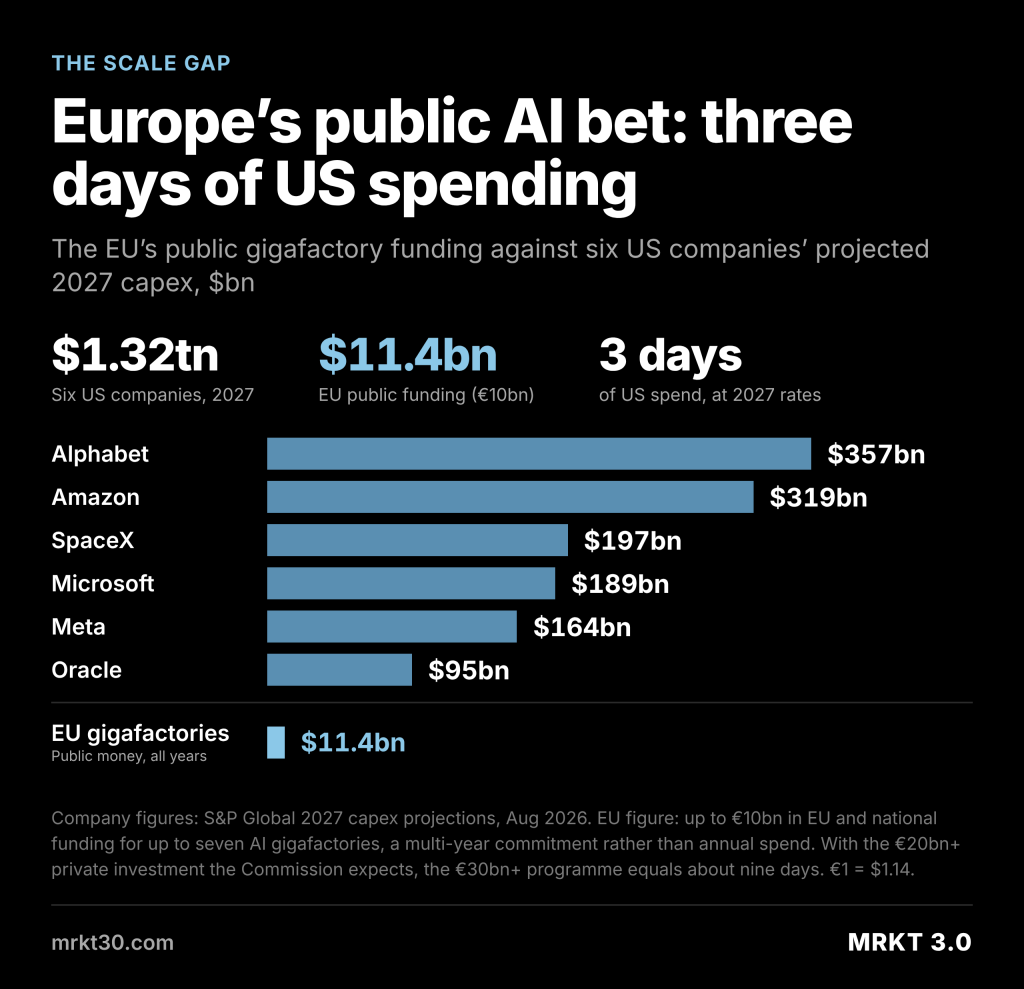
To close the gap, the EU has committed up to €10 billion, roughly $11.4 billion, in EU and national funding for up to seven AI gigafactories, specialised data centres dedicated to training frontier models. The European Commission expects that public money to pull in at least €20 billion in private investment, for a total above €30 billion. The call for tenders closes on November 12, with winners picked in early 2027 and the first sites expected to run within 18 months of signing, which puts them in service around 2028.
Much of the supply chain will come from abroad, which entrenches a different form of dependency. Following the EU-US trade agreement in July, the Commission signed letters of intent with American chipmakers NVIDIA, AMD and Qualcomm to secure hardware for the winning consortia. Once the gigafactories are running, there are no strict rules on who can buy the computing output. Given the lead American AI companies hold, European-funded capacity could end up sold straight to American tech giants.
The Arithmetic Problem
S&P Global Ratings projects that six companies (Alphabet, Amazon, Microsoft, Meta, Oracle and SpaceX) will spend around €1.14 trillion ($1.3 trillion) on capital expenditure in 2027, up from a forecast €777 billion ($870 billion) this year. The EU’s entire gigafactory commitment is worth about three days of that. In Europe alone, Microsoft and Google both have multi-site data centre programmes under way.
Along with Amazon, those three companies hold 70% of the European cloud market. European providers hold 15%, down from 29% in 2017, a slide that stopped only because the floor arrived. US cloud providers are putting roughly €10 billion a quarter into European capital programmes, which is a hill no European challenger can climb.
That is the backdrop to the AI Continent Action Plan, which the EU unveiled in 2025 with two headline ambitions: the gigafactories and a homegrown semiconductor industry. The difficulty for European AI sovereignty is that most of the data centres going up will depend on demand from American Big Tech. Even where the infrastructure is European-owned, it remains tied to foreign supply chains and foreign customers.
The SINES Data Campus
Portugal is emerging as a European data centre hub, led by the 1.2 gigawatt SINES Data Campus in Sines. Running on seawater cooling and renewable power, it is designed to be Europe’s largest AI-ready sustainable data centre, a bandwagon American billionaires might want to get on if they want to avoid the pitchforks of the American populace.
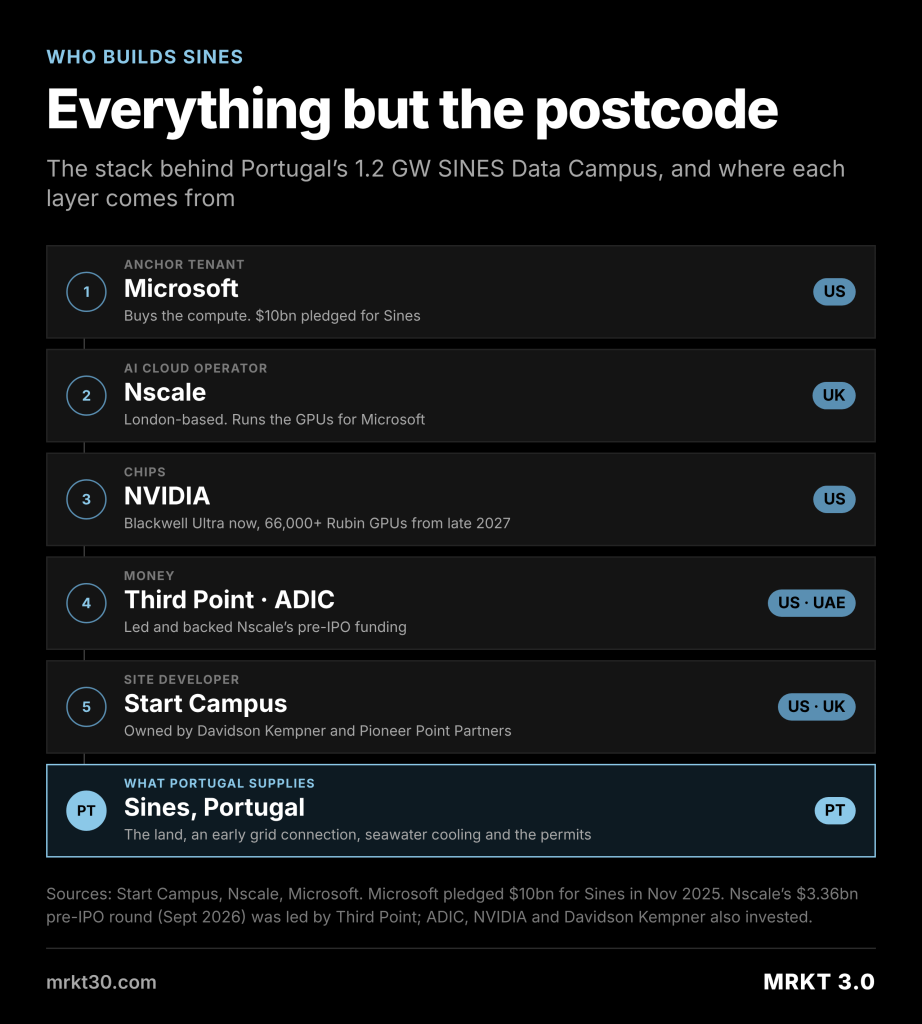
A Portuguese operator runs the park. The money behind it comes from somewhere else. The developer is an outfit called Start Campus, a blandly named joint venture between US investment fund Davidson Kempner and Britain’s Pioneer Point Partners. The €8.5 billion campus, targeted by 2030, was restated when Start Campus inaugurated SIN01 on 4 April 2025. Operations had already begun in the fourth quarter of 2024.
In October 2025, the London-based AI infrastructure company Nscale selected Start Campus for one of the EU’s first NVIDIA Blackwell Ultra deployments, more than 12,600 GPUs, in support of Microsoft. The following month, Microsoft’s Brad Smith pledged approximately €8.9 billion ($10 billion) to AI data centres in Sines at the Web Summit in Lisbon. In May 2026, Nscale added €695 million ($812 million) to build a second 200-megawatt building and supply more than 66,000 NVIDIA Rubin GPUs from late 2027.
Nscale itself raised roughly €3 billion ahead of its IPO from backers including the American hedge fund Third Point and the Abu Dhabi Investment Council (ADIC). A British company, American and Gulf capital, American chips, an American anchor tenant, and a Portuguese postcode.
What Portugal Actually Supplied
What Portugal actually supplied was the thing nobody else had: grid permission secured early, before the queue of European data centre applications grew long enough for regulators to start intervening. Portuguese officials have been explicit about the terms.
Infrastructure Minister Miguel Pinto Luz said in July that the country will only support data centre investment that delivers measurable productivity gains and real economic benefit, warning that the projects consume astronomical amounts of energy and sometimes produce few spillovers.
“We want to attract investment, but we do not want to become Europe’s dumping ground,” he said. With foreign investors holding the purse strings, opinions differ on how much of that benefit stays local.
Mistral Bucks the Trend, Up to a Point
France’s Mistral has gone further than anyone else in Europe toward owning its own compute. In February 2026, it announced a €1.2 billion plan with EcoDataCenter to build in Sweden. In March, it raised roughly €735 million ($830 million) in debt, its first ever, from a consortium of seven banks including Bpifrance, BNP Paribas and HSBC, to fund a 44-megawatt site at Bruyères-le-Châtel near Paris running 13,800 NVIDIA GB300 chips.
Arthur Mensch, CEO of Mistral, said, “Scaling our infrastructure in Europe is critical to empower our customers and to ensure AI innovation and autonomy remain at the heart of Europe.”
The point of the debt raise was to free Mistral from dependence on third-party cloud providers, and it worked out its own terms. Mistral is targeting 200 megawatts across Europe by the end of 2027. After Samsung took a stake in September, it is also the best-funded AI lab on the continent, valued at roughly €21 billion.
The independence has limits. The chips are NVIDIA’s. A planned 1.4 gigawatt campus near Paris is a joint venture with Bpifrance, NVIDIA and the Abu Dhabi fund MGX, which allegedly bribed the American president by investing in his family’s crypto firm. And in July, Mistral and Microsoft entered a multibillion-dollar partnership under which Microsoft funds European data centre expansion and takes compute capacity on the continent in return. Set against American rivals that each plan to spend over €100 billion this year, Mistral’s roughly €4 billion infrastructure budget is a different order of magnitude.
Energy is a Lever
Grid limitations are a daily problem for European industry. They are also the one point of leverage individual member states hold, because a data centre cannot be built where there is no power to connect it to.
European electricity is expensive. The International Energy Agency found that EU prices for energy-intensive industry again averaged more than double US levels in 2025 and nearly 50% above China’s. The average EU wholesale price that year was about $95 per megawatt-hour, roughly twice the US wholesale price.
Iberia is the exception. Wholesale prices in the MIBEL market that Portugal shares with Spain averaged just above €40 per megawatt-hour in the first quarter of 2026, against more than €90 in most European markets, according to the Portuguese renewables association APREN. That gap is a large part of why Iberian sites keep attracting AI infrastructure. Elsewhere, energy costs have hollowed out manufacturing competitiveness and made powering data centres a problem rather than a plan.
Fragmentation makes it worse. Spurred by AI, global data centre capacity is projected to nearly quadruple by 2035, from 88 gigawatts to as much as 340, while Europe’s share of that capacity is expected to shrink. Limited grid capacity in certain member states creates bottlenecks that can stall a build-out for years.
A Counterargument
As AI-related debt piles up for American financiers and Big Tech, there is an argument that Europe is well positioned precisely because it sat out the financing. If the AI bubble bursts, European economies carry far lower exposure. The S&P projections make the point: the six hyperscalers spending more than €1.16 trillion ($1.3 trillion) in 2027 are all expected to generate negative free operating cash flow in 2026 and 2027, with recovery not projected until 2029.
The technology itself is not going away, whatever happens to the companies building it. The European Central Bank estimates rapid AI adoption could lift eurozone productivity by as much as 4% over a decade. The catch is that Europe is adopting more slowly than the country it is buying from: Christine Lagarde notes that American workers spend two to three times as much of their week using AI as workers in the largest euro area economies.
One caveat stands out. Eurozone households hold around €440 billion in American technology companies, which means ordinary Europeans are helping finance the US build-out while homegrown alternatives stay scarce.
Then again, most European wealth never reaches the stock market at all. Around 80% of eurozone households own no shares, bonds or funds, more than 60% hold most of their wealth in property, and households sit on nearly €10 trillion in bank deposits. If the bubble bursts, the financial pain in Europe would be smaller than elsewhere, for the unflattering reason that Europeans were never in the trade.
Power and Permits
The United States hosts roughly 75% of global AI computing capacity. Europe holds about 5%. Those shares will shift as the build-out continues, but much of the new infrastructure will be foreign-owned, especially by American Big Tech.
What Europe controls is narrower and more concrete than capital: the land, the grid connections, the water, the permits and the political cover that any of this requires. Portugal used that leverage to land a €10 billion anchor tenant. Other member states will discover they have the same lever, or they will discover that the queue moved on without them.
The gigafactory tender closes on November 12. The first sites should be running around 2028. Between now and then, the same six companies are projected to spend on the order of $1.5 trillion: the rest of this year’s outlay plus the full 2027 bill.
Author: Tim Tolka, Senior Reporter
See Also:
Nscale IPO: $103 Billion of Contracts, Only 55MW Live
Where Will Europe Actually Put Its Data Centres?
Europe vs US AI Infrastructure: Who’s Winning?
The editorial team at #Mrkt30 has taken all precautions to ensure that no persons or organizations have been adversely affected or offered any sort of financial advice in this article. This article is most definitely not financial advice.