


Britain’s data-centre boom has reached Holyrood. Parish councils were already in the fight. The Scottish Parliament is now in it too.
On September 16, MSPs voted to pause planning decisions on hyperscale data centres until Scottish ministers publish national guidance. Ministers said they do not expect further approvals before Christmas. A Green motion for a full moratorium failed and planning authorities still keep their own powers under the pause. Even so, this is the first time a parliament in the UK has asked the pipeline to wait. The vote is not binding.
England, on the other hand, has kept going. Days earlier, Prime Minister Andy Burnham rejected a call from Blyth and Ashington MP Ian Lavery to halt new centres in the North East AI Growth Zone. On September 28, Buckinghamshire Council approved an Amazon data centre in Iver, beside the M25. That same council had already turned other schemes down on the patch.
Slough, North Devon and the Hertfordshire Green Belt show the same pattern. Residents are organising. Ministers are still backing new schemes.
Who Is Leading UK Data Centre Opposition?
Local resident groups are leading the individual fights. Oliver Hayes at Global Action Plan has become the clearest national voice. Foxglove is the group that takes the government to court.
Hayes, head of policy and campaigns, wants a pause on new AI data centres until environmental rules catch up. He gave evidence to Parliament’s Environmental Audit Committee on June 10. Foxglove, a small legal non-profit, gets the decision in front of a judge. The two work together often. Village campaigns still belong to the people who live next to the sites.
In Potters Bar, Ros Naylor helped set up the Potters Bar Special Interest Group after the South Mimms scheme. In Scotland, Action to Protect Rural Scotland has filed objections and tried to connect fights at Larbert, Auchtertool and Hermiston. In North Ockendon, the Environmental Law Foundation has backed residents against an East Havering campus that Digital Reef is promoting.
Newer groups sit outside that map. Slough Against Data Centres formed in July. No Devon Data Centre is fighting a 344-hectare Xlinks proposal on farmland outside Great Torrington. In Leeds, more than 300 people gathered on September 12 against a Microsoft site at Skelton Grange.
What Are the Main Data Centre Planning Objections?
Campaigners object to the site, the scale, and the load on power, water and local roads. Four complaints come up again and again.
- Green Belt and land. Hertfordshire and Buckinghamshire schemes sit on land that used to have protection, or on sites once lined up for homes. In Slough, campaigners ask what the town got back for becoming Europe’s data-centre alley.
- Power. One hyperscale data centre can draw as much electricity as a town. Britain is already one of the two European countries with the most data centres. This fight covers the next wave, on top of older buildings already running in Slough and Docklands.
- Water and backup generators. Cooling and diesel generators echo an argument this site has tracked elsewhere. Servers need power. The cheap way to get rid of the heat still involves water.
- Process. A University of Hertfordshire paper on Potters Bar argues that residents also object to being left out of the decision.
Where Has UK Data Centre Opposition Won and Lost?
Opposition won a court concession at Woodlands Park in Iver. It lost at Abbots Langley, at South Mimms, and this month on a separate Amazon site back in Iver.
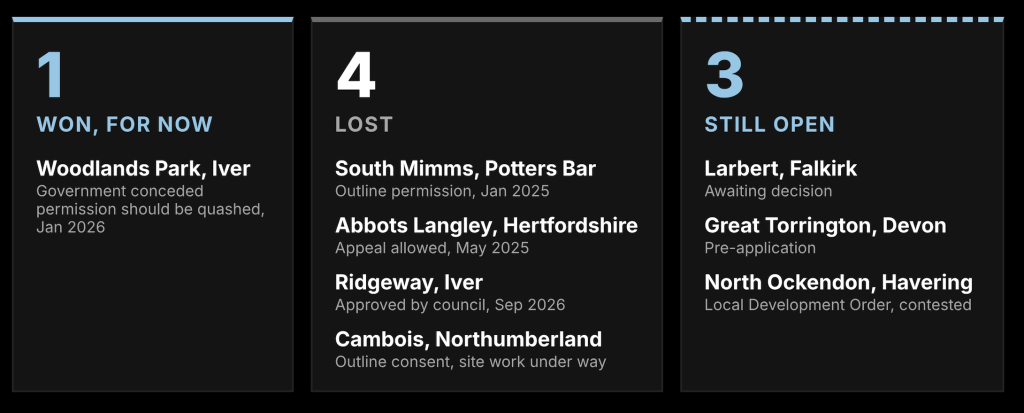
Buckinghamshire Council refused Greystoke Land‘s data centre on the Woodlands Park landfill. Government then approved it. Foxglove and Global Action Plan challenged that call. In January, ministers conceded that the court should quash the permission. Officials had signed it off on the hope of securing low-carbon power later. They later accepted they could not lock those measures in. The Treasury Solicitor called it a “serious logical error”. Ministers accepted that the permission should be quashed. The site can still come back for a fresh decision.
Three Rivers District Council refused Greystoke’s 84,000 square metre scheme at Abbots Langley in January 2024. Councillors cited Green Belt and the village. On May 12, 2025 the Secretary of State allowed the appeal. Officials classed the site as grey belt, so Greystoke did not have to prove very special circumstances. They noted the landscape harm. They still judged London’s need for capacity to outweigh it.
Hertsmere’s planning committee granted outline permission for DC01UK at South Mimms on January 23, 2025. That vote came a week after the AI Opportunities Action Plan. Residents and CPRE Hertfordshire objected. Councillors voted yes. Amazon’s Ridgeway scheme is a different site from Woodlands Park. Buckinghamshire approved it on September 28 anyway.
What Is the Government’s Plan for AI Growth Zones?
Ministers want more data centres, and they want them built faster. They have already classed the sector as national infrastructure to get there.
In 2024, the government designated data centres Critical National Infrastructure, in the same bracket as energy and water. AI Growth Zones are the main tool now. They pair sites with power and a smoother planning path. Ministers have tied the North East zone to as much as £30 billion of private investment and more than 5,000 jobs. Those figures are targets.
Inside the zone, the argument has already started. QTS, owned by Blackstone, is building a campus at Cambois on the old Blyth power station site. Two further applications sit nearby. Lavery wants a pause. Burnham does not. Planning policy is moving the same way. Government proposals argue that planning delay is holding AI infrastructure back. They also want clearer support for nationally important centres.
Scotland has split off. Holyrood rejected a ban, then asked for no further decisions until guidance lands. Schemes over 50 megawatts now need an environmental impact assessment. APRS says Apatura told that night’s hearing it would pause the Larbert application.
Why Does the UK Want to Build Data Centres?
The UK needs to build them for a variety of reasons. Those include jobs, local tax income, and a claim to keep sensitive computing on British soil.
The North East figure of £30 billion and 5,000 jobs is a government projection. Ministers have presented North Wales as supporting more than 3,400 jobs. Each Growth Zone also came with a £5 million promise for skills and local AI adoption. English councils would keep 100% of extra business rates in the zones for 25 years. Officials put the gain at £5 million to £10 million a site each year once it is running, from April 2027. The Starmer government wrote that rates rule. A later government can still rewrite it.
Ministers also say British compute cuts reliance on overseas sites and keeps sensitive workloads closer to home. Europe’s largest campus in the main public ranking still sits well behind the American gigawatt projects. Where the buildings go is a separate question this site has mapped. Grid queues are already deciding the map. A data centre does employ people. South Mimms came with a pitch of about 200 permanent on-site jobs. The construction peak is larger. So is the power draw.
What Happens Next for UK Data Centre Campaigns?
Three questions will shape the next phase. Will Westminster keep overturning local refusals? Will the grid queue bite harder than the planning committee? Will the campaigns start acting as one?
Abbots Langley shows a refusal can fall when officials frame the site as grey belt and the need argument sticks. Woodlands Park shows a government approval can fall when the environmental case is badly made. Amazon’s new Iver consent shows a council can also just say yes.
Contracted demand connection offers rose from 41 gigawatts to 125 gigawatts between November 2024 and June 2025. Data centres accounted for at least 80 gigawatts of that. On July 29, Ofgem proposed a Data Centre Commitment Fee of £237,500 to £712,500 per megawatt. Developers get the fee back if the site switches on, and lose it if the project drops out. The consultation has closed. The fee is still a proposal.
Opposition sits closer to a shared campaign than it did a year ago. Scotland has a parliamentary pause. England has a prime minister who has already rejected one. Fresh buildings will keep coming. Developers still have to decide what they will offer a village, or a mayor, before either lets them build.
Author: Connor Fitzgerald
See Also:
Largest Data Centres in the World: The Gigawatt Club (2026)