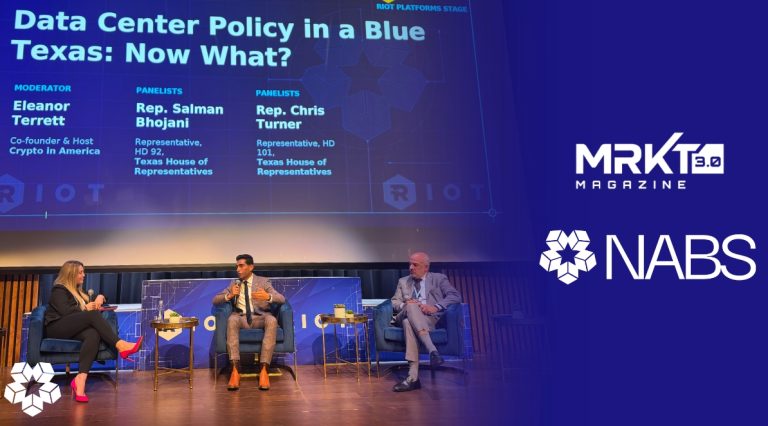

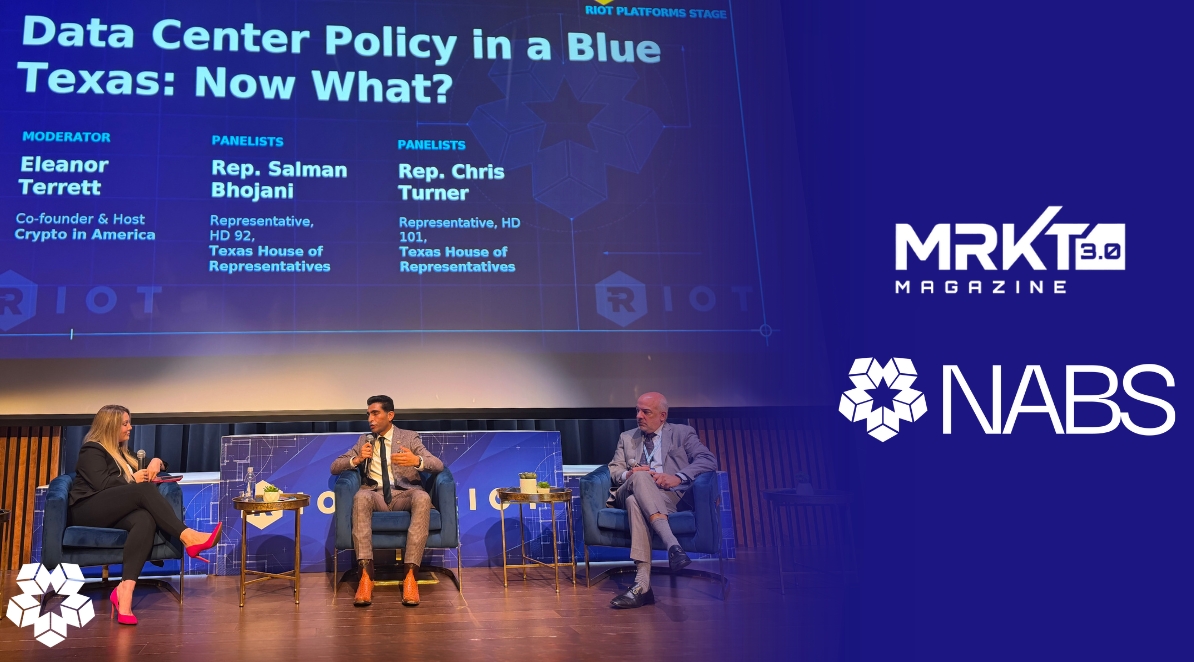
Data centers have become one of the biggest policy questions in Texas. The state has attracted large projects on the back of its power market, land, and business climate, but rising electricity demand and local pushback have put the issue in front of lawmakers. With Democrats gaining ground in the Texas House, the next panel at the North American Blockchain Summit asked what that shift could mean for the sector.
Rep. Chris Turner continued on stage, joined by fellow Democrat Rep. Salman Bhojani. Eleanor Terrett, co-founder and host of Crypto in America, moderated the discussion. The conversation turned to whether a change in the balance of power in Austin would alter the state’s approach to data centers and large technology projects.
Affordability and the Election
Turner opened by tying the election results to affordability. He pointed to tariffs and the war in Iran as drivers of higher costs, noting that diesel prices around $6 a gallon feed into the price of food and other goods while wages lag. “Affordability is, I think, the single biggest driver of what happened in this election,” he said.
He added that many voters in Texas felt state leaders had focused on culture wars and mid-decade redistricting rather than issues that affect families, including public schools and the state’s new school voucher program. The program, passed in 2025, lets families use public money to help pay for private school tuition or homeschooling expenses. Turner said he thinks the Republican push for it hurt them in the election.
Guardrails and the Innovation Capital Goal
Bhojani said he wants Texas to be the innovation capital of the world, but that the state still needs guardrails. He referenced the Texas Responsible AI Governance Act passed last session and said he has filed about 13 AI bills for the next one. He used the example of airline autopilot: most of the flying is automated, yet two pilots remain in the cockpit. “AI can flag things but cannot make the decisions,” he said. He also described a proposal for a Department of AI that would help state agencies share tools and reduce silos, drawing on his time as vice chair of the Delivery of Government Efficiency committee.
On the split between a Democratic House and a Republican Senate, Bhojani said technology is not a partisan issue and that he expects bipartisan cooperation. “Great ideas don’t have a monopoly from one party or the other,” he said. Turner agreed that tech policy in Texas has not been partisan, pointing to past bills on deepfakes that passed with broad support. He noted that the short 140-day legislative session forces lawmakers to work together quickly.
Data Centers, Power, and Local Concerns
Both lawmakers said Texas needs data centers. Turner listed healthcare records, law enforcement systems, and AI development as reasons the state cannot simply reject them. At the same time, he acknowledged bipartisan unease about electricity use, water consumption, and loss of local control. He argued that large power loads can help support new electricity generation in ERCOT, where wholesale prices are currently low. Low prices are good for consumers, he said, but they make it harder to attract investment in additional thermal generation. Data centers, in his view, can be part of the solution as long as transmission costs are not passed on to residential ratepayers.
On where data centers can be built, Turner said he generally supports local zoning control for cities and that rural counties may want a say, though he described giving counties that authority as a difficult political fight. Bhojani said there is currently “bipartisan hate” toward data centers over power and water, and that the response should be responsible regulation rather than bans. “We need data centers in Texas, but we need responsible data centers in Texas,” he said.
Will a Blue Texas Stay Business Friendly?
Terrett asked whether Democrats taking the House would lead to heavier regulation that drives business out of the state. Turner called those fears misplaced. “Texas is a business friendly state, and that’s not going to change,” he said. He pointed to the Houston Ship Channel and Dallas-Fort Worth Airport as larger drivers of the economy than recent legislative action and noted that divided government will require compromise. Even under full Democratic control, he said, the party would still want companies to expand and start in Texas.
Bhojani said the idea that Democrats are not business friendly is a myth. Both he and Turner are business owners, he noted, and he has looked at reducing regulatory costs that add to housing prices. “We’re the eighth largest economy in the world. We want to be the seventh largest,” he said. “Let’s make that happen.”
The panel closed with both lawmakers urging the industry to engage directly with Democratic members rather than assume hostility. On crypto, Bhojani said many colleagues still need education and pointed to his earlier bill on using blockchain for property records. Turner said the same approach applies across emerging technology: explain the benefit to constituents and the economy, and lawmakers on both sides will listen.
Author: Andy Samu
See Also:
Innovation at What Cost? The Big Debate About AI at the North American Blockchain Summit – MRKT3.0
Buy the Fear: Why the Post-Midterm Data Centre Sell-Off Went Too Far