
The European High Performance Computing Joint Undertaking (EuroHPC) built 19 regional AI factories across 16 EU member states, committing over €2.6 billion to the AI Factories and Antennas initiative. Meanwhile, US tech giants are projected to spend €680–765 billion on AI infrastructure in 2026 alone, according to Wall Street analysts. Europe controls less than 5% of global AI compute compared to America’s 70%, and the gap is widening.
US tech companies are pouring hundreds of billions into massive centralized AI clusters. Europe spent €2.6 billion building 19 smaller ones scattered across the continent.
Critics looked at the numbers and declared Europe is “losing the AI race.” The figures suggest they are right. But the criticism misses something crucial: Europe never had a better option.
The Criticism Europe Can’t Shake
Europe keeps hearing the same thing: you’re behind in AI. You don’t have Meta’s scale. You don’t have Google’s hyperscaler infrastructure. Your startups train models on American clouds.
All true.
Europe’s distributed model likely cannot match the raw power of centralized American clusters. But here’s what the critics miss: Europe didn’t fail to build a Meta-scale cluster. Europe couldn’t build one.
Understanding why Europe chose this path explains everything from the structure of EuroHPC to why flagship European AI company Mistral initially trained its models on Oracle Cloud and AWS.
What Europe Actually Built
Europe’s approach to AI infrastructure looks nothing like Silicon Valley’s playbook. And it wasn’t by choice.
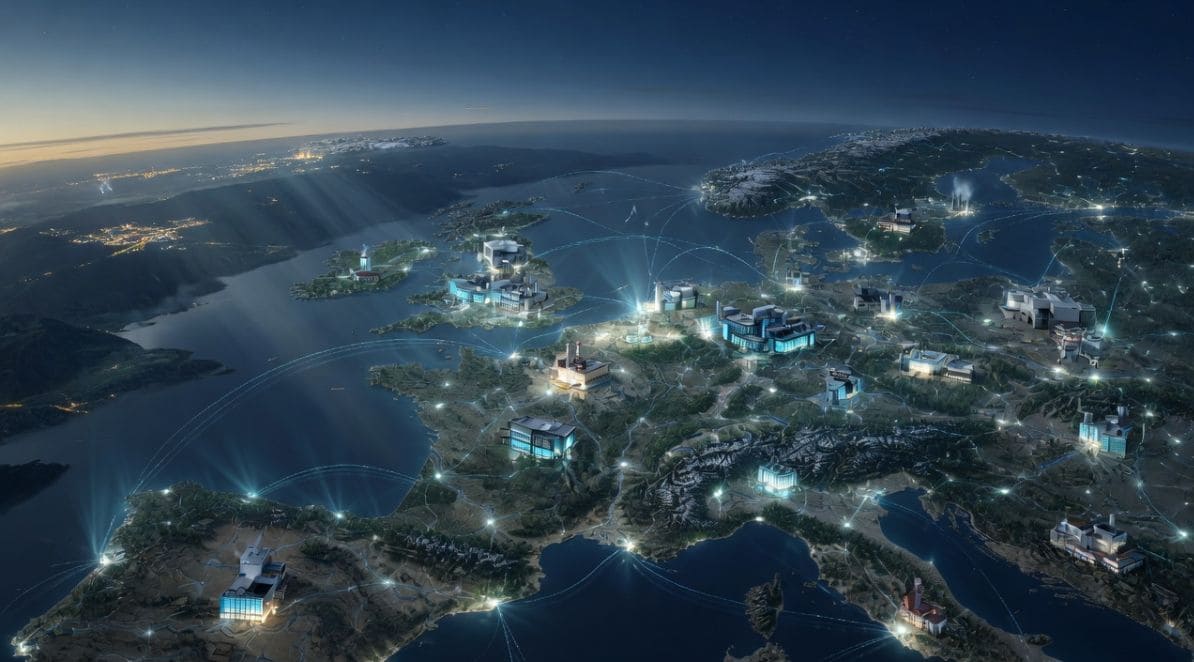
The EuroHPC built 19 regional AI factories across 16 member states. Each one is a co-funded partnership between the EU, national governments, and local institutions. From GAIA in Krakow to MareNostrum 5 in Barcelona to LUMI in Kajaani.
The factories are designed to be inclusive: AI-optimized supercomputers designed for startups, SMEs, universities, and researchers. Access is granted via EuroHPC’s allocation system rather than deep pockets.
The scale reality, however, is brutal. Europe controls less than 5% of global frontier AI compute.
How America Does It Differently
When Meta wants compute, Meta builds it. The same goes for Google, Microsoft, Amazon, and OpenAI.
Meta’s Grand Teton cluster contains 24,576 NVIDIA H100 GPUs in a single facility. Microsoft’s rumored OpenAI partnership clusters exceed 100,000 GPUs. These are the largest AI training sites on Earth.
How it works: Each company owns the data centers, buys GPUs directly from NVIDIA, trains their own models (Llama, GPT-4, Gemini), and deploys their own products. Zero public access unless you’re paying for cloud.
Timeline: 12 to 18 months from decision to deployment.
Investment scale: Meta alone has guided around €123 billion in capex for 2026.
The logic is speed and control. In a frontier-model race, you cannot wait for government procurement cycles.
Why Europe Can’t Just Copy Silicon Valley
Europe’s distributed model wasn’t Plan B. It was the only plan that could actually get built.
Europe cannot match US big tech spending. Big Tech is collectively committing €680–765 billion in AI-related infrastructure in 2026 alone. Matching that scale was never on the table.
Europe can’t centralize like China. Brussels doesn’t have the political authority to build one “European AI champion.” Member states won’t surrender control of critical infrastructure to a supranational body. Try getting France, Germany, Poland, and Italy to agree on who hosts “Europe’s compute center.” The meeting would last six years and produce nothing.
So Europe built what it could actually execute: a federated network where every member state gets infrastructure, nobody monopolizes access, and no single facility becomes a strategic bottleneck.
The trade off is scale. No European startup can access 100,000 GPUs the way OpenAI taps Microsoft’s clusters or how Google DeepMind accesses Google’s infrastructure. But the upside is resilience. If one factory goes offline, 18 others keep running.
The Real Trade Offs
That is not a system failure. That is the system working exactly as designed: prioritizing broad access and resilience over raw dominance.
The Bet Europe Made
Europe has traded scale for sovereignty because the political and economic realities of 27 member states left no other viable path.
The question is no longer whether Europe is “behind” – the compute gap is obvious. The real question is whether a distributed, sovereign model can remain competitive when the gap is this wide.
Whether resilience without scale ultimately matters may be the question that decides Europe’s place in the AI era.

See Also:
The EU’s Sovereign AI Push: Claiming Tech Independence
Gaia AI Factory: Why EuroHPC Chose Krakow for Europe’s Most Strategic Supercomputer
EU AI Factories 2026: Europe’s 5 Sovereign Hubs
Frequently Asked Questions
Europe has 19 operational or planned AI factories under the EuroHPC Joint Undertaking, with 5 additional gigafactories in development. Each facility is co-funded by the EU, national governments, and regional institutions.
US hyperscalers (Meta, Google, Microsoft) build private, vertically-integrated AI clusters for their own use. Europe’s AI factories are public infrastructure providing shared compute access to startups, researchers, and SMEs across multiple countries.
Europe controls less than 5% of global frontier AI infrastructure, while US companies control approximately 70%. Meta’s single Grand Teton cluster (24,576 GPUs) is larger than any individual European AI factory by more than 10x.
Europe’s 19-factory model reflects political and economic reality: no single European company has Meta-scale capital, and EU member states won’t cede control of critical infrastructure to a centralized authority. Distribution was the only politically feasible path.
Yes. EuroHPC prioritizes compute access for startups, SMEs, and research institutions through an allocation system. Unlike US hyperscaler infrastructure (which is private), European AI factories provide shared public access.
Mistral AI trained on Oracle Cloud and AWS infrastructure because no European facility had sufficient capacity for frontier model training at scale. This reflects the scale gap between distributed regional facilities and centralized hyperscaler clusters.