
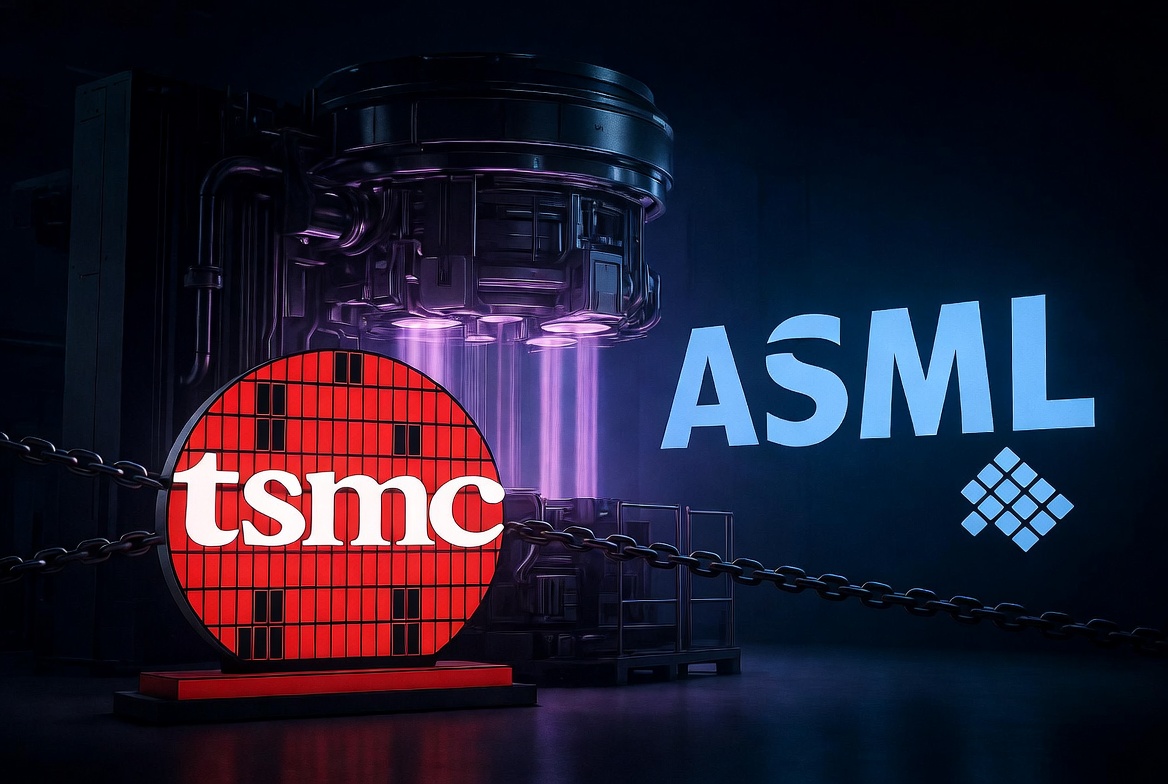
TSMC, which produces the vast majority of the world’s most advanced logic chips, announced it will delay using ASML’s newest $410 million lithography machines until 2029 due to cost concerns. This decision signals that even the most profitable chipmaker sees current AI infrastructure economics as unsustainable.
The world’s most important chipmaker said no to the world’s most advanced chipmaking machine. And that decision tells you everything about the impossible position the semiconductor industry finds itself in right now.
Taiwan Semiconductor Manufacturing Company (TSMC), the company behind virtually every advanced chip powering AI systems from ChatGPT to autonomous vehicles, announced it won’t deploy ASML’s latest extreme ultraviolet lithography machines for production until at least 2029. The reason? They’re simply too expensive at €350 million ($410 million) each.
“We continue to be able to harvest the benefit from current EUV,” TSMC Deputy Co-Chief Operating Officer Kevin Zhang told reporters. He continued that the next generation machines are “very, very expensive.”
It’s a polite way of saying: the economics don’t work anymore.
The AI Boom’s Hidden Bottleneck
Here’s what makes this moment so critical. Artificial intelligence is devouring semiconductors at an unprecedented rate. The global semiconductor market is projected to reach $975 billion this year, with some high-growth forecasts exceeding $1.3 trillion amid booming AI demand.
Microsoft, Google, Amazon, and Meta are collectively spending hundreds of billions on AI infrastructure, all of which requires the most advanced chips imaginable.
But making those chips requires specific machines. And right now, only one company in the world can make those machines: ASML, a Dutch equipment manufacturer that has carved out one of the most valuable monopolies in modern technology.
ASML’s extreme ultraviolet lithography machines are the size of a double-decker bus and contain over 100,000 parts from 800 suppliers across more than a dozen countries. They use light at incredibly small wavelengths that require mirrors polished to atomic perfection. A single ASML EUV machine can cost anywhere from $150 million to over $400 million, depending on the model.
These machines are indispensable. Without them, you can’t make the 3 nanometer and 2 nanometer chips that power today’s most advanced AI systems. Intel is the first to deploy the newest high-NA systems for volume manufacturing, but TSMC, ASML’s largest customer, is now pumping the brakes.
The China Factor Changes Everything
While TSMC worries about machine costs, China is playing a different game entirely. Beijing has responded to US export controls by imposing its own restrictions on rare earth materials critical to chip manufacturing: gallium, antimony, and germanium. These materials are indispensable, and China controls much of the global supply.
The escalation follows years of increasingly aggressive US restrictions. The October 2024 export rules effectively banned exports of NVIDIA’s H100, H200, B100, and B200 GPUs to China. ASML’s most advanced EUV machines have been prohibited from Chinese sales since 2019.
China’s response? Double down on semiconductor self-sufficiency. The country has committed tens of billions in state funding to domestic chipmakers like SMIC, though they still lag several generations behind TSMC and Samsung in advanced manufacturing. China accounted for roughly 20% of ASML’s 2026 sales, but that percentage is shrinking as export restrictions tighten.
This isn’t just a trade war. It’s a fundamental restructuring of the global technology supply chain, and the semiconductor industry sits at the center of it.
The Supply Chain That Can’t Afford to Break
This brings us back to TSMC and its $410 million machines. Taiwan Semiconductor makes the vast majority of leading-edge logic chips. Almost every NVIDIA Blackwell GPU, Apple A19 processor, AMD EPYC server chip, and advanced AI accelerator from companies like Microsoft, Google, and Meta is made in TSMC’s factories in Hsinchu and Tainan, Taiwan.
This concentration creates what defense analysts call a “strategic vulnerability.” If anything disrupts TSMC’s Taiwan operations, whether from natural disaster, accident, or geopolitical conflict, the global technology industry grinds to a halt.
Yet TSMC can’t afford to deploy machines that cost half a billion dollars if the economics don’t justify it. The company’s decision to hold off on ASML’s newest machines until 2029 signals something important: even the world’s most profitable chipmaker sees these cost curves as unsustainable.
What Problems Is the Semiconductor Industry Facing?
The semiconductor industry is caught in a vise.
AI development isn’t slowing down. Every major technology company is racing to build larger models, which require more computing power, which requires more advanced chips. The semiconductor industry simply cannot keep up with this pace.
At the same time, the supply chain is fracturing along geopolitical battle lines. US export controls, Chinese restrictions, and the push for domestic manufacturing across multiple countries mean the industry is splintering into incompatible ecosystems. What used to be a global supply chain is becoming regional fortresses.
And the economics are breaking. When the world’s most important chipmaker says the most advanced manufacturing equipment is too expensive to use, that tells you something fundamental has broken. The traditional cost curves that made computers cheaper and faster every year for five decades are hitting limits.
How Are Chipmakers Responding to Rising Costs?
ASML is responding by investing $2.2 billion in capacity expansion and pushing to increase shipments. The company’s CEO warned that missing delivery deadlines could push customers toward rivals or alternative technologies. But what rivals? What alternatives? ASML’s monopoly is so complete that there are no meaningful competitors for advanced lithography equipment.
Texas Instruments is trying a different strategy with an $11 billion bet on older chip technology that serves cars, factories, and defense systems. These chips don’t need the most advanced machines, but they’re critical for supply chain security. It’s an acknowledgment that not every chip needs to be cutting edge.
The reshoring effort is real, but it will take a decade or more to meaningfully reduce dependence on Taiwan. In the meantime, the semiconductor supply chain remains dangerously concentrated, eye-wateringly expensive, and increasingly tangled in great power competition between the US and China.
What It All Means
TSMC’s decision to skip ASML’s most expensive machines isn’t just about cost control. It’s a warning sign that the AI boom’s infrastructure demands are colliding with modern economic and geopolitical realities.
The machines that make the chips that power AI are becoming too expensive for even the world’s best chipmaker to justify. That’s not a sustainable trajectory. Something has to give.
Frequently Asked Questions
The machines cost $410 million each, and TSMC believes it can continue using current generation equipment effectively until at least 2029. The economics don’t justify the upgrade cost.
TSMC produces roughly 90% of the world’s most advanced semiconductors at 3 nanometer and below, creating a dangerous concentration of supply.
The $52.7 billion CHIPS Act is funding new facilities, but manufacturing costs run 30 to 50% higher in the US than Asia. Full reshoring will take a decade or more.
A disruption to TSMC’s Taiwan operations would halt production of virtually all cutting edge AI chips, affecting every major tech company from NVIDIA to Apple to Google.

See Also:
Why TSMC’s Record Profits Point to a Bright AI Future