
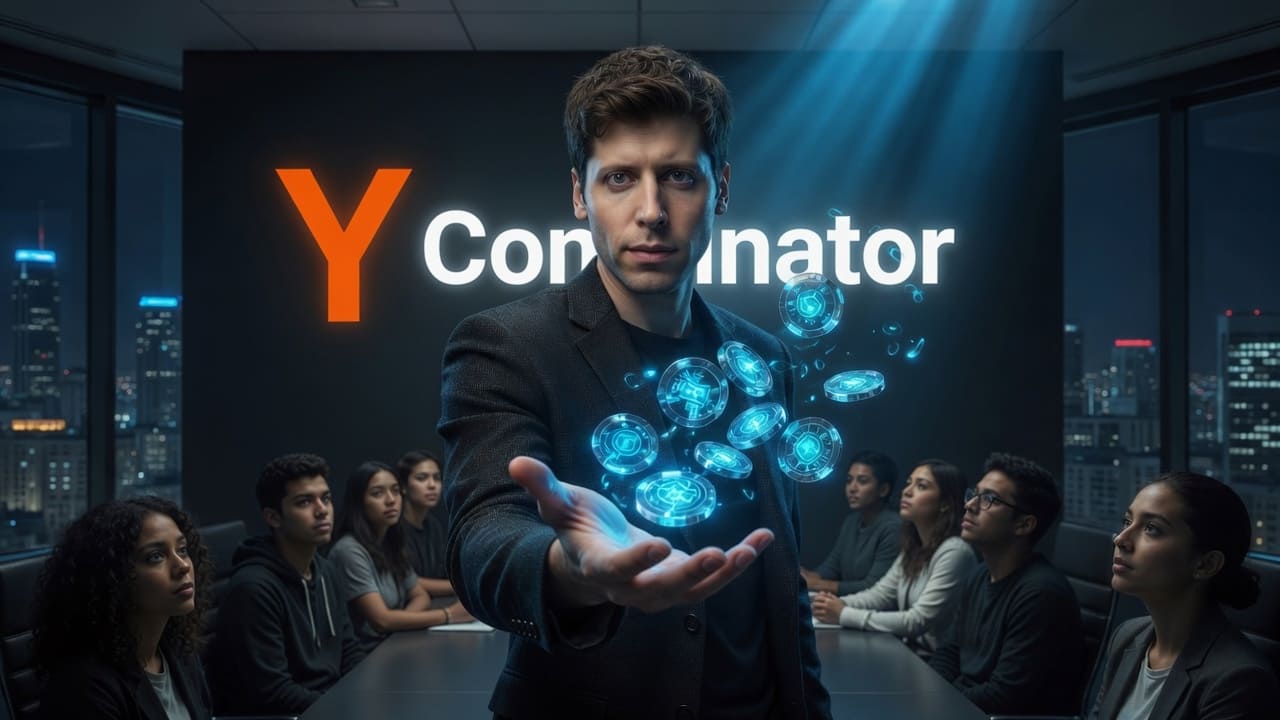
In May 2026, Sam Altman, CEO of OpenAI, walked into a Y Combinator event and made what Tyler Bosmeny, partner at YC, called a “mic drop moment”.
That day, he offered every startup in the room $2 million in OpenAI API tokens. Unlike cash, these tokens could be used as compute credits that startups typically burn through when building their products. In exchange, Altman would get equity stakes in all 169 companies in the cohort. To put that more bluntly, that’s roughly a $200 million commitment deployed across an entire generation of founders in a single evening.
Was this actually an act of generosity? Or something more sinister? To understand that, you have to go back to the beginning of Altman and YC’s journey.
How YC Became the Gold Standard of VC
YC is one of the big dogs within the venture capital firms.
It was founded in 2005 in Silicon Valley and runs four cohorts a year with each lasting three months. Founders move to San Francisco, get intensive mentoring, and at the end pitch to hundreds of investors on Demo Day. In exchange for all of this, YC typically takes a 7% equity stake and hands over $500k in cash.
YC’s model works on volume and network, and has now backed more than 5,000 companies. And its star-studded alumni speaks for itself, with names including Airbnb, Stripe, Dropbox, Reddit, DoorDash, and Instacart. This portfolio collectively represents hundreds of billions in market value.
Being a YC company has become a signal, and that signal is that you have been through the filter, and you are in the network. And when you are in the network, institutional investors start to take notice.
Altman’s Connection to YC
Altman first entered the YC orbit as a wide-eyed founder in 2005. His company, Loopt, was a location-based social app, and, although it didn’t become the next Facebook, it did give him a foot in the door to Silicon Valley’s VC golden child.
By 2011, he was a part-time partner. And then, in 2014, YC’s founder Paul Graham asked Altman to succeed him as president. Under Altman, YC tripled the number of startups it processed per batch and also cemented its position as the definitive on-ramp for Silicon Valley ambition. And this paid off. YC exploded and backed breakout successes like Stripe and Airbnb while also pushing into hard tech.
The most common assumption about OpenAI’s origins is that it came out of Y Combinator the way its other breakout stars did: a small team, a batch, a $500k cheque, a Demo Day. But that is not what happened.
In December 2015, OpenAI was founded as a nonprofit research organization. Its initial backers included industry titans including Elon Musk, Greg Brockman, Reid Hoffman, Jessica Livingston, Peter Thiel, Amazon Web Services, Infosys, and YC Research, Y Combinator’s nonprofit arm. Together, they pledged a total of $1 billion.
Yet OpenAI’s origin story was anything but clean.
The Origin Story That Wasn’t
At the time of founding OpenAI, Altman was the president of Y Combinator. He had taken the role in 2014, expanded the programme, and was by all accounts the most powerful person in the building. He was simultaneously co-founding OpenAI on the side, using YC Research as one of the organisation’s first institutional backers.
There is a small but important detail buried in the record. TechCrunch later reported that YC Research never actually contributed any of its pledged funds to OpenAI. By 2021, tax filings showed that only $133 million of the original $1 billion in pledges had actually been collected, a fraction of what was announced. The founding story, in other words, was partly fiction. YC Research lent its name and its credibility. However, and this is the important part, the money never fully arrived.
By 2020, YC Research had been quietly renamed OpenResearch and separated from Y Combinator entirely. The vehicle had served its purpose.
Altman did not found OpenAI through YC. He founded it while running YC, using YC’s institutional halo to attract talent and co-founders, and then moved on. Then, he recruited Ilya Sutskever to join by offering him YC stock, not OpenAI equity. He co-chaired the new organisation alongside Musk. And he did all of this from the president’s chair of the world’s most famous startup accelerator.
Four Rewrites, One Direction
What followed is a ten-year exercise in structural transformation, each step presented as a necessary evolution, each one moving power further away from the nonprofit origins and closer to a conventional tech giant.
2015: OpenAI launches as a pure nonprofit. Its mission is to advance AI for the benefit of humanity, apparently with no obligation to generate financial returns. Musk serves as co-chair. The goal, according to Altman, is to prevent AI from being monopolized by a small group of corporations. Within these early years, progress was relatively slow, and confidence was low. At this point, the co-founders were, by one account, unsure if OpenAI would survive.
2019: OpenAI announces it is transitioning to a “capped-profit” model. OpenAI LP was a new hybrid structure designed to attract investment while nominally capping returns for investors. The company stated this was due to the lab needing to invest billions into compute, talent, and supercomputing infrastructure, that no nonprofit could raise. Enter Microsoft, which came in to invest a whopping $1 billion. This is when Altman stepped down from YC to focus on OpenAI full-time.
2023: OpenAI launched ChatGPT and skyrocketed to being the most talked-about company on Earth. Then, in November, Altman gets fired. Reports indicate that Altman was fired for not being “consistently candid with his communications.” Former board member Helen Toner later said this included withholding information about ChatGPT’s release before it happened, providing inaccurate information about the company’s safety processes, and, crucially, failing to disclose that he personally owned the OpenAI Startup Fund, a vehicle he had not mentioned to the board. Altman was reinstated five days later after more than 700 of the company’s 770 employees threatened to walk. And, perhaps unsurprisingly, the board members who voted to fire him were gone within a week.
2025 to 2026: OpenAI closes a $40 billion funding round led by SoftBank, valuing the company at $300 billion, the largest private tech fundraise on record. By October 2025, the nonprofit structure is formally retired. The OpenAI Foundation retains a stake and governance rights. The for-profit arm becomes OpenAI Group PBC, a public benefit corporation. In May 2026, the company files a confidential S-1 with the SEC. The reported valuation is now $852 billion. The target listing window is now September 2026. Goldman Sachs and Morgan Stanley are leading the deal.
One small detail worth noting: as of the filing, Altman’s equity stake in the company he runs is listed as TBD.
The Return of Altman to YC, and Tokenmaxxing
Which brings us back to the YC event in May 2026.
The man who left Y Combinator in 2019 returned to the room and made every founder an offer: $2 million in OpenAI API tokens for equity via an uncapped SAFE that converts at the startup’s first priced round (typically Series A). Altman framed the strategy as “tokenmaxxing”. This is the process of encouraging startups to aggressively use tokens both for internal workflows and product building from day one. YC managing director Jared Friedman confirmed the structure. The deal runs through OpenAI as a company, not Altman personally.
The deal operates on two levels.
First, OpenAI secures equity stakes in 169 (potentially hundreds of) early-stage companies for compute it already controls. As inference costs fall, the tokens become increasingly cheap to provide, making the equity received look like a bargain.
Second, it locks startups into building on OpenAI rather than competitors like Anthropic or Google. Investor Jason Calacanis warned founders that OpenAI becomes both your infrastructure provider and an equity holder watching what you build. Others note that API access already provides visibility, equity may simply align incentives further.
What It Tells You
One number frames everything.
In 2015, OpenAI launched with a $1 billion pledge, $133 million of which was actually collected. In 2026, it is approaching a potential $1 trillion IPO, losing an estimated $14 billion a year, and still the most sought-after investment in AI.
Altman has run one of the most improbable institutional manoeuvres in recent tech history, using the world’s most famous startup accelerator as the launch vehicle for the company that now threatens to make the traditional VC model obsolete. His token offer to YC’s current cohort is not a throwback. It is the logical conclusion. He built the house, he left, and now he has come back to wire it to his platform.
Whether that is vision or consolidation depends on which side of the table you are sitting on. But the founders signing those SAFEs should probably know the full history of the man handing out the tokens. And this is far from the first time questions have been raised about Altman’s conduct. The YC Research pledge that never arrived, the board that fired him for candor failures, the startup fund he forgot to mention: it is a pattern, not a one-off. As MRKT 3.0 has previously reported, insiders have used considerably stronger language to describe it.

See Also:
Musk vs Altman Lawsuit: When Tech Lovers Turn Toxic
Insiders Call Sam Altman “Pathological Liar,” OpenAI Spends Big Bucks on Tech Bro Podcast
Frequently Asked Questions
No. While Altman was president of YC when OpenAI was founded in 2015, OpenAI was not a standard YC batch company. It was launched as a nonprofit with backing from YC Research (YC’s nonprofit arm), but it did not go through the regular accelerator program, receive the standard $500k investment, or participate in Demo Day.
Altman offered $2 million worth of OpenAI API tokens to each startup in the cohort in exchange for equity via an uncapped SAFE. The deal covered roughly 169 companies in the batch and was widely referred to as “tokenmaxxing.”
As of the confidential S-1 filing in May 2026, OpenAI was valued at approximately $852 billion. The company is targeting a public listing window around September 2026, with Goldman Sachs and Morgan Stanley leading the deal.