

This month, Stockholm-born legal AI company Legora committed to nearly 100,000 square feet of office space in New York and more than 550 new jobs. It remains headquartered in Sweden, but one of its biggest growth bets now sits across the Atlantic.
That tension runs through the Swedish AI startups of 2026. Lovable, Legora and Neko Health are attracting global demand, while Einride has entered American public markets. Sweden can clearly create AI winners, but the question is whether it can keep their next stage of growth at home.
Why Does Sweden Build AI Faster Than It Adopts It?
In 2025, 35% of Swedish enterprises with at least 10 employees used AI, up from 25.2% in 2024, placing Sweden third in the EU behind Denmark at 42% and Finland at 37.8%. Adoption reached 71.9% among companies with at least 250 employees, against 30.8% among those with 10 to 49. Sweden is not an AI laggard. Its weakness is how unevenly the technology has spread beyond its largest companies.
The supply side looks different. Stockholm has long been credited with more unicorns per capita than any city outside Silicon Valley. Sifted counted €454 million across 28 AI-native deals by early November 2025, more than triple 2024’s €124 million.
MRKT 3.0‘s Denmark edition tracked Europe’s adoption leader; the Finland edition asked which country was buying up the AI startups others built. Sweden flips the question. Its breakouts stay headquartered in Stockholm while scaling into America, and they operate at the application layer, turning existing models into products for software, law, medicine and freight.
Which Swedish AI Startups Own the Workflow Layer?
Lovable (founded 2023), built by former Sana engineer and Depict co-founder Anton Osika with former Depict engineering lead Fabian Hedin, turns natural-language prompts into working applications. It raised $330 million in December 2025 at a $6.6 billion valuation, led by CapitalG and Menlo Ventures. By June 2026, the company told TechCrunch its annualised revenue run rate had passed $500 million, with roughly one million projects starting each week.
Legora (founded 2023), built by Max Junestrand, Sigge Labor and August Erséus, applies AI to legal research, review and drafting. Junestrand brought venture and commercial experience; Labor and Erséus had experimented with legal AI since 2020. On 30 April, Legora extended its Series D to $600 million at a $5.6 billion post-money valuation and said it had passed $100 million in annual recurring revenue. Junestrand also backed Finland’s Qutwo, founded by former Silo AI chief Peter Sarlin, Silo AI co-founder Kaj-Mikael Björk and former IQM technology chief Kuan Yen Tan, another turn in the Nordic founder-recycling loop. Legora even hired English actor Jude Law for a global campaign.
Finance follows the pattern. Grasp (founded 2020 by former McKinsey consultants Richard Karlsson and Johan Cederqvist Devér, with Simon Hällqvist) provides AI assistants for financial advisers and consultants. It raised $7 million in October 2025 for its AI analyst.
All three point to Sweden’s application-layer advantage: owning a paid workflow can matter more than training the largest model. It is also where the American pull is strongest, since US investors led both Lovable’s latest round and Legora’s Series D.
How Do Neko, Einride and Kognic Take AI Into the Physical World?
Neko Health (founded 2018) by Spotify co-founder Daniel Ek and engineer Hjalmar Nilsonne combines proprietary sensors, software and clinicians in a preventive body scan. On 15 July, it closed a $700 million round after completing more than 100,000 scans, with over 350,000 people registered or on its waitlist. Its first US clinics are due to open in 2026.
Einride (founded 2016) uses AI to plan and operate electric and autonomous freight. It was built by Robert Falck, a former Volvo manufacturing-engineering director, alongside product-and-brand operator Linnéa Kornehed Falck and serial entrepreneur Filip Lilja. It began trading on Nasdaq in June after a SPAC deal valued it at $1.35 billion pre-money and brought a $113 million PIPE. The headquarters stayed in Stockholm. The listing went to New York.
Kognic provides the enabling layer. Daniel Langkilde and Oscar Petersson founded the Gothenburg company in 2018, and it raised roughly €8.7 million in its latest reported financing in August 2024 while building sensor-fusion annotation for autonomous systems.
The physical-world bets are the most capital-hungry of the group, which is why they are also the most America-bound: Einride chose Nasdaq, and Neko is opening clinics in the United States before it has scaled at home.
Which Swedish AI Startups Are Deepening the Bench?
Tandem Health (founded 2023) builds an AI medical assistant for clinicians. Its founders combine Lukas Saari‘s McKinsey and Spotify AI experience, Oscar Boldt-Christmas‘s healthcare advisory background and Oliver Åstrand‘s engineering work at Google X and Uber. Tandem raised $50 million in June 2025. It says tens of thousands of clinicians use its assistant, and more than 200,000 NHS professionals can reach it through its partner Accurx.
Pit (founded 2025) builds governed, custom software for back-office processes. It was created by a team from Voi, Klarna and iZettle, including chief executive Adam Jafer and Voi co-founder Fredrik Hjelm, and launched in May 2026 with a $16 million seed round led by Andreessen Horowitz.
Brickanta, founded in 2018 by Lucas Otterling and Linus Bein Fahlander, raised about €7 million in January 2026 for agentic construction estimating and procurement; Lovable’s Anton Osika joined the round.
Deeper in the bench sits Redpine (founded 2024), created by former venture capitalist and Antler investor Anders Hammarbäck with early Spotify employee David Österdahl. It raised $8 million to give AI agents licensed access to premium, non-public data.
The pattern holds even at seed stage. Andreessen Horowitz led Pit’s first round, so the American pull starts early rather than only at the growth end.
Is 35% Adoption Even the Right Scorecard?
The strongest defence of Sweden’s model is that adoption is the wrong yardstick for a country that builds rather than buys. A 35% domestic figure measures consumption, not creation, and it misses what accrues to Sweden anyway: the intellectual property, the equity, the export revenue, and the founder wealth that recycles into the next company. Max Junestrand backing Qutwo and Anton Osika backing Brickanta are the flywheel, not footnotes. Judge a creator economy by a consumer metric and of course it looks behind.
It is a good argument. Three companies show where it breaks.
Klarna shows the limit of adoption done fast. Founded in 2005 by Stockholm School of Economics classmates Sebastian Siemiatkowski, Niklas Adalberth and Victor Jacobsson, the fintech said in February 2024 that its AI assistant handled two-thirds of customer-service chats and did the work of 700 full-time agents. By 2025, Siemiatkowski acknowledged the company had gone too far: cost-first automation had produced “lower quality”, and Klarna began recruiting human agents again. It floated in New York at $40 in September 2025. At about $18.62 on 30 July 2026, it trades roughly 53% below its offer price. The recalibration did not disprove AI adoption. It showed that speed, cost and service quality are different metrics.
Gavagai is the sharper warning. Data scientists Magnus Sahlgren and Jussi Karlgren founded the Stockholm text-analysis company in 2008, years before the generative-AI boom. It raised SEK 150 million (about €13.6 million) but entered bankruptcy in July 2024 after failing to turn strong multilingual technology into a broad enough commercial product. Good technology is not the same as a durable business.
Sana is the export problem in its cleanest form. Founded in 2016 by self-taught programmer Joel Hellermark and brand-and-growth operator Anna Nordell-Westling, it agreed to a roughly $1.1 billion sale to California-based Workday, which completed the acquisition in November 2025. Sweden built the asset, but an American company took control.
Do the Headquarters Stay While the Growth Moves West?
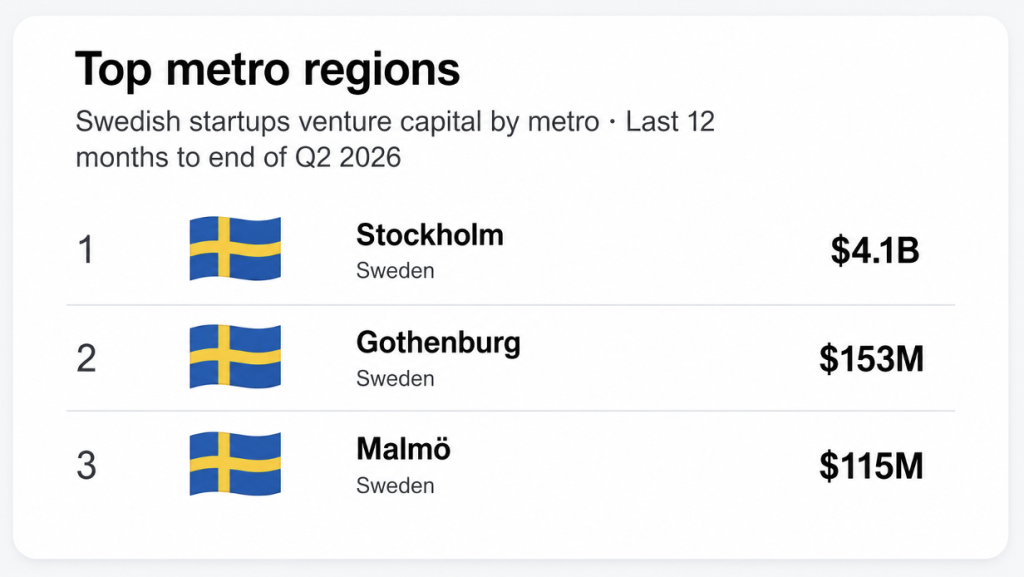
A Stockholm headquarters does not guarantee that the next stage of value creation stays in Sweden. US investors led Lovable’s latest round and Legora’s Series D; NVIDIA joined Legora; Einride chose Nasdaq; Neko is opening American clinics; and Legora is hiring hundreds in New York. The model is concentrated at home, too. Dealroom counted 38 of Sweden’s 58 unicorns in Stockholm and $4.1 billion of venture funding there in the 12 months to the end of Q2 2026, against $153 million in Gothenburg and $115 million in Malmö.
Then there is price. Lovable jumped from a $1.8 billion valuation in July 2025 to $6.6 billion five months later. Legora rose from $1.8 billion valuation in October 2025, then reached $5.6 billion six months later, about 56 times company-reported annual recurring revenue. Durable leaders, or artefacts of a 2026 valuation cycle?
Sweden can build AI winners and keep their headquarters. The unresolved question is how much “Swedish” still means when the capital, hiring and public-market liquidity increasingly sit in America.
Author: Richardson Chinonyerem
See Also:
Finnish AI Startups to Watch in 2026: IQM to QuTwo