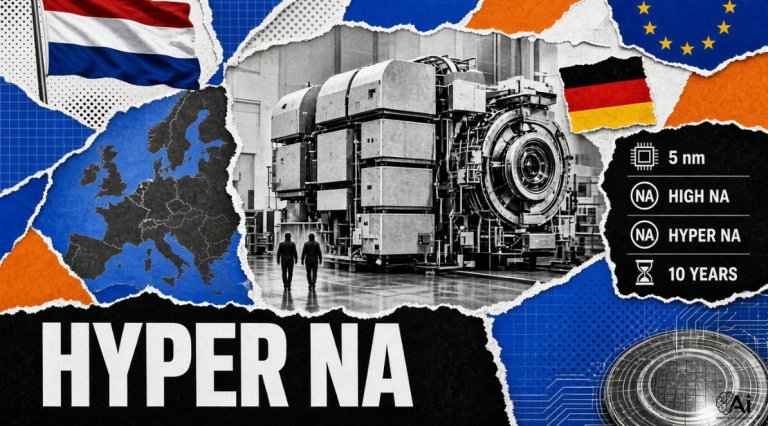

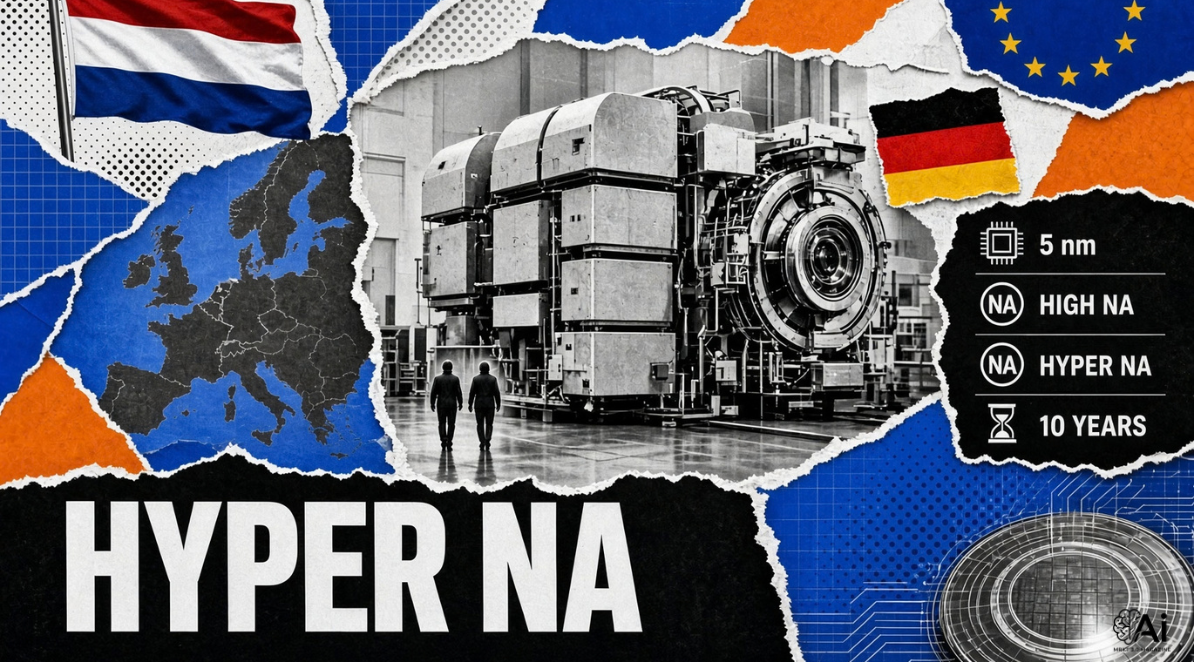
ASML builds the machines that print the smallest lines on a chip, and its current top tool is High NA. Hyper NA, the successor to High NA, is the machine that would come after it, and the engineers working on it do not expect it this decade.
A peer-reviewed paper in the October issue of the Journal of Micro/ Nanopatterning, Materials, and Metrology puts Hyper NA about 10 years out, Reuters reported on October 8. The authors work at ASML and at optics partner Carl Zeiss. The paper says the new tool would print finer circuitry than High NA while using much of the same kit.
ASML has begun developing the machine and has not committed to producing it. The company had no immediate comment. The paper says much of the existing equipment carries over, though challenges remain.
What Could Hyper NA Print?
The paper puts the gain at features as small as 5 nanometres, more than a third smaller than High NA. Smaller lines are what chipmakers use to buy speed and lower power, even as chips stack in three dimensions.
Zeiss can already make mirrors precise enough, the authors say, and ASML’s current extreme-ultraviolet light source can be reused as it is. The machine would be only slightly larger than a High NA tool, which is already the size of a double-decker bus. Beyond Hyper NA, the paper says, tools would likely need a shorter wavelength of light, still a matter for academic research.
Who Is Still Buying the Machine It Replaces?
High NA is only just entering production, which is why a Hyper NA EUV tool about 10 years out would follow a machine most customers have not yet installed.
Intel has begun using High NA in production. Samsung and SK Hynix plan to follow in 2028, and TSMC in 2030, reports indicated last month. On that timetable, Hyper NA would arrive only a few years after the biggest chipmakers adopt its predecessor.
Who Is Trying to Route Around ASML?
The paper says a free-electron laser would not change the design of the lighting system. That is the pitch xLight, a US startup building those sources, is selling: swap the light source, keep the scanner. Substrate, another US startup, is pursuing X-ray lithography instead of extreme ultraviolet.
ASML still holds the monopoly on those tools, which is why it sits at the centre of US export rules while China tries to build its own. Hyper NA is the bet on keeping that lead into the 2030s, if customers will pay for a machine ASML has not promised to build.
Author: Grace Sharp
See Also:
European Tech Sovereignty: ASML’s Crown Jewel in the AI Race 2026
Is China Building Its Own ASML? The Firm That Triggered the Sell-Off
The Cloud Security Act Explained: What It Means for ASML and Europe