
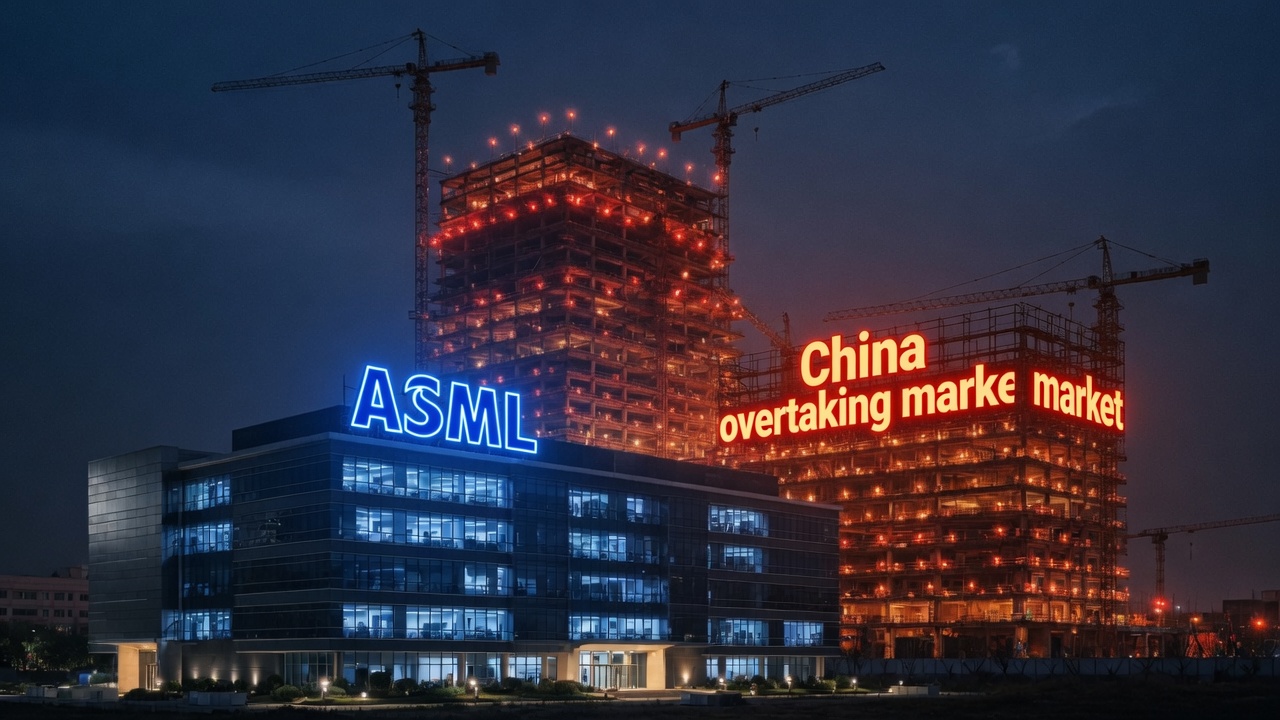
For a decade, the entire Western strategy for slowing China’s chip industry rested on one assumption: that Beijing could not build its own ASML. On 27 July that assumption took its first big hit.
The Information reported that a Shanghai-based, state-backed company has begun mass-producing homegrown immersion DUV lithography machines, the most advanced lithography tool China is still allowed to buy. Investors reacted as if China’s own ASML had arrived overnight, and ASML shed roughly 12% across two sessions.
The interesting angle is what China’s new machines could do to global policy. Export controls were built to keep China dependent on ASML. The first real evidence that China can build the tool itself suggests the controls may be accelerating the very thing they were meant to prevent.
What Did China Actually Build?
The Information described an unnamed, mysterious, state-backed Shanghai firm. Reuters subsequently identified the lead manufacturer as Shanghai Aishengna Electronic Technology Group, which absorbed teams from startups including Shanghai Yuliangsheng.
What is being built is an immersion DUV system, the most capable lithography Chinese manufacturers can still legally obtain after export controls closed the door on ASML’s more advanced EUV technology. The plan, as reported, is roughly five machines in 2026 and about twenty in 2027. This could go to chipmakers including SMIC, Hua Hong and ChangXin Memory Technologies (also known as ChangXin or CXMT). Those first units are for testing and integration, a process that usually takes months before commercial production begins.
Why Did ASML Fall So Hard on So Little?
ASML’s own Q2 results, published on 15 July, put China at approximately 20% of total net sales, on a full-year forecast the company raised to between €43bn and €45bn.
Five domestic machines isn’t actually that much compared to an order book the company describes as being substantially sold out for 2027. One analyst calculated that even twenty Chinese tools next year would cost ASML around €1.4bn in sales, about 2.4% of projected group sales.
So why all the panic? Because the market was not pricing five machines. It was pricing the precedent. The fear is that if China has finally conquered the lithography bottleneck, the rest of the toolchain, deposition, etch and inspection, becomes vulnerable to replacement too. That is a bet on direction, not on this year’s shipments, which is why the shares pared their losses later in the session once the arithmetic sank in.
Is China’s Own ASML a Real Threat?
A JPMorgan analyst called the reaction overblown. They stressed that producing a handful of tools is not the same as producing tools that can run a factory floor. Analysts at SemiAnalysis listed the stack against China DUV: tool performance, scaling production of the machine itself, fleet performance, the surrounding ecosystem, and poor economics against fully depreciated ASML machines, with scaling the machine itself the most underestimated part.
And the frontier is moving away from China, not towards it. While Beijing was assembling its first immersion line, Intel began production use of ASML’s roughly $400m High-NA EUV tool. This is technology that is two to three generations beyond anything China is building and cannot legally buy.
Does This Break the Export-Control Strategy?
Here, the story stops being about a share price and starts being about Brussels and The Hague.
The MATCH Act, still awaiting full passage after clearing the House Foreign Affairs Committee in April, would ban DUV immersion sales and servicing to SMIC, Huawei, YMTC, CXMT and Hua Hong. Allies would have 150 days from enactment to match the US rules. That clock has not yet started, yet the premise on which the bill rests is already under pressure.
Read together, the two events describe a trap. The MATCH Act would force the Netherlands to cut ASML off from its remaining Chinese revenue in the name of keeping China dependent. The homegrown line is early evidence that the dependency is already ending, accelerated by the very controls meant to preserve it. Europe would take the sales hit and the strategic loss at once.
None of this means China has caught up. It means the clock the West is running may be counting down to a strategy that has already expired. ASML will be fine for years. The question the sell-off should have asked is not whether China can dent ASML’s 2027 numbers. It is whether the machine on the bench in Shanghai makes the servicing-chokepoint bet, the one Congress is about to force on Europe, obsolete before it takes effect.

See Also:
MATCH Act Explained: The US Ban on ASML’s China Chip Tools
What Do ASML’s Q2 2026 Results Tell Us About the AI Boom?
What Is Yuanjiwei, the Chinese Startup Promising 5nm Chips Without EUV?