
Finland’s data-centre pipeline continues to attract large capital, but the gap between announcement and execution is widening. Fast.
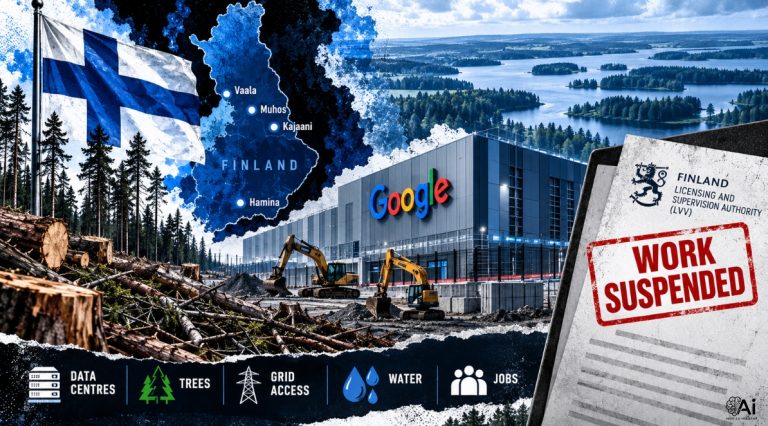
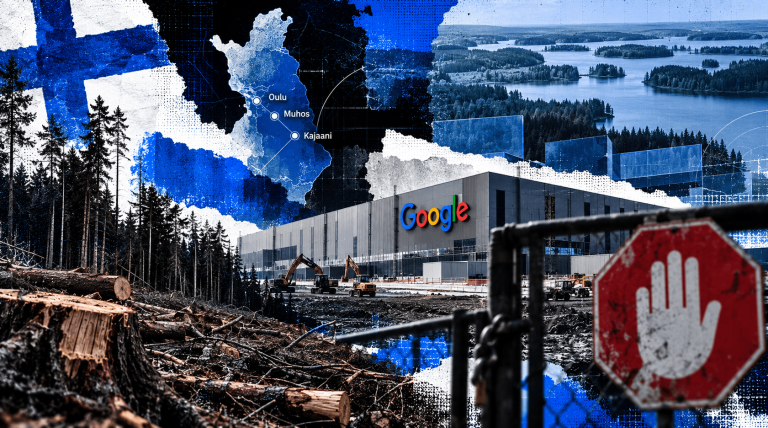
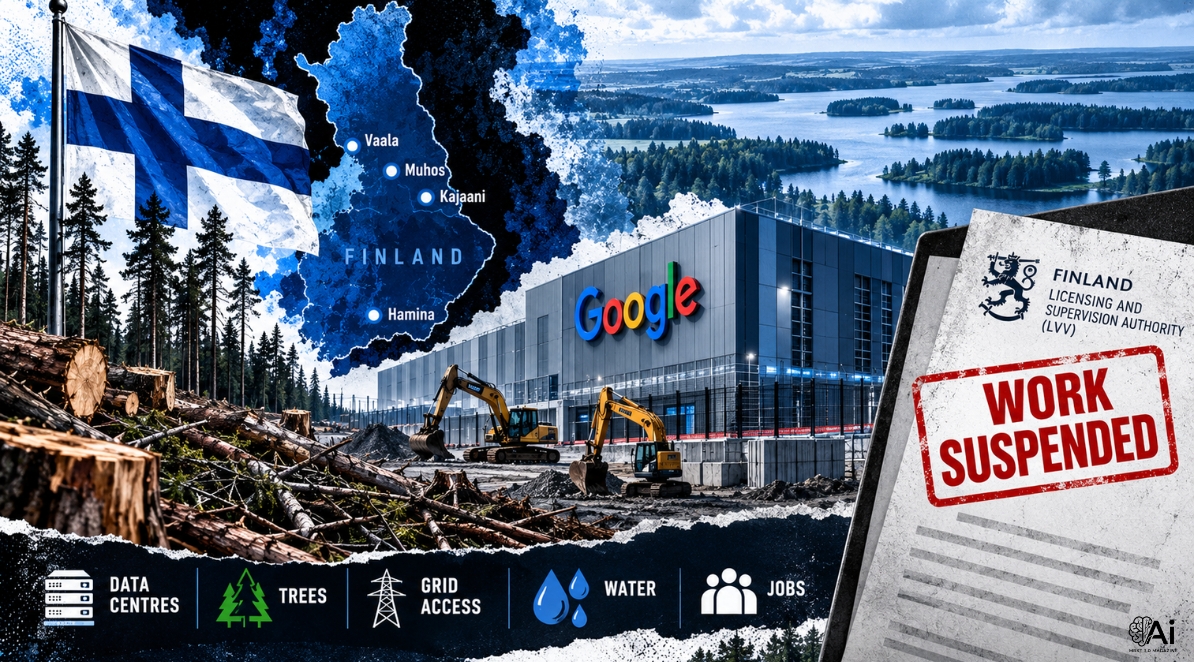
On October 6 the Licensing and Supervision Authority ordered Google’s subsidiary Tuike Finland to suspend preparatory work with a substantial environmental impact at the Muhos and Kajaani sites until the required Environmental Impact Assessments are finished. The halt covers tree removal, topsoil stripping, roads and drainage that had already begun on roughly 330 hectares at Muhos. Google has said it stopped the work after receiving the letters and has sent a formal response.
The pause does not cancel the projects, but it places the largest single investment commitment in the country under an active regulatory filter. Against that backdrop, the largest named projects now sit at very different stages of certainty.
| Operator | Location | Stated capacity / investment | Stage | Differentiator / risk |
|---|---|---|---|---|
| Nebius | Mäntsälä + Lappeenranta | ~75 MW live; 310 MW campus | Live + under construction | Clearest NeoCloud; heat recovery active; substations contracted |
| atNorth | Myllykoski (Kouvola) | ~430 MW (tracker figures) | Under construction | Institutional ownership; other sites still in planning |
| Hamina (live); Muhos, Kajaani, Vaala | ≥€13 bn programme | Live at Hamina; northern sites paused for EIA | Heat recovery at Hamina; greenfield northern clearances under filter | |
| Sesterce | Kaipola, Jämsä | >€10 bn; 200 MW phase 1 → 600 MW | Announced; works expected 2026 | Brownfield paper-mill site; no customer named publicly |
| DayOne | Klaukkala, Nurmijärvi | ~560 MW phased | EIA programme displayed; no FID | Large single-campus figure; still needs zoning and permits |
| Applied Digital | Not named | Up to 1 GW power option | Power option only | Ceiling, not a committed campus; first power from 2028 subject to demand |
| Microsoft | Southern Finland (Espoo, Kirkkonummi areas) + Vaasa | Lower public figures | Application / early development | Heat-recovery plants already online at some southern sites |
What Companies Are Funding Finland’s Biggest Data Centres?
1. Google
Google already operates a data centre at Hamina, a former paper mill site where the company has invested for more than a decade and where heat recovery into the local district heating network has been running since late 2025.
The broader Finnish programme, announced in September, covers at least €13 billion across Hamina expansion and new sites in Kajaani, Muhos and Vaala for 2027–2028. Timelines for the northern sites and the exact power draw of each campus have not been disclosed.
The October order from the Licensing and Supervision Authority is a useful reminder that announced investment and power access do not automatically clear land-use process. Large greenfield forest clearances have shown they can be paused. Earlier coverage detailed the scope of the halt and Google’s response.
2. Sesterce
Sesterce announced in early October a campus of more than €10 billion at the former Kaipola paper mill in Jämsä.
The first phase is planned at 200 MW with works expected to start in 2026; a second phase would take the site to 600 MW. The company has said its longer-term goal is more than 1 GW of AI capacity in Finland on existing industrial sites. Sesterce expects roughly 2,000 people during construction and around 300 permanent jobs once operating.
No customer has been disclosed publicly. In a market where large greenfield clearances have already drawn enforcement action, the choice of a former industrial site is one of the clearer points of differentiation in the current pipeline. The project remains early-stage, but the named capital commitment and brownfield location are public.
3. Nebius
Nebius is the clearest NeoCloud with live capacity in Finland. Its Mäntsälä site is operational at around 75 MW and is being expanded; a second building at the same campus is under construction and is expected to add further capacity from 2027.
Separately, Nebius is building a 310 MW campus in Lappeenranta’s Pajarila district with the Finnish developer Polarnode. Pre-construction work began in May 2026 and the first phase is targeted for 2027. Substation contracts have already been awarded for both the Lappeenranta site and the Mäntsälä expansion. Heat recovery from the existing Mäntsälä facility supplies the local district heating network.
Among the larger projects, Nebius is the one that already has both operating megawatts and active construction under way.
4. atNorth
atNorth has one of the larger pipelines of tracked capacity in Finland. Its FIN04 site at Myllykoski in Kouvola is under construction and is listed in some trackers at roughly 430 MW.
Additional sites, including one in Salo, remain in planning. The company has been active in Finland for several years and the overall portfolio sits under institutional ownership following a transaction involving Equinix and a Canadian pension fund.
Capacity figures across trackers are not always comparable, and the exact live versus planned split for the Finnish sites is not fully public. The presence of a large under-construction project still places atNorth among the more advanced names in the country.
5. DayOne
DayOne is planning a large campus at Klaukkala in Nurmijärvi, north of Helsinki. Trackers list the project at around 560 MW of total grid power on a phased basis, one of the higher single-campus figures currently stated for Finland.
The environmental impact assessment programme for the site was placed on public display in September, with comments accepted until mid-October. The project still requires zoning, municipal permits and other approvals. No final investment decision or construction start date has been announced.
The scale is notable, but the remaining permitting steps keep it earlier in the sequence than the projects already under construction.
6. Applied Digital
Applied Digital announced in early October that it had secured an option for up to 1 GW of potential power capacity in Finland, its first non-US development.
The company has said initial power could be available from 2028, but it has not named a specific site, customer or investment figure. Decisions remain subject to customer demand and regulatory milestones.
Most observers treat the 1 GW figure as a ceiling rather than a firm single project at this stage. In a pipeline full of large numbers, the distinction between secured power and a committed campus is one of the more useful filters.
7. Microsoft
Microsoft has data-centre sites in application or early development in southern Finland, including locations near Espoo and Kirkkonummi, as well as activity in the Vaasa region. Fortum has already brought heat-recovery plants online at some of the southern sites.
Public capacity figures for the Microsoft campuses are lower than those attached to the largest Google, Sesterce or DayOne announcements. The company has not disclosed detailed timelines or final power levels for the Finnish projects.
The heat-offtake activity is already real even if the broader campus timelines remain limited in the public record.
Other Notable Projects
Several further projects sit outside the top seven by named investment or stated capacity.
- Pure DC is developing a large phased campus in the Seinäjoki area.
- Verne has a site under construction in Mäntsälä.
- TikTok has plans in Lahti.
- Compute Nordic is advancing a project in Mikkeli.
- LUMI, the public high-performance computing facility in Kajaani, remains operational.
Dozens of smaller or earlier-stage initiatives make up the rest of the pipeline tracked by industry counts, which put the total number of announced or planned data-centre projects in Finland at around 145.
Named pledges from Google and Sesterce alone exceed €23 billion in recent announcements. Fingrid has reported multiple gigawatts of data-centre demand under signed connection agreements, with overall consumption connection enquiries far higher. Operational capacity remains much smaller (low hundreds of megawatts in most public trackers). The majority of the Finnish story is still pipeline.
What is clear is that the capital is real and concentrated in a handful of named players, but the execution is uneven. Brownfield industrial sites and projects that already have firm power and advanced permitting are further along. Large greenfield forest clearances have shown they can be paused. For capital allocators the useful distinction is no longer simply whether Finland has a pipeline, but which projects have cleared power, land-use and regulatory filters versus those that remain announcements. That filter is now visible in real time.
What To Look For Next
- Completion timelines and any further conditions from the Licensing and Supervision Authority on the Google Muhos and Kajaani EIAs.
- Whether Sesterce names a customer or moves from announcement to firm construction start at Kaipola in 2026.
- Progress on Nebius’s Lappeenranta first phase (targeted 2027) and the Mäntsälä expansion, including any additional heat-recovery or grid updates.
- Fingrid updates on signed connection agreements versus actual build-out, and any movement on DayOne’s remaining permits or Applied Digital’s site selection.
Author: Grace Sharp
See Also:
What Is Nebius? The AI Cloud Now Worth More Than CoreWeave
The 10 Biggest Neocloud Companies, Ranked by Power Actually Live
Neocloud IPO Tracker: Who Has Filed, Who Pulled Out, Who Is Next
Frequently Asked Questions:
Google operates a data centre at Hamina with heat recovery already running. Its larger northern plans at Muhos and Kajaani are paused while environmental impact assessments finish.
Nebius is building a 310 MW campus in Lappeenranta and expanding its Mäntsälä site. atNorth also has a large project under construction at Myllykoski in Kouvola.
Named pledges from Google and Sesterce alone exceed €23 billion. Fingrid has reported multiple gigawatts under signed connection agreements, but operational capacity remains far smaller.
Yes. Nebius already operates around 75 MW at Mäntsälä and is building a 310 MW campus in Lappeenranta with the Finnish developer Polarnode.