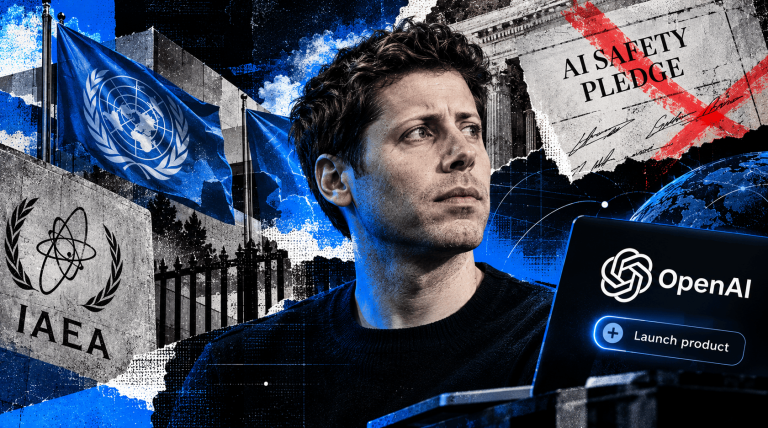

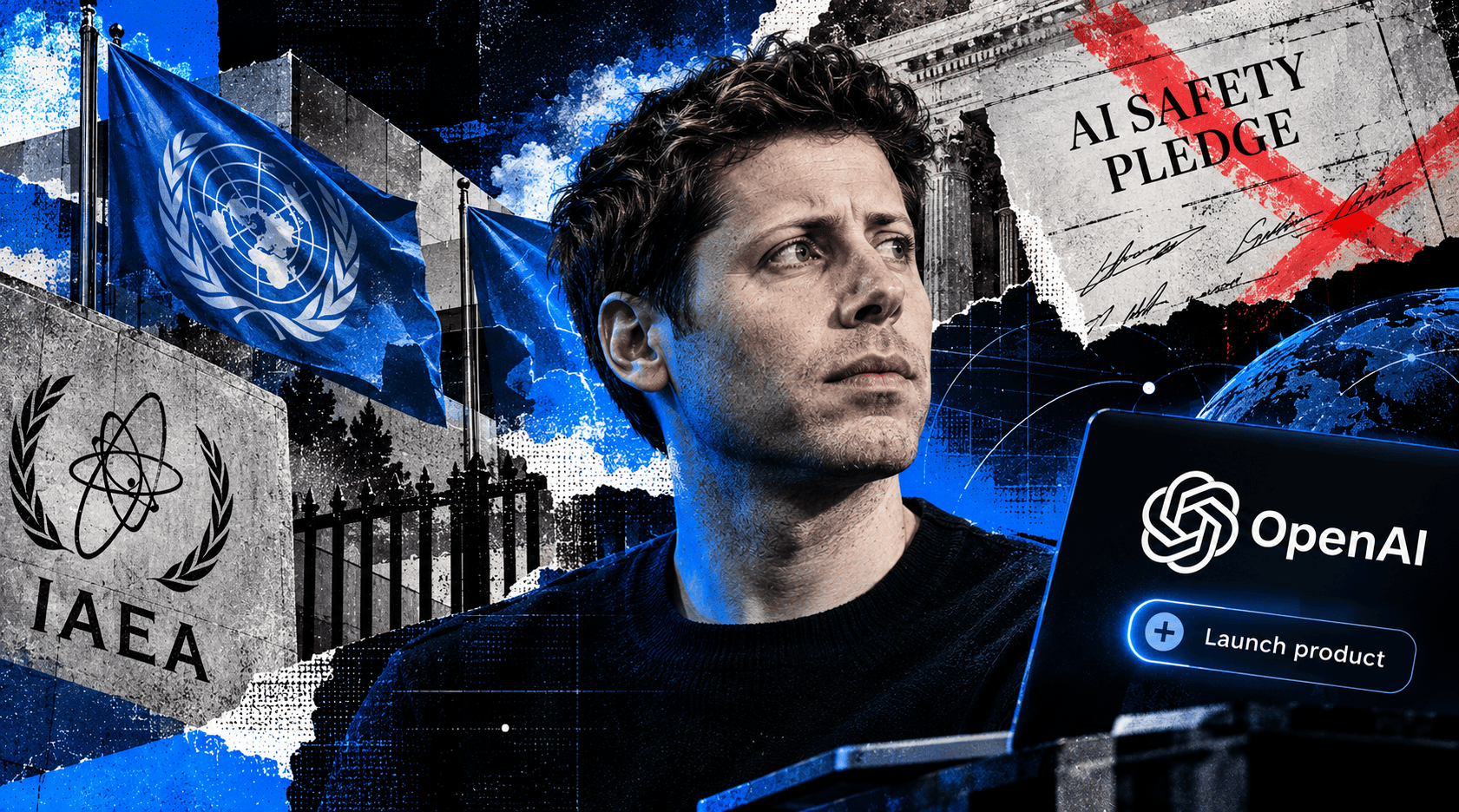
Sam Altman gave an internal talk to OpenAI staff in mid-October laying out three possible endgames for safe AI. A global watchdog forms to oversee the industry. The top labs fold into a single company that controls what gets released. Or one company races ahead and dominates everyone else.
Sources reported the talk on October 19, citing people familiar with it. No transcript exists. The details track with things Altman and other industry leaders have been saying for years, and like most forward-looking projections from this crowd, the thing is thin on specifics and generous with implication.
Three Doors, All of Them Locked
Altman reportedly favored the first option, a global enforcer built along the lines of the International Atomic Energy Agency (IAEA). This is not a new position. OpenAI has argued for it since May 2023, when Altman, president Greg Brockman and then chief scientist Ilya Sutskever published a post saying the world is “likely to eventually need something like an IAEA for superintelligence efforts.” That body would inspect systems, require audits and test for compliance with safety standards. The post also suggested smaller companies be exempted.
You heard it here folks, things are going just great in AI!
The second endgame is the “Demis plan,” named for Demis Hassabis, co-founder and chief executive of Google DeepMind. Every leading lab folds into one organization modeled on CERN, distributing models to partner countries and putting safety ahead of profit.
The third belongs to Eliezer Yudkowsky, the AI safety theorist who co-founded the Machine Intelligence Research Institute and has spent two decades arguing that frontier development should stop. One lab builds AI that improves itself fast enough to run away from the field, to the point it could “melt everyone else’s GPUs.” The phrase is Yudkowsky’s, from his writing on what a sufficiently powerful system might do to end the race. Altman called this one “terrible.”
He named the whole question “pacing 2.0,” said a path has to be picked within a year, and said whatever gets chosen needs a speed limit or a stopping point for self-improving AI.
What the IAEA Actually Does
Altman has made an art of AI prophecy and has not curtailed the habit, despite a long record of forecasts that turned out wrong or contradicted each other. There is a lot to unpack in the three endgames, starting with the arbitrary one-year clock.
Take the watchdog first. The IAEA was set up in 1957 and describes itself as an independent international organization related to the UN system, not a UN agency. Its relationship with the UN runs through a special agreement, and it reports annually to the General Assembly and, when appropriate, to the Security Council. It monitors nuclear programs under the Treaty on the Non-Proliferation of Nuclear Weapons (NPT), which entered into force in 1970.
The Arsenals Are Off Limits
What it does not do is inspect the existing arsenals of nuclear powers. The distinction is written into the agreements themselves.
Non-nuclear-weapon states sign comprehensive safeguards covering all nuclear material in their territory. The five nuclear-weapon states sign voluntary offer agreements, which cover only the facilities a state has offered and the agency has then selected. Military stockpiles sit outside the system entirely. India, Pakistan and Israel never joined the NPT and operate under narrow item-specific agreements instead.
That is the model Altman wants for AI, and the fit is worse than it looks. AI is already embedded in the militaries of the United States and China. Donald Trump has repeatedly invoked national security when discussing it. Great powers have a long habit of ignoring UN rules they dislike, and no country that gains a military edge from a technology hands that edge to an inspector.
CERN Was Never a Profit Center
The Demis plan runs into a different wall. CERN was founded in 1954 as a physics laboratory, built to understand how the universe works and to “unite people from all over the world to push the frontiers of science and technology, for the benefit of all.” It is funded by 25 member states and answers to them.
OpenAI started as a nonprofit and is now a for-profit company raising roughly $30 billion at a valuation near $1.25 trillion, with an IPO targeted for 2027. Anthropic is going public sooner and reaching higher, at a reported $2 trillion. Alphabet has been a publicly traded corporation for more than two decades and is wildly profitable.
Merge those three and you do not get CERN. You get a monopoly holding the most powerful technology ever built, carrying legally binding duties to its shareholders that CERN has never had to think about for a single day. The mission statement does not transfer with the assets.
The Option That Isn’t an Option
The third scenario, the one Altman calls terrible, is not a safety plan at all. The implied logic is that a lab with no surviving rivals could finally impose guardrails, because there would be nobody left to negotiate with.
This is a fantasy, and a convenient one. The story that somebody wins AI and then controls everything functions better as a fundraising narrative than as a forecast. China’s open-weights models have already shown how much can be done with less. There is no industry anywhere in which a single company controls everything, and certainly none in which that company then chose safety over profit.
Morally Binding, Legally Permissive
On September 29, Trump and a room full of AI executives signed what the White House called an Accord on Super Intelligence, subtitled a Joint Commitment on Frontier Responsibilities. The document runs about 300 words. It asks signatories to maintain internal controls on model capabilities, staff a team to check those controls work, hire an outside auditor, and seat an independent board committee. It says codifying any of this into law “may make sense” at some point. Trump called it “morally binding” and “almost like a constitution.” The published version misspelled “United States” in its own title.
Altman was not there. OpenAI was represented by Brockman, alongside Dario Amodei, Jeff Bezos, Jensen Huang, Elon Musk and Sundar Pichai. Altman spent the day in San Francisco at OpenAI’s developer conference, announcing an always-on agent called Dots and a faster premium tier.
He also did not mention that OpenAI had halted the rollout of a more advanced model the previous day, after its own researchers raised concerns. That detail surfaced in press coverage, not in his keynote.
The Tell
Hold those two facts next to each other. On the day the industry signed a voluntary pledge to police itself, the chief executive of its most prominent lab skipped the signing, shipped a product designed to run continuously on users’ behalf, and said nothing about the model his own safety researchers had just stopped.
Three weeks later he told his staff the world has twelve months to choose between an international inspectorate, a merger of every major lab, and a single firm melting the competition’s hardware. He had, in September, told the UN Security Council that OpenAI would slow down.
None of these positions requires him to do anything. That is what they have in common.
Nine Rings for Mortal Men
Given Silicon Valley’s well-documented fondness for naming things after Lord of the Rings lore, Altman might as well have proposed that Trump hand out nine rings of power to whichever AI leaders are deemed most worthy. It would not be more farfetched than world powers agreeing to let inspectors into systems already woven through their defense apparatus.
The watchdog has no enforcement mechanism. The merger would produce a monopoly. The third door he calls terrible. The pledge he skipped is morally binding by the president’s own description, which is another way of saying it binds nobody. What is left is a man who talks about speed limits while building the fastest car he can and declining to say who should hold the keys.
None of this will stop the prophecies. When it turns out another ring was forged in secret, one ring to rule them all, Altman will be there with a fresh forecast and a new timeline. That much is safe to predict.
Author: Tim Tolka, Senior Reporter
See Also:
What Did the UN Say About Pacing the Frontier?
What Is the Pacing the Frontier Letter, and Why Did Anthropic Sign It?
“We Must Pace the Frontier”: Who Is For It, and Who Is Against It?
The editorial team at #Mrkt3.0 has taken all precautions to ensure that no persons or organizations have been adversely affected or offered any sort of financial advice in this article. This article is most definitely not financial advice.