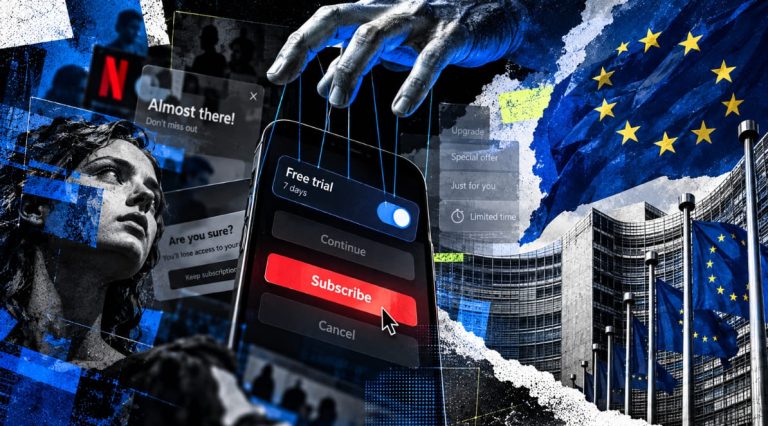

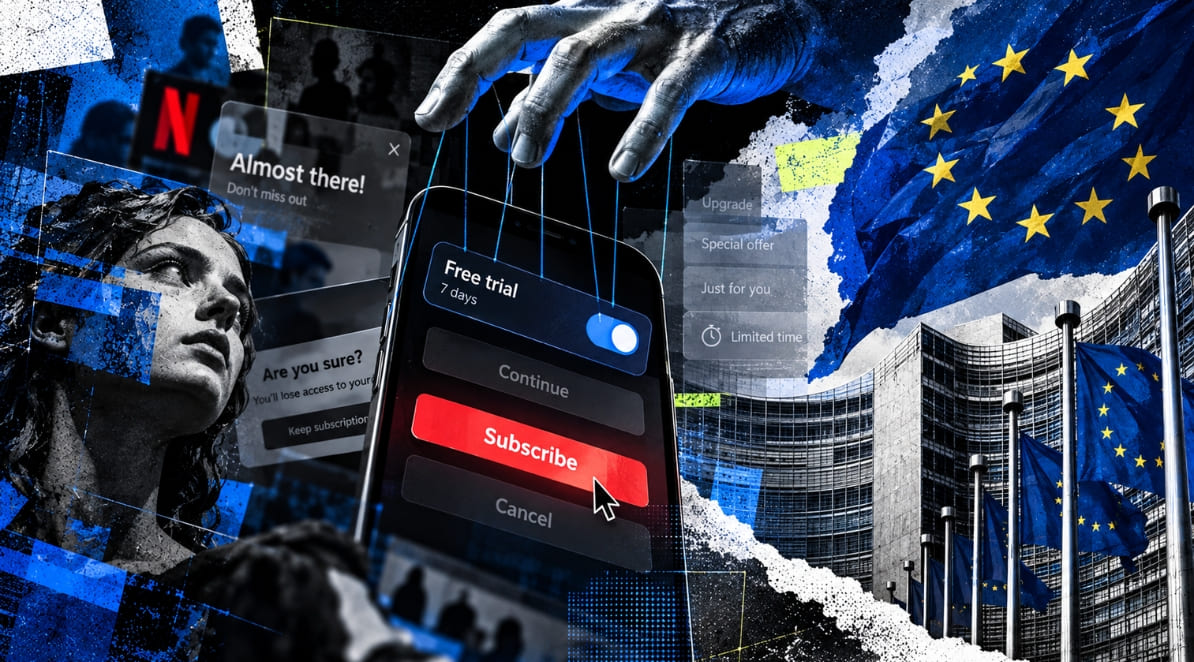
When a free trial silently converts or cancellation takes multiple buried clicks, the friction is rarely accidental. The European Commission’s 2024 Digital Fairness Fitness Check found that unfair online practices cost EU consumers close to €8 billion a year. This figure underpins the upcoming Digital Fairness Act.
The Digital Fairness Act, expected around November 11, 2026, will tighten rules on dark patterns, addictive design, subscription traps, influencer marketing and unfair personalisation. It sits alongside the EU’s KIDS Act and Digital Services Act (DSA) but applies more broadly to adult consumers.
The closest existing benchmark is Amazon’s 2022 commitment to let EU customers cancel Prime in two clicks, secured only after the European Commission had pressed the point for over a year. The new Act would turn that one-off outcome into a general rule.
What the Digital Fairness Act Is and When It Arrives
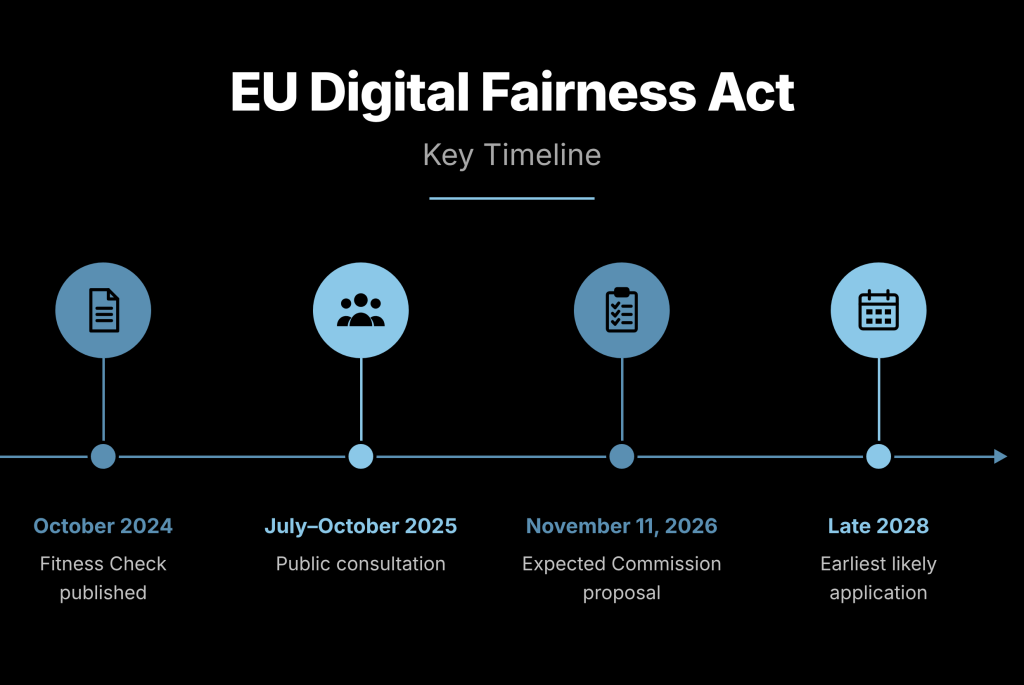
Existing consumer rules remain relevant but only partially deliver high-level protection once products and services move online. The Digital Fairness Act is a consumer law instrument that builds directly on the Fitness Check of EU consumer law on digital fairness, published in October 2024. The Fitness Check concluded that the Unfair Commercial Practices Directive, Consumer Rights Directive and Unfair Contract Terms Directive remain necessary but only partly effective in digital environments. It estimated consumer detriment around €8 billion a year, while the cost to business of complying with existing consumer law is no more than €737 million.
After the 2024 Fitness Check showed gaps in consumer protection online, President Ursula von der Leyen asked Commissioner Michael McGrath to prepare a Digital Fairness Act. The Commission ran a public consultation in October 2025 and now expects to publish the proposal on November 11, 2026. Application is unlikely before late 2028.
What the Digital Fairness Act Is Expected to Cover
The Commission has signalled six key areas of commercial practices that current rules only partially address:
| Area | Examples of practices expected to be in scope |
|---|---|
| Dark patterns | Countdown timers, pre-selected options, misleading buttons |
| Addictive design | Infinite scroll, autoplay, rewards, penalties for disengagement |
| Subscriptions and digital contracts | Silent free-trial conversion, hard cancellation, missing renewal notices |
| Influencer marketing | Inadequate disclosure, pressure on brands and agencies |
| Unfair personalisation | Pricing or targeting that exploits financial stress, emotional state or age |
| Game mechanics | Loot boxes, pay-to-win features, in-game currencies |
It remains open whether the final text will use a banned list of practices, a general fairness clause that enforcers interpret, or both. It is also not yet confirmed whether the Act will be a standalone instrument or targeted amendments to the existing consumer directives.
Who It Hits
The rules are expected to reach any trader offering digital products or services to EU consumers, regardless of size. Platforms, streaming services, e-commerce sites, app developers, gaming companies, travel and ticketing platforms and any business relying on subscription models or personalised interfaces will fall within scope.
The exposure is extremely wide because the Digital Fairness Act is a consumer law, it is not based on simply how large a platform is. Small firms who previously relied on general consumer law will need more specific compliance.
The Act is likely to place particular focus on subscription services (streaming, cloud, SaaS, news) and on personalised pricing, including in sectors such as transport, live entertainment, culture and sport. Influencer marketing agencies and brands using influencer content will face clearer disclosure and accountability expectations.
How It Sits with the DSA, KIDS Act and AI Act
The new rules are intended to fill gaps left by existing digital and consumer legislation rather than replace them. The Digital Fairness Act will work alongside the DSA and will be a complementary consumer-protection instrument rather than replace it. The DSA already targets manipulative interface designs and certain obligations for protecting minors. Recent DSA enforcement has already produced substantial fines. The Digital Fairness Act extends the fairness lens to adult consumers and commercial practices. Traders who previously fell outside the DSA’s scope will now be forced to comply.
The proposal is also expected to be accompanied by a revision of the Consumer Protection Cooperation Regulation, which governs cross-border enforcement. Industry groups have already argued that many of the targeted practices are covered by existing rules and that stronger enforcement should take priority over new legislation; the Commission has said it intends to avoid unnecessary duplication.
The forthcoming KIDS Act focuses more tightly on age rules, safety-by-design for services used by children, and restrictions on addictive features aimed at minors. The Digital Fairness Act addresses wider fairness concerns that affect adults too.
The AI Act already prohibits certain manipulative techniques that cause significant harm or that have addictive features. The Digital Fairness Act approaches similar territory from a commercial-conduct angle, whether or not AI is involved. Overlap exists where AI companies use personalisation or systems which exploit vulnerabilities. The Commission has stated its intention to avoid unnecessary duplication, conflicting obligations or enforcement gaps while closing remaining consumer-protection gaps.
What It Means for Product Design
Cancellation flows are the clearest near-term test. The Amazon outcome of a visible button, two steps and no distracting warnings is the benchmark regulators already uphold. Under the Digital Fairness Act, leaving a subscription should be as easy as joining. Companies will also face expectations of clearer pre-contractual information, renewal reminders and price-rise notices.
Engagement features raise larger commercial questions. If autoplay, infinite scroll and streak mechanics must be off by default, retention models built on them will need a different justification. Fairness and safety by design and by default become the rule, with users able to opt in. Product and growth teams will need to ensure choice architecture and commercial flows meet explicit digital-fairness standards. Harder cancellations, defaults that favour higher-spend options, unsubstantiated scarcity or emotional messages, and personalisation that targets vulnerability all move into higher-risk territory.
What It Means for Compliance and Investors
Compliance work and investor risk both turn on how far the new rules reach into existing commercial models.
Compliance teams will need to watch the burden of proof. Under the Digital Fairness Act, companies may need to map existing interfaces against the Fitness Check findings. The KIDS Act already requires platforms to demonstrate safety by design, so firms that keep design rationales, test results and consent flows on file are likely to be better placed. This, however, is an inference drawn from the KIDS Act, not a confirmed feature of the Digital Fairness Act.
For investors, the exposure and financial risk lies in a company’s profits and business practices. Investors should examine whether a company’s profits rely on consumer practices that regulators might restrict including: auto-renewals, engagement-driven advertising, personalised pricing and in-game spending. Companies could lose revenue if consumer protection laws restrict these practices and tighter consumer protections could reduce future earnings.
Founders and investors should factor in compliance timelines. While proposals will arrive within weeks, the multi-year legislative process and transition period means there is still room to adjust before mandatory application and compliance. Enforcement will rely on existing consumer-protection authorities and updated CPC frameworks.
Companies may face financial penalties under more than one regulatory framework, increasing costs and uncertainty for investors. Companies already investing in transparent design will face lower adjustment costs; those that depend on friction face more material change.
What to Watch on November 11
The proposal will not reinvent consumer law. It aims to make the existing framework fit data-driven commercial practices and attention-economy design that the 2005–2011 directives never fully anticipated. Everyday design and commercial choices that once sat in a grey zone will now be tested against a more precise fairness standard. Preparing for the audit is cheaper than redesign under time pressure later.
When the text lands, four points will show how far the new rules reach:
- Whether the Commission opts for a banned list of practices, a general fairness clause, or both.
- Whether addictive features (infinite scroll, autoplay, streaks) are prohibited, must be off by default, or left optional.
- How personalised pricing is treated, especially where it exploits financial stress, emotional state or age.
- How the proposal relates to DSA Article 25 and the existing consumer directives, and whether it creates duplication or closes genuine gaps.
Author: Alice Hitchens
See Also:
Meet the People Behind Europe’s AI Regulation
Digital Services Act Fines Hit €870 Million: X, Temu and AliExpress
EU KIDS Act Explained: Age Rules, AI Companions and the Verification Gap
Frequently Asked Questions
A forthcoming EU consumer law instrument expected to tighten rules on dark patterns, addictive design, subscription traps, influencer marketing and unfair personalisation. It is not yet law.
The Commission proposal is widely expected on 11 November 2026 as part of a Consumer Package. Application is unlikely before late 2028.
The DSA already covers some manipulative interfaces and minor-protection duties. The KIDS Act focuses on children. The Digital Fairness Act extends fairness standards more broadly to adult consumers and commercial practices across sectors.
It is expected to address both. Whether through a banned list, a general clause, or requirements that certain features be off by default remains open until the proposal is published.
Any trader offering digital products or services to EU consumers. Scope is not limited by platform size the way the DSA is.