
Europe’s AI data center build is leaving the five cities that concentrated most of the continent’s commercial computing capacity. Power availability and permits, rather than pure demand or latency, now determine where the largest new campuses are built, and the destinations already have active local disputes.
What Is FLAP-D?
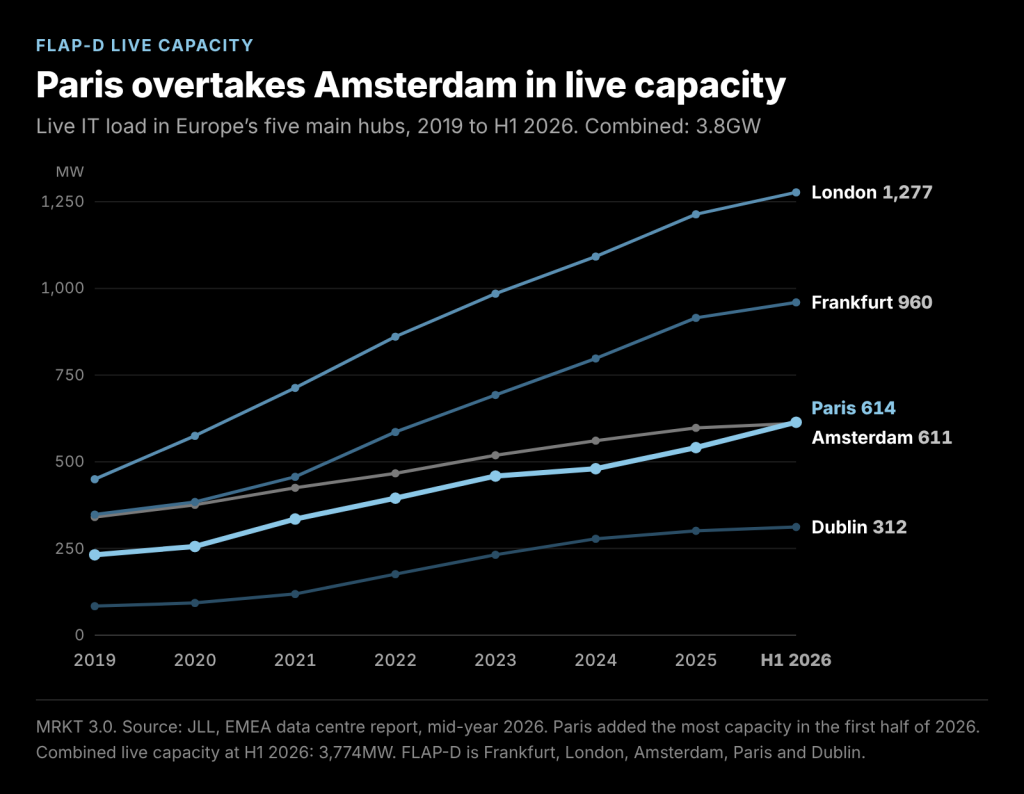
FLAP-D stands for Frankfurt, London, Amsterdam, Paris and Dublin, Europe’s five core data center markets. Together they held about 3.8 GW of live capacity in the first half of 2026, up from 1.8 GW in 2019. Paris led first-half deliveries with 72.5 MW. Another 1.4 GW is under construction and 2 GW is planned.
The hubs grew because businesses wanted servers close to their users. Financial centers were early buyers, paying for lower latency to support high-frequency trading, while Dublin’s growth came from hyperscale cloud operators. Banks, enterprises and network operators still cluster in these cities, and workloads that depend on low latency continue to stay in primary markets.
Why the Hubs Are Full
Colocation vacancy across FLAP-D fell to 6.4% in the second quarter of 2026, down from a 16.9% peak in 2021. Frankfurt is the tightest at 3.1%. Prime powered land now costs €2.26 million per megawatt, 82% more than in 2021.
Power is the main constraint. According to reports, grid lead times in primary markets can reach 10 years, and Frankfurt’s can run to 24 months or more.
National rules add to the pressure. The Netherlands capped hyperscale grid connections at 70 MW in 2022 and limited new hyperscale sites to two designated areas. Ireland’s Commission for Regulation of Utilities now requires large new data centers to bring their own dispatchable generation or storage and match 80% of annual demand with new Irish renewables, under a policy finalized in December 2025. The framework, live since March 31, is pushing developers toward regional Irish sites.
Price follows scarcity. Capacity pricing in the five markets is expected to rise an average of 12% in 2026, with 20 MW-plus deals reaching £145/kW in London and €145/kW elsewhere.
Where New Capacity Is Heading
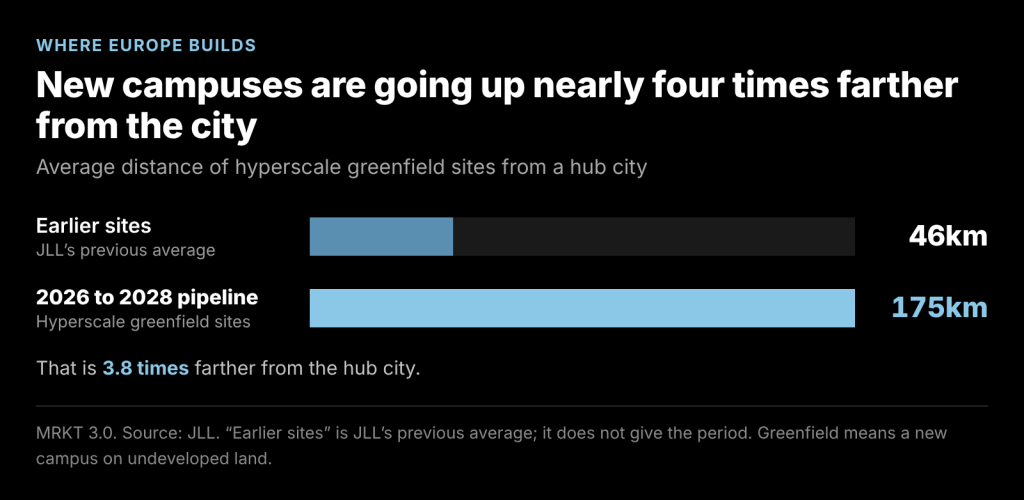
New campuses are moving further out. Hyperscale greenfield sites in the 2026 to 2028 pipeline sit an average of 175 km from a hub city, up from 46 km, and greenfield’s share of the pipeline has risen to 39%, up from 8% in the previous three years.
“The determining factor is increasingly where sufficient power can be secured, rather than simply where demand exists,” said Assad Noori, JLL’s head of data centers for work dynamics in EMEA. JLL names Milan, Iberia and the Nordics as the regions attracting capital and expects over half of Europe’s AI growth to occur in the Nordics and Tier 2 markets.
The shift is already visible in the numbers. Secondary and tertiary markets accounted for 55% of European take-up in the second quarter, and FLAP-D received only about 37% of the roughly 700 MW delivered. Research projects that half of Europe’s data center capacity will sit outside the traditional hubs by 2035.
Opposition in the Next Wave Regions
Each region named as a destination has an active dispute.
In the Nordics, Finland’s Supervisory Agency ordered Google’s local entity to suspend preparatory work at its Muhos and Kajaani sites by October 23, while it investigates whether more than 300 hectares of forest were cleared without an environmental impact assessment. Google announced a €13 billion investment in Finland in September. “We have fallen short of our own high standards in this instance,” spokesman Sondre Ronander said.
In Iberia, Aragon expects more than €60 billion of data center and digital investment over the next decade, including Microsoft’s plan for up to €10 billion. Ecologistas en Acción has filed what is reported to be Spain’s first lawsuit against a major data center, challenging the fast-track approval of Amazon’s project. Madrid’s draft decree would require facilities above 1 MW to source at least 80% of their power in every operating hour from new renewables.
In regional Germany, residents protested a proposed 700 MW, €25 billion campus outside Freyenstein in Brandenburg. In southeast France, the Grenoble administrative court suspended the building permit for Sesterce’s 40 MW AI site at Alixan in July after a residents’ collective challenged it.
Scotland’s Parliament passed a non-binding vote on September 16 stating that no AI data center planning decisions should be made until national guidance is published. Scotland has 24 proposed data centers, and a near 1 GW campus at Chapelcross drew over 1,000 objections in 48 hours.
FLAP-D Is Still Growing
The hubs are still adding capacity. Reports forecast about 453 MW of new FLAP-D supply in 2026, and its report states, “growth is broadening, not relocating.” Primary markets still command a 2.3x price premium over secondary ones, and Frankfurt alone has 311 MW in development and 687 MW planned.
The split is by workload. AI training clusters of 100 MW or more do not need low latency, so they follow cheap, available power. Latency-sensitive enterprise workloads are staying in the hubs.
Dates Worth Watching
The EU’s call for up to seven AI gigafactories is the next date to watch. The program is backed by up to €10 billion in EU and national funding. EuroHPC’s July launch notice set a November 12 deadline; a TED change notice published in October extended it to December 3, 17:00 CET, which is the date now shown on the official tender page. Selection is expected in early 2027.
Spain’s government aims to approve its data center decree before the November 29 general election, and the next government could revise it. Scotland’s ministers have promised planning guidance by Christmas. Finland’s investigation will determine when Google’s sites restart.
Author: Ayanfe Fakunle
See Also:
Who Is Fighting Data Centres in Europe? The 2026 Opposition Map
Where Will Europe Actually Put Its Data Centres?
How We Checked This:
Figures come from JLL’s EMEA data centre mid-year 2026 report, CBRE’s May capacity pricing forecast, Ember’s grids analysis, and primary reporting on individual projects and regulatory actions. No source names a coiner of the FLAP-D term, so none is given here.