
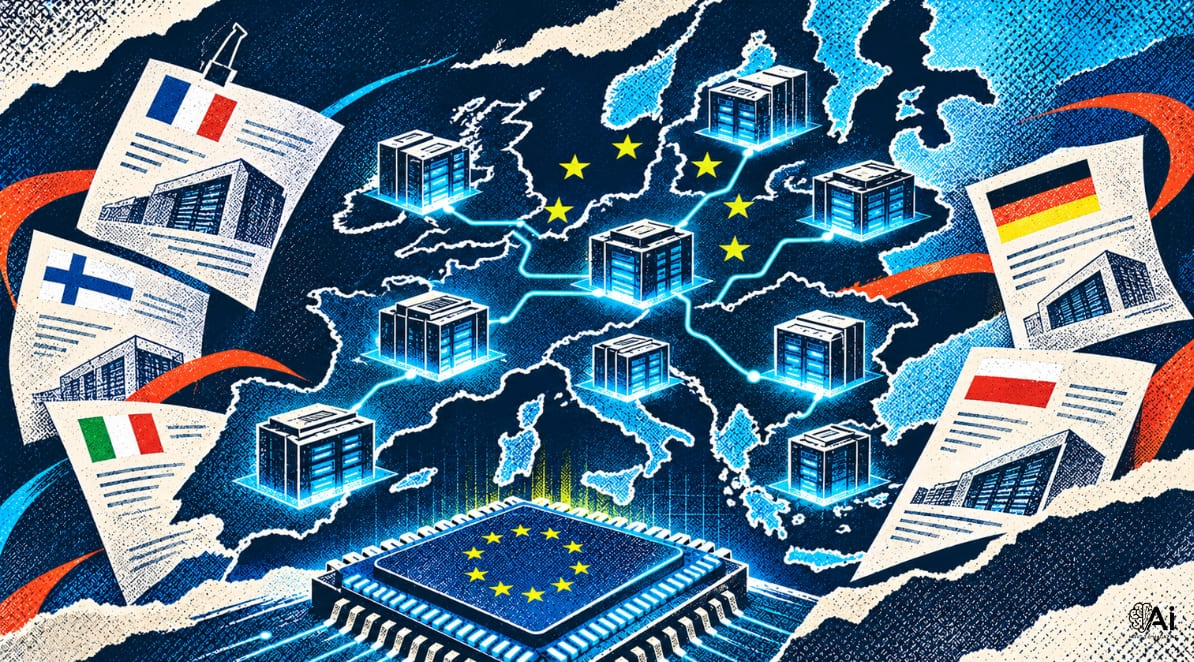
Europe’s plan for AI gigafactories is framed as a €30 billion programme. Only up to €10 billion of that is expected from public sources (EU funding matched by participating states). At least €20 billion is meant to come from private investors. Of the EU’s contribution, up to €1 billion is available for Phase 1 under the current budget. The additional €4 billion envisaged for Phase 2 depends on the next Multiannual Financial Framework (2028–2034).
The European Commission and EuroHPC Joint Undertaking opened the call on July 30, 2026, for up to seven facilities across at least seven member states. Eighteen countries signed the joint procurement agreement. The Netherlands did not. On November 5 EuroHPC voided all drafts and submissions already in the system for technical reasons and required them to be recreated and resubmitted. Awards are targeted for early 2027, with construction starting that year and Phase 1 operations required within 18 months of contract signature.
This is not a conventional data-centre funding round. It is a joint procurement of computing capacity, subject to EU control tests, data rules and a Phase 2 budget that has not yet been secured. Those conditions will decide which bids advance as much as the chips themselves.
Which Consortia Are Bidding for Europe’s AI Gigafactories?
Interest has clustered around a few named groups. On November 5 EuroHPC invalidated every draft and completed submission already in the system and told bidders to recreate and resubmit them. The call documents did not change. None of the publicly announced consortia has confirmed that it has filed a final resubmission.
| Country | Bid | Reported members | Status |
|---|---|---|---|
| France | AION | Led by Scaleway (iliad Group) with Ardian, Artefact, Bull, Capgemini, EDF, Orange and others. Broader ecosystem includes Hugging Face, Nokia, Schneider Electric | Announced May 20 2026. Publicly reported as a multi-billion project (around €10 billion) for a single site. One of the most fully assembled industrial consortia |
| France (Strasbourg) | ÆTHER | 2CRSi (initiator) with SiPearl, Axelera AI, Viridien, OUTSCALE, Électricité de Strasbourg, Equans, Nhood and others | Two industrial sites under negotiation. Initial combined capacity of roughly 42 megawatts, with a longer-term trajectory toward 400 megawatts if grid capacity allows |
| Italy | State-backed NewCo / Eni-led | Eni, Enel, Terna, Snam, Saipem, Leonardo, FiberCop, CDP | Still being finalised with the Treasury. Government has signalled strong intent to host |
| Finland / Nordic-Baltic | AI Gigafactory Northern | Nokia, Nscale, Skeleton Technologies, Telia, Verda | Announced November 16, 2026. Federated multi-site proposal spanning Oulu (Finland), Iru (Estonia), Valmiera (Latvia) and a Swedish site still to be named. Intends to bid |
Other signatory states, including Germany, Poland, Czechia, Denmark, Greece, Portugal and Spain, have been reported as interested in hosting. Detailed public consortia and firm site commitments remain limited or confidential.
How Much Public Money Is Actually Available for AI Gigafactories?
The €30 billion figure is a mobilisation target. The Commission has said public support will reach up to €10 billion, with EU funding of up to €5 billion matched by participating states. Private investment is expected to supply at least €20 billion. The EU contribution is capped at the lower of the relevant funding ceiling or 17% of the project’s eligible IT capital expenditure (IT CAPEX).
Up to €1 billion is available for Phase 1 under the current EU budget. That contribution becomes legally committed through the relevant contracts once they are signed. The additional €4 billion for Phase 2 depends on the 2028–2034 Multiannual Financial Framework, plus any successor arrangement to EuroHPC and matching national funds.
| EU money | Lot 1 (up to 4 medium sites) | Lot 2 (up to 3 large sites) | Total |
|---|---|---|---|
| Phase 1, per site | €100 million | €200 million | |
| Phase 1, all sites | €400 million | €600 million | €1 billion |
| Phase 2, per site | €400 million | €800 million | |
| Phase 2, all sites | €1.6 billion | €2.4 billion | €4 billion |
| Maximum per site, both phases | €500 million | €1 billion | |
| Maximum all sites | €2 billion | €3 billion | €5 billion |
Three features of the design matter (drawn from the call page and tender specifications):
- Public money buys computing time under long-term offtake contracts. It is not a construction grant.
- The EU pays the lower of the stated ceiling and 17% of computing capital expenditure. Sites are expected to cost at least €4 billion–€5 billion each.
- Only the Phase 1 envelope is available under the current budget. Phase 2 remains contingent on the next Multiannual Financial Framework.
Awards are made in ranking order only up to the available budget, so fewer than seven sites could be selected.
What Rules Decide Who Wins the AI Gigafactory Bids?
The selection process is a joint procurement under the amended EuroHPC Regulation. The legal basis is Council Regulation (EU) 2021/1173 as amended by Regulation (EU) 2026/150 in January 2026, which added AI gigafactories to EuroHPC’s mandate.
Who can bid and who controls the vehicle. The coordinator must be incorporated and headquartered in the EU and effectively controlled by EU member-state entities or EU nationals. The control test looks through the full ownership chain; a minority veto can count as control. Non-EU members and non-EU capital are permitted provided they confer no direct or indirect control. Major ownership changes require approval from a public governance body that includes the Commission and signatory states.
Where the data sits. Core operational data must be stored and processed in the EU, under the jurisdiction of a member state, and protected from third-country access. Core technical operations must remain under EU-based operational oversight and be performed within the EU by qualified personnel. Subcontracting is permitted, including by third-country entities, provided sovereignty and security requirements are maintained. Customers may still retain operational autonomy over their own partitions. Every host state must supply a formal letter of commitment or the bid is ineligible. Winning facilities must also comply with GDPR, the AI Act and applicable cybersecurity rules.
What Scale and Power Must AI Gigafactories Deliver?
The reference point in the call is JUPITER in Jülich, treated as roughly 24,000 H100-equivalent accelerator chips. An H100-equivalent is a performance unit rather than a literal chip count. The minima below are taken from the tender specifications.
| Phase 1 minimum | Phase 2 minimum | Phase 2 Power (IT Load) | |
|---|---|---|---|
| Lot 1 (medium) | 25,000 H100-eq accelerators | 75,000 H100-eq accelerators | 120 megawatts |
| Lot 2 (large) | 40,000 H100-eq accelerators | 100,000 H100-eq accelerators | 150 megawatts |
Across four medium and three large sites the Phase 2 minima would total at least 600,000 H100-equivalents and 930 megawatts of IT load. IT load excludes cooling and losses, so actual grid demand would be higher. Bidders may propose lower power figures if they can justify them. The call also sets sustainability and energy-efficiency requirements, but it does not impose a fixed minimum share of renewable power.
How Are AI Gigafactory Bids Scored?
Evaluation is staged. The weights below are from the tender specifications.
| Stage | Criterion | Weight |
|---|---|---|
| Part 1 | Technical quality | 40% |
| Part 1 | Impact | 20% |
| Part 1 | Financial feasibility | 40% |
| Final Ranking | Part 1 score | 50% |
| Final Ranking | Scale and service quality | 25% |
| Final Ranking | Performance-adjusted cost | 25% |
Financial feasibility carries equal weight with technical quality in the first stage. It covers the financing package, debt-to-equity ratio and cost of capital. A technically strong bid with weak funding will lose ground early. Plans to deploy European-controlled software earlier attract higher technical scores.
Why Did the Netherlands Stay Out of the AI Gigafactory Programme?
The Netherlands did not sign the joint procurement agreement and therefore sits outside the EuroHPC tender. Reporting indicates the government was unwilling to reserve the scale of public money or pre-commit to offtake that participation would have required.
Separately, private developer VOLT is advancing a multi-building AI campus in the Port of Rotterdam. It has described the project as a 600-megawatt campus of six buildings with an estimated first-phase funding need of around €7 billion (€2.5 billion for construction and infrastructure plus €4.5 billion for compute). Nebius has signed a letter of intent to take a substantial share of the first phase. The project is entirely private. Secondary reporting puts first capacity in late 2029 or early 2030, subject to financing and permits. VOLT has also described itself as an Nvidia AI Gigafactory partner.
The contrast is instructive. VOLT carries no public offtake contract, no EU control test and no Phase 2 budget risk. It also has no guaranteed buyer beyond the Nebius letter of intent. How much additional comfort the EuroHPC offtake actually provides to lenders remains an open question.
What Are the Main Criticisms of Europe’s AI Gigafactory Plan?
Critics focus on scale and financing structure. Seven sites at the Phase 2 power minima would deliver at least 930 megawatts of IT load. OpenAI’s Stargate campus in Abilene, Texas, has been reported as heading towards roughly 1.2 gigawatts of capacity. Although the figures are not directly comparable (European IT load versus generally reported campus power), the headline scale illustrates the difference between Europe’s proposed infrastructure and the largest US projects.
The second issue is risk allocation. The EU is buying compute capacity rather than building facilities, and its contribution is capped at 17% of computing capital expenditure. If reserved capacity goes unused, the idle-compute risk sits with public buyers. Letters of intent signed by the Commission with NVIDIA, AMD and Qualcomm are access arrangements, not firm chip orders. A sovereignty programme that continues to rely on US hardware contains an obvious tension.
Supporters argue the design is deliberate leverage. Phase 1 supplies only €100 million–€200 million per site against multi-billion-euro build costs, but it offers a fixed-price, multi-year buyer. That is the element lenders typically want to see. Phase 1 prices are fixed for the initial contract period and the framework runs for six and a half years. An informal call in 2025 drew 76 expressions of interest covering 60 sites in 16 member states. On this reading, the available Phase 1 money is a signal; the test is whether the remaining capital follows.
What Happens Next for the EU AI Gigafactory Tender?
After the November 5 voiding of existing submissions, the EuroHPC call page confirmed Lot 2 (large sites) closes on December 3, 2026 at 17:00 CET and Lot 1 (medium sites) on February 4, 2027 at 17:00 CET. The Lot 1 extension was granted so member states could complete national budget procedures and submit financial commitments. The Commission’s original launch press release still lists November 12.
Three points will matter before awards:
- The budget fight. Phase 2 requires the next Multiannual Financial Framework and a successor framework to EuroHPC. Any shortfall or delay directly reduces the indicative €4 billion.
- Host-state letters of commitment. Every bid needs one. They will show which governments are prepared to match EU money. The Lot 1 extension suggests some are still completing that step.
- Chip supply. The Commission has signed letters of intent with NVIDIA, AMD and Qualcomm. Bidders may also source from European or other suppliers. Few consortia have named their suppliers in detail. ÆTHER has identified SiPearl and Axelera; VOLT has positioned itself as an NVIDIA partner.
EU Executive Vice-President Henna Virkkunen said at the launch: “The opening of the AI Gigafactories call represents a milestone in our AI Continent ambitions. Access to the raw scale of computing power within AI Gigafactories is a strategic necessity for Europe as AI development accelerates.”
Whether the programme ultimately delivers competitive frontier capacity will depend on the scoring outcome and on whether Phase 2 funding is secured.
Author: Alice Hitchens
See Also:
Europe Is Hosting an AI Build-Out It Cannot Afford to Fund
Frequently Asked Questions
Up to seven, across at least seven member states, subject to the evaluation and available funding.
Up to €1 billion is available for Phase 1 under the current budget. Up to €4 billion more is envisaged for Phase 2, depending on the next EU budget (2028–2034).
Eighteen member states signed the joint procurement agreement: Croatia, Czechia, Denmark, Estonia, Finland, France, Germany, Greece, Hungary, Ireland, Italy, Latvia, Lithuania, Poland, Portugal, Slovakia, Spain and Sweden. The Netherlands did not.
Publicly announced groups include the French AION and ÆTHER consortia, an Italian Eni-led group still being finalised, and AI Gigafactory Northern (Nokia, Nscale, Skeleton Technologies, Telia and Verda). Other countries have expressed interest but have not published full consortia.
Award decisions are targeted for early 2027. Lot 2 closes on 3 December 2026 and Lot 1 on 4 February 2027.
It did not sign the joint procurement agreement. Reporting indicates the government was unwilling to set aside the public money or pre-commit to offtake that participation would have required. A large private campus is instead being developed by VOLT in Rotterdam.