


Will AI make people better at their jobs, or make some of those jobs disappear? That’s the big question hanging over the debate about the future of work. The talk of “AI unemployables” captures a fear at the heart of it. If companies can do the same work with fewer people, what happens to the workers whose jobs go?
The tech company Oracle gives us one of the clearest examples of how hard that question actually is to answer. It ended its 2026 financial year with about 21,000 fewer full-time employees than it had a year earlier. Whilst the company said deploying AI had already reduced its workforce, its annual report gave no figure for how many of those jobs went because of AI.
MRKT 3.0 reviewed 17 cases worldwide to see how much companies can tell us about what happened inside their businesses. Which work moved to AI, which jobs went, and how often could the sources establish a link between the two?
2026 Workforce Changes and the Evidence on AI
The table is ordered by the reported workforce figure, from largest to smallest. Where a source gives a minimum, we sort by that minimum. The figures include announced cuts, reported proposals and a net change in headcount. The final column explains what the evidence says about AI’s role in each case.
| Company | Workforce figure | What the evidence says about AI |
|---|---|---|
| Oracle · June | About 21,000 fewer full-time employees, from 162,000 a year earlier to 141,000 on 31 May 2026. Net headcount change. | Oracle said deploying AI had already reduced its workforce. The annual report also lists other reasons for workforce adjustments and gives no AI-specific count. |
| HSBC · March | About 20,000 roles could be affected over three to five years. | Bloomberg linked the proposal to an AI overhaul of middle- and back-office functions. The potential reduction could also include leaving vacancies unfilled or exiting businesses. |
| Amazon · January | About 16,000 roles affected by announced organisational changes. | Amazon cited fewer management layers and less bureaucracy. CEO Andy Jassy had separately said generative AI would shrink the corporate workforce over time. The January announcement gave no AI rationale for that round. |
| SAP · November | At least 10,000 positions under consideration, or at least 9% of the global workforce. The figure could change after labour negotiations. | Bloomberg linked the proposal to AI. Reuters separately reported that sizeable cuts were in preparation. SAP declined to comment whether cuts were planned. |
| Meta · April and May | About 8,000 employees affected by the May cuts, roughly 10% of the workforce. Meta separately decided against filling about 6,000 vacancies. | Finance chief Susan Li said a leaner operating model would help offset substantial investments. Meta’s disclosures did not link the May cuts to AI taking over specific roles. |
| British American Tobacco · June | Around 5,500 planned job cuts. A further 3,500 roles were due to move to third-party firms. | Reuters reported that AI was part of BAT’s wider cost-cutting programme. The company gave no separate figure for jobs AI would replace. |
| Barclays · October | About 5,000 jobs expected to go in 2026, around 5% of the workforce. Finance chief Anna Cross said about 1,000 roles had already gone by October. | Barclays linked the reductions to a wider drive to cut costs through technology. CEO C.S. Venkatakrishnan described AI as the “icing on the cake.” Barclays gave no figure for roles AI would replace. |
| Microsoft · July | About 4,800 roles, or 2.1% of the global workforce, announced on 6 July. | Chief people officer Amy Coleman wrote, “I also want to be direct that the roles eliminated today are not being replaced by AI.” |
| Dow · January | Around 4,500 roles covered by planned severance. | Dow said AI and automation would help improve productivity as part of a wider programme to simplify operations and reduce costs. It gave no breakdown of which roles AI would replace. |
| Block · February | More than 4,000 people asked to leave or entering consultation. | Management linked the decision to operate with fewer people to what its AI tools could do. The shareholder letter gave no count of roles eliminated because AI took over specific work. |
| Cisco · May | Nearly 4,000 jobs affected by a restructuring, according to Reuters. | Cisco said the restructuring would free up investment for AI, silicon, optics and security. Its annual report gives no evidence that AI took over the work of the roles affected. |
| Cloudflare· May | More than 1,100 employees worldwide, about 20% of the workforce, in cuts announced on 7 May. | The founders said AI agents were already in use across the company and described plans to redesign teams around them. They gave no AI-specific count. |
| Snap · April | About 1,000 team members affected. Snap separately announced the closure of more than 300 vacant roles. | Its CEO said AI helped smaller teams reduce repetitive work. The company also cited cost reductions and investment priorities. |
| Coinbase · May | About 700 employees, or 14% of its global workforce, according to its filing. | The CEO cited both the crypto downturn and changes to how teams work with AI. |
| FICO · October | About 570 roles, according to a Reuters estimate based on the previous year’s headcount. FICO disclosed a plan covering about 15% of positions. | Its filing cited AI-driven product development alongside fewer management layers and simpler operations. |
| Gainsight· November | About 270 roles, according to a source cited by Investing.com. The CEO confirmed cuts without giving a number. | Gainsight said AI agents would serve smaller accounts. The reported figure covers the wider restructuring, which also included moving some employees into its AI services business. |
Standard Chartered set a separate target that runs through 2030. The bank said it wanted to reduce corporate functions roles by more than 15% as it made greater use of AI and automation. That is roughly a target of more than 7,000 roles. The bank’s investor presentation defines corporate functions to include support staff and some workers outside its employee headcount, such as agency workers.
Mizuho illustrates what happens when AI changes the work and employees move into other jobs. The bank expects AI to take over work equivalent to about 5,000 clerical roles in Japan over a decade and plans to redeploy the affected employees. It told reporters, “It is not a headcount reduction.”
How Often Have Employers Cited AI in Job Cuts?
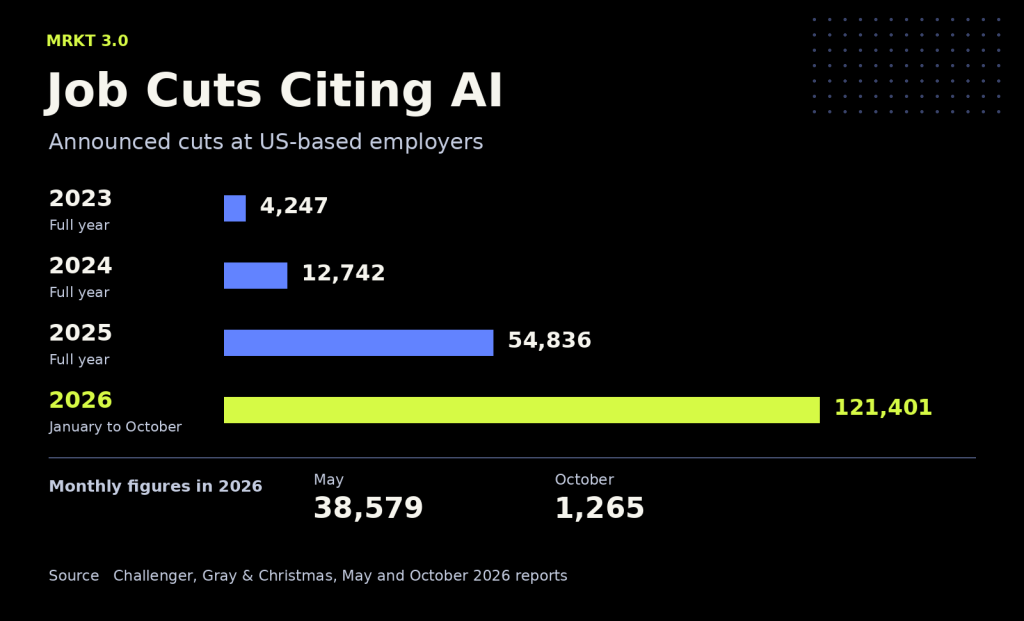
Challenger, Gray & Christmas began recording AI as a reason for job cuts in 2023. Its figures show how many planned cuts US-based employers have linked to AI in their announcements. The series tracks the reasons given for planned cuts and leaves open which jobs AI took over.
| Period | Announced job cuts citing AI at US-based employers |
| 2023 · Full year | 4,247 |
| 2024 · Full year | 12,742 |
| 2025 · Full year | 54,836 |
| 2026 · January to October | 121,401 |
The annual figures hide a change in 2026. In May, AI was cited in announcements covering 38,579 cuts. By October that had fallen to 1,265, the lowest monthly figure of the year through October. Market and economic conditions had also overtaken AI as the most cited reason for cuts that year.
What Work Is Actually Moving to AI?
At Block, chief executive Jack Dorsey made the case for a smaller company in a letter to shareholders. “Intelligence tools have changed what it means to build and run a company,” he wrote. The letter said more than 4,000 people were being asked to leave or entering consultation. It tells shareholders why Dorsey thought the company could do more with fewer people. The question it leaves open is which jobs those tools made redundant.
Gainsight offers a closer look at the work itself. Chief executive Chuck Ganapathi described how its largest customers would get a dedicated person, while an AI agent would serve smaller accounts. Some employees moved into the company’s AI services business. The roughly 270 roles cover the wider restructuring, so we still don’t know how many people lost their jobs because agents took over those accounts.
How Earlier Cases Compare
A company can remove thousands of roles over several years as people retire or contracts come to an end. In October 2024, Intesa Sanpaolo announced a plan for 9,000 exits by 2027, with 7,000 in Italy and 2,000 at international subsidiaries. Its agreement with unions covered 4,000 voluntary exits through retirement or a solidarity fund. The bank discussed the plan in the context of digitalisation and AI, and it also set out plans to hire.
In February 2025, DBS said it expected about 4,000 temporary and contract roles to go over three years as AI took on more work. A spokesperson said the reduction would come as project-based contracts ended. The bank said permanent staff would be unaffected. Whether DBS reached its forecast is a question for later disclosures.
What Happens to the People Whose Jobs Go?
A company can use AI to help one team do its job and use the same technology to take work away from another. Gainsight gives a glimpse of how both can happen in one restructuring. It described plans to assign smaller accounts to AI agents while moving some employees into its AI services business. That leaves an important question about who gets the chance to move into the work the company is keeping or creating.
This is where we come back to the idea of “AI unemployables.” A role disappearing tells us what happened at one employer. To understand what it means for the person who held it, we’d need to know whether they were offered another role, what training was available and whether comparable jobs were still open elsewhere. There’s a question for people entering the workforce, too. If companies hand more routine tasks to AI, where will new hires learn the work those tasks used to teach them?
The next disclosures worth watching are the ones that get specific about which teams lost roles, which workers moved into new ones and whether employers saw the savings they expected. For all the attention paid to how many jobs might go, where people find work afterwards is just as much a part of the story.
Author: Grace Sharp
See Also:
Barclays CEO Says AI Is “Icing on the Cake” as Bank Cuts 5,000 Jobs
How We Count AI Job Cuts
The tracker covers 17 selected workforce changes worldwide, including Standard Chartered’s 2030 target. Each entry identifies what the figure measures, from proposed cuts to changes in headcount. Mizuho appears separately as an example of redeployment.
We use company filings, statements and independent reporting to assess AI’s role. A cut counts as directly attributable to AI only when the evidence identifies the work it took over and specifies how many roles went as a result. We record where the jobs were based when disclosed and update entries as new evidence emerges.
Frequently Asked Questions
Challenger, Gray & Christmas recorded 121,401 announced job cuts citing AI among US-based employers from January to October 2026, up from 48,414 over the same period in 2025. The figures measure planned cuts for which AI was cited as a reason. They do not establish how many jobs AI took over.
Oracle said deploying AI had already reduced its workforce. Block and Cloudflare also linked decisions to cut jobs to changes in how they use AI. The disclosures reviewed gave no separate count of roles eliminated because AI took over specific work.
Oracle reported about 21,000 fewer full-time employees at the end of its 2026 financial year than a year earlier. Its annual report says AI deployment reduced its workforce and lists other reasons for staffing changes. The 21,000 figure measures the net change in headcount, and Oracle did not disclose how much of that change was due to AI.
Barclays expected about 5,000 jobs to go in 2026 as part of a wider effort to reduce costs and modernise its operations. The bank included AI in that effort and did not say how many of the affected roles AI would replace.