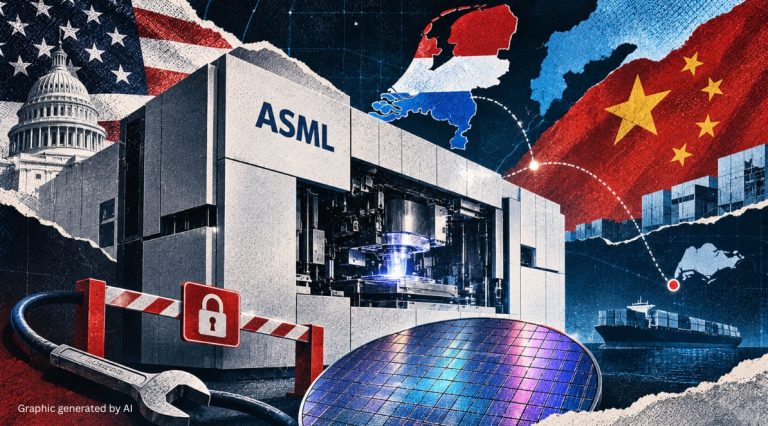

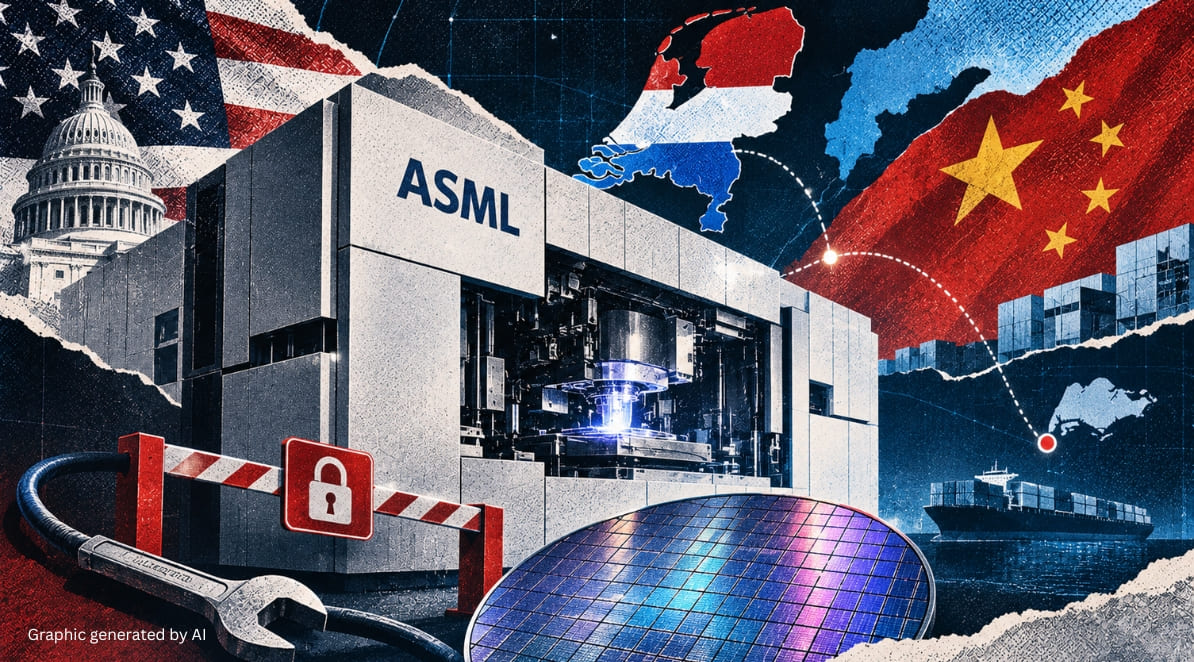
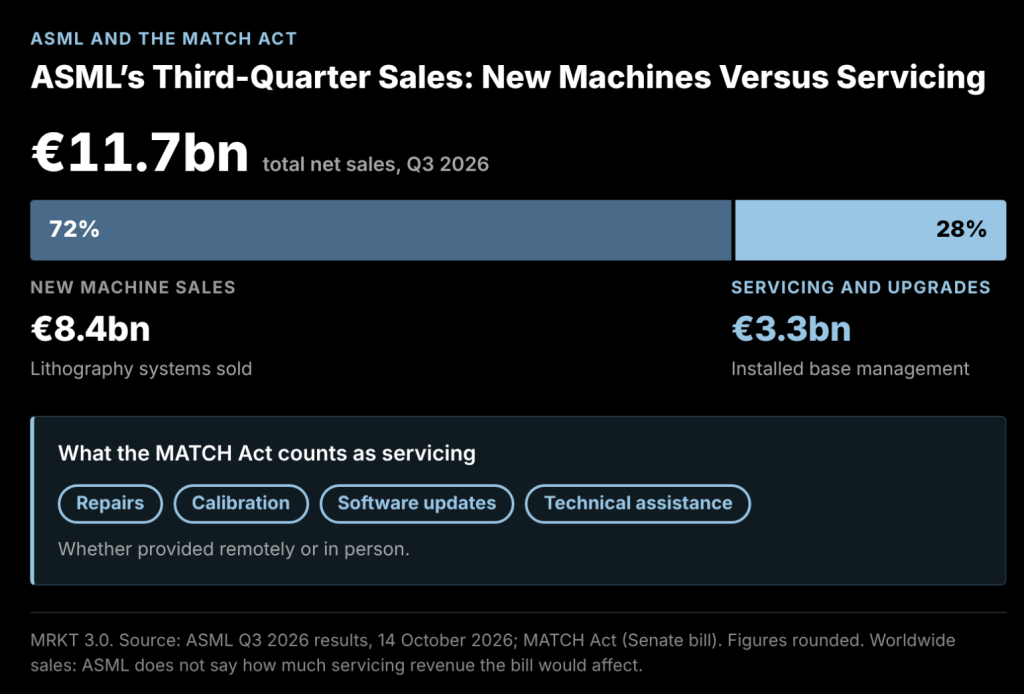
When ASML sells one of its lithography machines, its relationship with the customer is far from over. The machines require maintenance, replacement parts, software updates and specialist engineering support throughout their operational lives. In the third quarter of 2026 alone, servicing and upgrading its installed equipment brought in a neat €3.3 billion for the Dutch technology company.
But what happens when a government on the other side of the Atlantic decides that some of those machines should no longer be serviced?
On November 23, NVIDIA reinstated Jensen Huang as chief executive. On the same day, the United States added Singapore-based NVIDIA customer Megaspeed to its trade blacklist amid an investigation into the suspected diversion of advanced AI chips to China. Megaspeed continues to maintain that its business complies with US export controls.
Huang may have his job back, but the political fallout is definitely far from over. Congress is renewing its push for tighter semiconductor export controls, and some of the proposed legislation could have considerable consequences for Europe’s most important semiconductor equipment manufacturer.
From NVIDIA to ASML
On November 13, the chairs of three US House committees called for Congress to pass four pieces of export-control legislation through the National Defense Authorization Act (NDAA). Referring to the controversy surrounding NVIDIA and Megaspeed, the committee chairs described it as “a prime example of why Congress must immediately pass” the four bills.
Among them is the Multilateral Alignment of Technology Controls on Hardware (MATCH) Act, a bipartisan proposal introduced in the Senate in April 2026, which we covered when it was first introduced.
The legislation addresses a longstanding frustration among American policymakers. Restricting the export of US semiconductor manufacturing equipment becomes considerably less effective if manufacturers in allied countries can continue supplying equivalent technology to Chinese customers.
The MATCH Act seeks to close these gaps, bringing American and allied export restrictions into closer alignment. Yet, for the Netherlands, the issue goes far beyond which machines ASML can sell.
ASML’s Business Beyond Selling Machines
Much of the discussion surrounding ASML and China has centred on extreme ultraviolet (EUV) lithography. ASML is the world’s only commercial supplier of EUV lithography systems, which are essential to manufacturing many of the most advanced semiconductors.
China has been unable to acquire these machines directly from ASML, but it has remained a significant market for the company’s deep ultraviolet (DUV) technology.
The Netherlands introduced additional export licensing requirements for advanced semiconductor manufacturing equipment in September 2023, subsequently expanding them in September 2024. The MATCH Act could go even further. The original Senate bill explicitly covers immersion DUV lithography equipment and proposes restrictions on servicing certain equipment at designated facilities.
The legislation’s definition of servicing is particularly extensive, covering activities such as repairs, calibration, software updates and technical assistance, whether provided remotely or in person.
These activities represent a substantial part of ASML’s business. In its October 14 financial results, the company reported €11.7 billion in quarterly net sales, of which €3.3 billion came from servicing and upgrading its installed equipment. To put that into perspective, that is around 28% of its worldwide quarterly revenue.
China also remains an important market for ASML, with the company expecting the country to account for around 20% of its total sales in 2026.
What these figures don’t do is tell us how much of ASML’s servicing revenue would be exposed to the proposed restrictions. They do, however, explain why access to existing customers matters to the export-control debate alongside the sale of new machines.
The Netherlands Has Already Challenged Washington
The potential impact on ASML’s existing business has not gone unnoticed in the Netherlands.
In May, Dutch parliamentarians questioned the government about the MATCH Act, including whether restrictions on maintenance could expose ASML and its suppliers to legal claims for failing to fulfil existing contracts.
The government’s June 15 response acknowledged that the proposed legislation could require companies to obtain licences before servicing equipment they had already delivered to certain customers. The Dutch government also raised concerns that servicing licence applications could face a presumption of denial, although the wording of the legislation remains subject to negotiation.
The Dutch government also confirmed that it had raised its concerns directly with members of Congress and the US administration, particularly over the extraterritorial application of American export controls.
“The government values good cooperation with partners, but opposes the extraterritorial effect of the American proposal,” Dutch Minister for Foreign Trade and Development Cooperation Sjoerd Sjoerdsma told parliament on June 15. The Dutch government’s opposition has not softened in the months since, with the foreign ministry reiterating its objections to the proposed American restrictions in November.
Under the existing European framework, the Netherlands assesses export licence applications on a case-by-case basis. Although the country supports international coordination on semiconductor restrictions, it has defended the principle that countries should retain control over their own legislation.
For Europe, this could be a big problem. ASML’s position in the global semiconductor industry gives the Netherlands considerable technological influence. Yet the international nature of its supply chain also gives Washington leverage over how that technology is commercialised.
Under the original Senate proposal, the US administration would first pursue diplomatic agreements with allied countries. Should those efforts fail to produce sufficiently aligned restrictions, it could be required to extend American export controls to equipment from the countries concerned.
Congress Wants to Know Where NVIDIA’s Chips End Up
While the MATCH Act concerns the machines used to manufacture semiconductors, other proposals under consideration address the chips themselves.
The Chip Security Act, introduced by Republican senator Tom Cotton in May 2025, proposes location-verification mechanisms for advanced chips subject to export controls. The intention behind the legislation is to identify semiconductors that have been diverted to prohibited destinations after being legally exported elsewhere.
The AI OVERWATCH Act, meanwhile, would introduce greater statutory restrictions and congressional oversight of advanced AI chip exports to countries of concern.
A fourth proposal, the Remote Access Security Act, addresses another potential loophole: the ability to access advanced computing resources remotely without physically importing the chips.
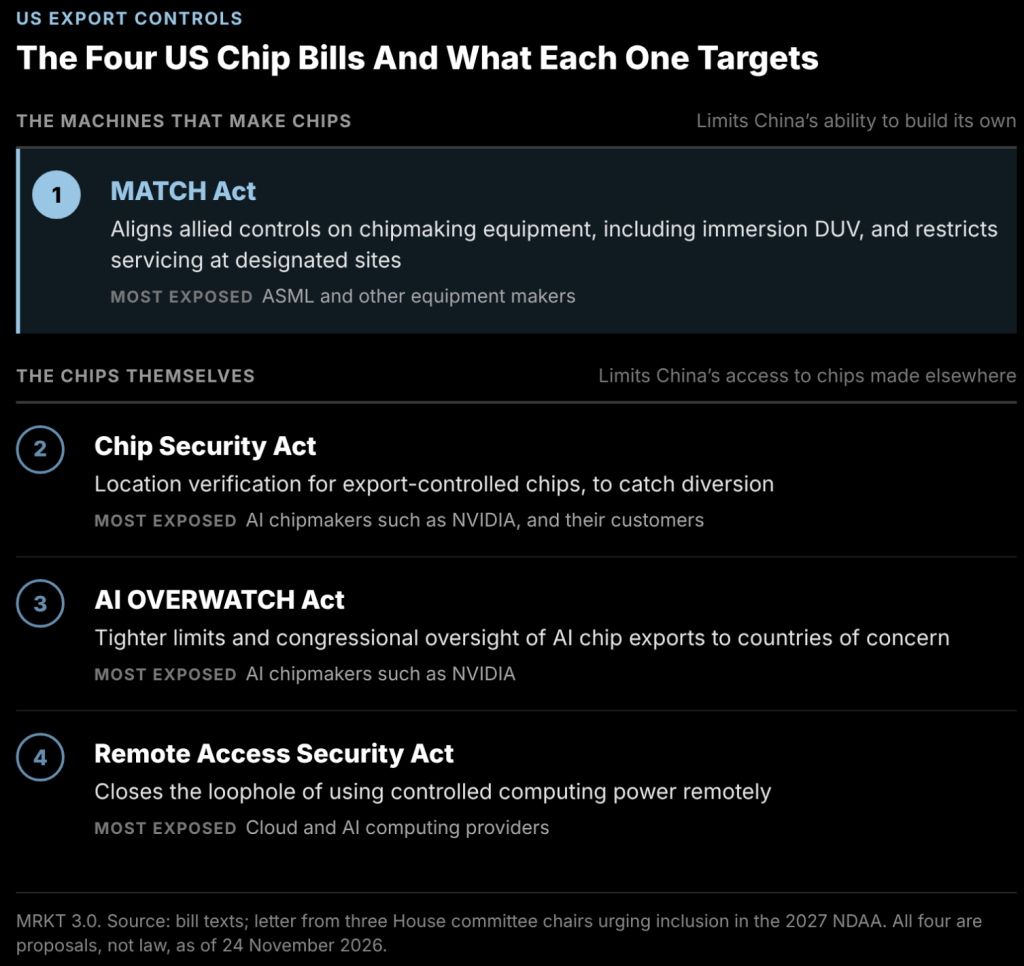
The distinction between each of these proposals is important to understand. Restricting the sale of semiconductor manufacturing equipment limits China’s ability to develop its own advanced chips. Restricting the export, movement and remote use of AI processors limits its ability to access them from elsewhere.
For European AI infrastructure companies that rely heavily on American hardware, the Chip Security Act also raises questions about future compliance requirements. Much will depend on how location verification is implemented and what responsibilities fall on manufacturers, exporters and their customers.
The proposed location-verification requirements should not, however, be interpreted as a general restriction on European data centres.
Will Tighter Export Controls Accelerate Chinese Innovation?
Support for stronger semiconductor export restrictions crosses party lines in Washington, but the industry has its reservations.
In an October 16 letter to Senate leadership, a coalition of industry associations expressed opposition to incorporating the MATCH Act, Chip Security Act and AI OVERWATCH Act into the defence legislation. One of the longer-term questions surrounding semiconductor export controls is whether restricting China’s access to foreign technology will ultimately accelerate the development of domestic alternatives.
Chinese semiconductor equipment companies, including Shenzhen-based SiCarrier, are already working to reduce the country’s dependence on overseas manufacturers. For companies such as ASML, further restrictions could mean losing revenue from Chinese customers while giving domestic competitors a greater incentive to develop alternative technologies.
What Happens Next for ASML?
Despite Huang’s reinstatement, congressional scrutiny of NVIDIA is set to continue in December, with the chief executive scheduled to appear before the Senate Banking Committee on December 3.
Lawmakers are also working towards finalising the defence legislation for the 2027 fiscal year. As we reported in August, incorporating the MATCH Act into the NDAA offers its supporters an alternative route to getting the legislation passed. However, the inclusion of semiconductor export-control proposals in the Senate’s legislative negotiations does not guarantee that they will survive in the final version of the NDAA.
For ASML, one of the most important details to watch is whether the MATCH Act’s provisions concerning equipment servicing remain intact, alongside any concessions negotiated with allied governments.
Much of Europe’s discussion about technological sovereignty concerns its ability to develop its own AI models, build its own infrastructure and reduce its dependence on American technology.
ASML is one of the few European technology companies upon which the rest of the world is heavily dependent. The MATCH Act offers an interesting test of how much commercial and political autonomy that position actually affords the Netherlands.
Author: Grace Sharp
See Also:
Will the MATCH Act Pass by Riding the Defense Bill?
The Chip Security Act Explained: Will US Chips Come to Europe With a Tracking Device?
What Is SiCarrier, the Chinese Startup Built to Break ASML’s Monopoly?
Frequently Asked Questions:
The MATCH Act seeks to align US and allied semiconductor export controls. For ASML, this could introduce further restrictions on the sale, maintenance and technical support of certain semiconductor manufacturing equipment used by Chinese chipmakers.
Yes, if the relevant provisions of the MATCH Act are enacted and implemented. The original Senate proposal envisages licensing requirements for servicing certain equipment at designated facilities, potentially affecting machines ASML has already delivered.
As of November 24, 2026, the MATCH Act has not become law. Provisions from the legislation are under consideration as part of the National Defense Authorization Act (NDAA) for the 2027 fiscal year, but their inclusion in the final legislation is not guaranteed.
The Dutch government has expressed concerns about the extraterritorial reach of US export controls and their potential impact on existing commercial relationships. The Netherlands supports international coordination but maintains that countries should retain responsibility for their own export-control legislation.
The investigation into suspected diversion of advanced NVIDIA chips to China has renewed congressional calls for tighter semiconductor export controls. Although the MATCH Act predates the controversy, lawmakers have used recent developments to reinforce their arguments for passing the legislation.