
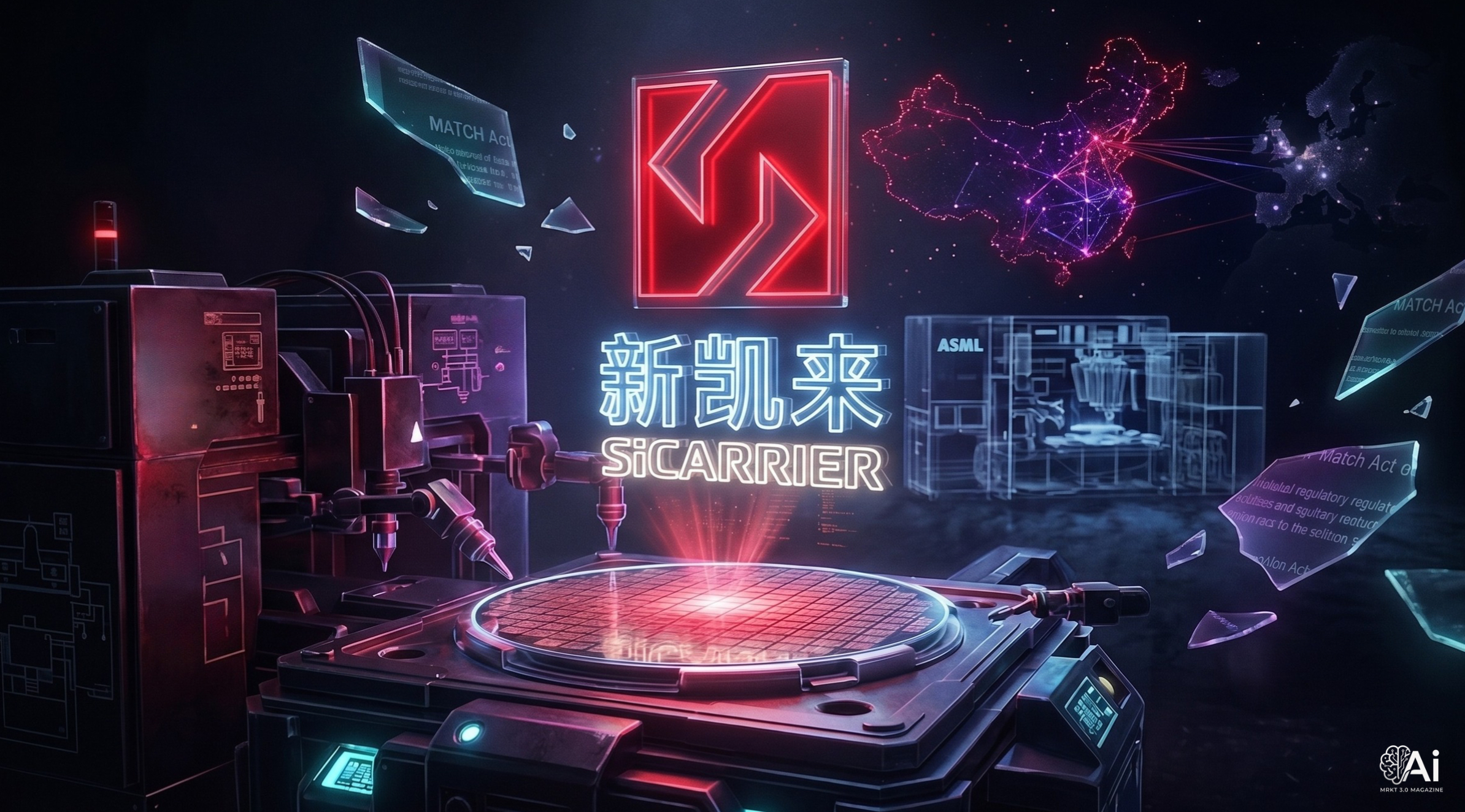
China’s chip plants still depend on hundreds of ASML scanners, and on Dutch engineers to keep those machines running, which proposed regulation like the MATCH Act would restrict. In Shenzhen, a state-owned startup named SiCarrier is assembling the tools China’s plants need to end this reliance once and for all.
That risk sits in Europe as much as in Washington. China supplied 33% of ASML’s revenue in 2025, guided down to around 20% this year. The Dutch firm is still the pivot of the modern chip economy, and a large part of that business is already on Chinese floors.
Who Is SiCarrier and Why Does Washington Care?
SiCarrier was, until early 2025, close to invisible. Reuters reported that its operating arm, Shenzhen SiCarrier Industry Machines, was founded in 2022, while its parent is fully owned by a state-backed investment fund in Shenzhen.
The company collaborates with Huawei, Bloomberg has reported, and the US Commerce Department added it to the Entity List among 140 firms in December 2024.
At Semicon China in 2025 it arrived with around 30 tools and one of the busiest booths at the fair. Its president, Du Lijun, told Reuters that China could route around the lithography controls entirely, arguing there might be a path to 5 nanometre chips using “non optical technologies” rather than the light based machines it cannot buy. Its tools, he confirmed, are already used by SMIC.
Chinese media reported in September 2025 that SiCarrier’s non-lithography business was valued at RMB 65 billion in a financing round then nearing completion. It should be noted that this figure came from people familiar with the company, not from audited accounts or a public filing.
Why Is Lithography the Wrong Place to Look?
It’s important to not just fixate on EUV. Chipmaking is not one machine, it is a chain: deposition, etching, metrology, inspection, cleaning, and lithography. Lithography is the step China cannot yet do at the leading edge, the ground we mapped when High NA EUV cleared its first high volume milestone. Every other step, SiCarrier is now shipping.
That is the strategy. Make the 90% of the toolchain that is not lithography fully domestic, qualify it inside real factories, and you shrink the problem to a single bottleneck.
A machine from Shanghai Yuliangsheng Technology, a firm Tom’s Hardware and the Financial Times have linked to SiCarrier through investors and staff, has been in trials at SMIC since September 2025. In late July, The Information reported that China had begun producing homegrown immersion DUV tools, with first deliveries expected this year to SMIC, Hua Hong and CXMT. Reuters separately named Shanghai Aishengna as the state vehicle assembling those teams, and put the run rate at about five machines this year and 20 in 2027.
On the leading edge, Reuters revealed a Chinese EUV prototype built by former ASML engineers, although that remains years from production.
What Would the MATCH Act Actually Change?
The MATCH Act, which we broke down when it first landed, does something the earlier controls did not. Its immersion DUV provisions cover servicing and technical assistance, not only new sales, extending the controls to ASML tools already installed and running in Chinese factories. The House version cleared the House Foreign Affairs Committee on 22 April, with a Senate companion filed as S. 4281. Sponsors have since folded it into the annual defence bill, the vehicle most likely to carry it into law.
Cut off servicing, and a Chinese chipmaker’s calculation changes overnight. A domestic tool that is slower and lower yielding stops being a downgrade and becomes insurance. The named first customers for the homegrown scanner, SMIC, Hua Hong and CXMT, are the same firms US law already designates as restricted entities. SiCarrier’s unglamorous full stack is being built for exactly the world the MATCH Act would create.
Can China Really Do Without ASML?
ASML still expects to ship about 130 immersion systems in 2026 and still holds almost all of that market. SiCarrier is qualifying etch, deposition and metrology inside SMIC, Hua Hong and CXMT, the same names the MATCH Act would lock out of servicing. If those tools hold up, China does not need to beat ASML. It needs a stack good enough that losing Dutch engineers is a delay, not a shutdown.

See Also:
What Do ASML’s Q2 2026 Results Tell Us About the AI Boom?
MATCH Act Explained: The US Ban on ASML’s China Chip Tools
The Chip Security Act Explained: Will US Chips Come to Europe With a Tracking Device?