
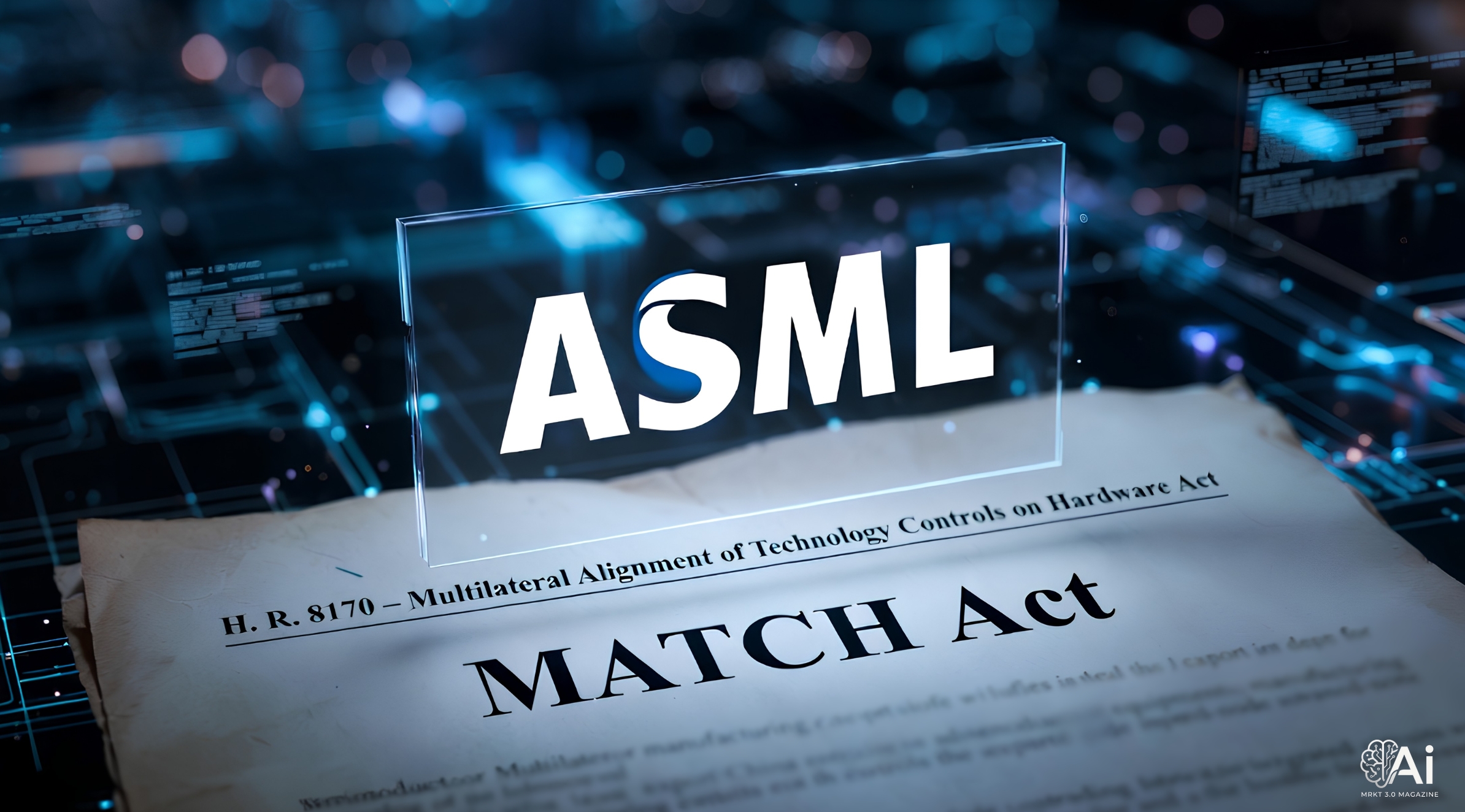
The bill that would cut ASML off from China has stopped trying to pass on its own, because it simply does not need to. The backers have folded it into the one bill Congress passes every year without fail, where it could become law without ever facing the vote it might lose.
That retreat is strategic. When the House Foreign Affairs Committee marked the MATCH Act up in April, more members voted against it than against the two other chip bills beside it, uneasy about what tighter unilateral controls would do to relationships with allies.
So rather than risk one, its sponsors reached for the defence budget. The office of Senator Jim Banks noted in mid-July that the Senate’s NDAA manager’s amendment would carry the MATCH Act, the Chip Security Act and the AI Overwatch Act together, bundled into the annual defence bill. Attach a controversial measure to must-pass legislation and it inherits the vehicle’s momentum. No standalone vote, no floor fight to lose.
Is a Statute Stronger Than an Export Licence?
For the past year the export-control story has run in two directions at once. Congress has been trying to tighten the rules while the Trump administration has been loosening them. Evidence of this can be seen in January, when the Commerce Department revised its licensing policy to let NVIDIA’s H200 chips reach China on a case-by-case basis.
A licence can be revised, revoked or traded away in a negotiation. A statute cannot, at least not easily. If the MATCH Act rides the NDAA into law, that softer executive posture gets much harder to sustain, because chipmakers would have to route their China deals past Congress rather than the White House. The fight dressed up as America versus China is really Congress versus the White House over who controls export policy.
What Does This Mean for ASML?
If the MATCH Act is passed, there would be significant implications for ASML. The bill directs allied governments to match US controls on deep ultraviolet tools, and on the servicing of machines already installed in China, within 150 days, or Washington extends its own jurisdiction over any allied tool built with American technology. As a bill, that 150-day clock is a negotiating lever. As a statute, it is a deadline.
The Dutch position shows why the distinction bites. The Netherlands has required a licence to service restricted ASML tools in China since 2024, and has kept granting them. A codified MATCH Act removes the room to keep saying yes, which is precisely the point of it.
ASML is the company with the most to lose here. China was its largest market in 2025 at 33% of revenue, a share already expected to fall toward 20% this year before any of this becomes law.
Could It Still Fall Apart?
The MATCH Act could easily still face problems, because sitting in the Senate manager’s amendment is not the same as being law.
The House passed its version of the FY2027 defence bill on 22 July by 216–212. The Senate, however, has not yet passed its own bill: Democrats blocked the motion to proceed on 14 July (50–46), citing the Iran war and the topline. As of early August only informal talks are under way. Even if the Senate eventually clears its version, the two chambers still have to reconcile the text. The AI Overwatch Act’s ban on advanced-chip sales has already been trimmed from two years to 18 months, and House Foreign Affairs’ ranking member has said he is not comfortable with the Senate’s version of it.
So the honest answer is that the MATCH Act has found a clever route, not a guaranteed one.

See Also:
What Do ASML’s Q2 2026 Results Tell Us About the AI Boom?
MATCH Act Explained: The US Ban on ASML’s China Chip Tools
The Chip Security Act Explained: Will US Chips Come to Europe With a Tracking Device?