
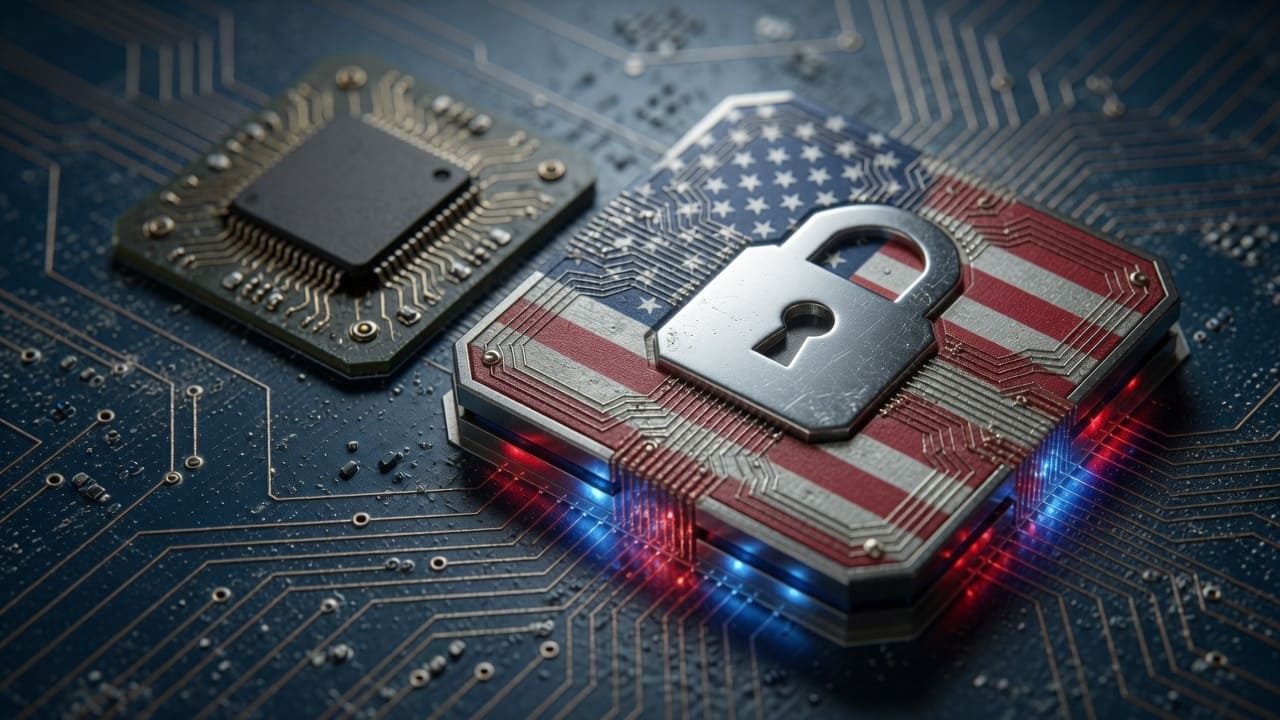
Washington has spent three years deciding which chips China is allowed to have. The Chip Security Act asks a different question entirely: where is every advanced American chip, right now, anywhere in the world?
And, if you run a European data centre full of NVIDIA hardware, that question includes you.
What Does the Chip Security Act Actually Require?
The bill, H.R. 3447 in the House and S.1705 in the Senate, directs the Commerce Department to require chip security mechanisms on export-controlled AI chips within 180 days of enactment. In practice that means location verification built into the hardware, firmware or software of anything classified under the export codes covering advanced AI accelerators.
The bill leaves the method open, so a software or firmware ping or a delay-based check would qualify, and the text explicitly rules out anything that hinders the chip itself, such as a kill switch or geofencing mechanism.
Exporters would also face a mandatory reporting duty. Anyone with credible information that a chip has wandered from its licensed location must tell the Bureau of Industry and Security promptly. Commerce and the Pentagon then get a year to study what else might be bolted on. The latest draft floats “workload verification methods”, which would mean reporting on what tasks foreign customers are running on American silicon.
Why Is the Chip Security Act Moving Now?
The reason behind the Chip Security Act is largely due to smuggling.
The bill grew out of the House Select Committee on China’s DeepSeek report, which concluded the company built its models on tens of thousands of restricted NVIDIA chips. The Justice Department has since been indicting alleged smuggling networks accused of routing billions of dollars of hardware into China through Thailand and Malaysia. The House Foreign Affairs Committee vote in March was 42-0.
What Does the Chip Industry Say?
Supporters have a genuinely decent argument. In June, six verification firms including GeoComply wrote to congressional leadership arguing that tracking makes exports easier, not harder. If Commerce can see where chips are, it can approve larger shipments to more countries with less paranoia. Verified compliance becomes a fast lane, not a leash. Even the Congressional Budget Office prices the enforcement apparatus at a modest $12 million over five years.
The chipmakers themselves are not buying it. The Semiconductor Industry Association came out against the bill on 2 March, with president and CEO John Neuffer explaining:
“SIA members are fully committed to complying with export controls, and we strongly oppose the illicit diversion and misuse of our chip technologies.” He continued that, “while we understand policymakers’ interest in addressing this issue, we cannot support blanket mandates for new, untested, and potentially infeasible on-chip mechanisms, such as what is being proposed in the Chip Security Act.”
ITI, the broader tech lobby, goes further, adding that a government tracking mandate would deepen the impression of US control over the American AI stack, “pushing the very countries that should be core customers of U.S. providers toward alternatives”.
What Does the Chip Security Act Mean for Europe?
Europe did not vote for the leash either way. European buyers are already asking whether the American AI stack comes with too many strings attached, and Chinese vendors would happily market their chips as tracking-free. For some buyers that pitch will land. A bill written to stop Shenzhen smugglers may end up nudging Rotterdam procurement teams.
The timing matters as well. Brussels proposed its own Chips Act 2.0 in June precisely to reduce strategic dependencies, with photonic chips among its named priorities. Dependency on tracked US hardware is exactly the kind of lever the sovereignty argument feeds on, and China’s domestic chipmaking push, from SMIC to startups like Yuanjiwei, is waiting for the opening.
It also completes a pattern. The MATCH Act went after the machines that make chips. The Cloud Security Act went after remote access to compute. This one goes after the chips themselves. Same sponsor circle, same logic, tightening ring.
Where Does the Bill Go Next?
The House version awaits a floor vote.
The Senate companion sat untouched in the Banking Committee for over a year, but it has just found a faster vehicle. Punchbowl News reported this week that the Senate NDAA manager’s amendment is set to include the Chip Security Act, alongside the MATCH Act, according to multiple sources. Riding the must-pass defence bill is how export-control ideas become law, though nothing is final until the NDAA is. If it passes, the 180-day clock starts, and every advanced chip leaving America will need to phone home.

See Also:
The Cloud Security Act Explained: What It Means for ASML and Europe
European Tech Sovereignty: ASML’s Crown Jewel in the AI Race 2026