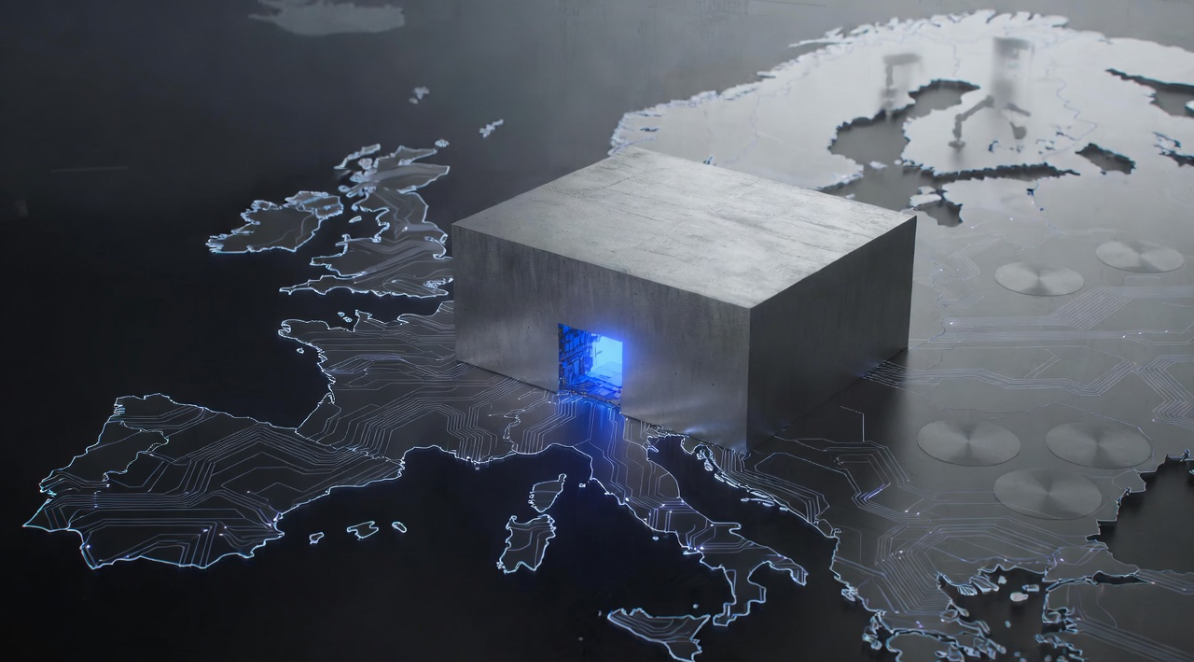
Europe has spent the last decade learning the hard way that AI sovereignty isn’t optional. Surveillance scandals exposed data vulnerabilities. AI compute dependence turned innovation into a permission-based system. Foreign tech dominance put critical infrastructure at the mercy of others. Each crisis delivered the same verdict: depend on others for your future, and someone else will write it.
Yet Europe controls less than 5% of the world’s frontier-scale AI infrastructure. The clusters capable of training trillion-parameter models live mostly in American data centers. The accelerators that power them are designed in California and built in Taiwan. European startups, universities, and defense contractors rent access, and with it, hand over strategic leverage.
Ian Bremmer, founder of Eurasia Group and a leading geopolitical analyst, put it bluntly in his 2025 commentary:
“They’re not going to own it. They’re not going to make it… There are going to be takers, not makers.”
Brussels has woken up to the reality that sovereignty in AI cannot be outsourced. The European High Performance Computing (Euro HPC) has now declared AI sovereignty as a non-negotiable for Europe. The continent is building its backbone, starting with 19 regional AI factories already in play, which are leading the charge today. These lay the critical foundations, with up to five larger Gigafactories on the horizon to deliver massive scale to Europe’s AI infrastructure.
Who are the top 5 AI factories leading this revolution? Let’s have a look.
The Sovereignty Crisis That Forced Brussels’ Hand
The harsh reality of dependence isn’t abstract, it’s already limiting Europe’s ability to innovate independently. Without sovereign compute at scale, European players remain locked into renting foreign infrastructure, ceding control over data flows, model development, and strategic decisions.
A clear example of this is how European AI startups routinely train models on US clouds because no domestic alternative exists at scale. This exposes them to surveillance risks, GDPR leaks, potential foreign access, and sudden service cut-offs.
The numbers remain humiliating:
- US hyperscalers still control around 70-72% of the European cloud market (AWS, Azure, Google dominating as of 2025 data).
- Private AI investment in the US is roughly 24x higher than in Europe (e.g., $109B US vs. $4-8B EU in recent annual figures).
- Europe stays heavily dependent on US-designed GPU architectures (Nvidia leading, AMD/Intel following) and Taiwanese fabs (TSMC primary) for frontier AI chips. Although ASML’s EUV monopoly gives Europe crucial supply-chain leverage, it doesn’t yet unlock independent GPU design or full-scale production.
Europe’s path to AI sovereignty will continue to face challenges, particularly as the EU’s AI Act’s high-risk rules take effect on 2 August 2026. Varying approaches by member states to implementation, enforcement, and national oversight could fragment these efforts, leading to inconsistencies that slow cross-border projects and deter investment.
The risks of delay could be catastrophic: billions spent might yield little if regulatory hurdles and fragmentation leave the next generation of frontier models trained elsewhere, locking Europe deeper into dependence and strategic vulnerability.
The AI Factories Leading Europe’s Sovereignty Push
The momentum to challenge Europe’s dependence is already underway with the 19 operational or selected AI Factories under EuroHPC. These are regional ecosystems which are built around AI-optimized supercomputers, data services, talent support, and priority access for startups and SMEs. They form the foundation that future gigafactories will scale upon.
Here are the five that are stealing the show:
JAIF – JUPITER AI Factory (Germany, Jülich)
The undisputed star. Powered by JUPITER, JAIF is Europe’s first exascale beast (fully online since late 2025), with a booster packing nearly 24,000 NVIDIA GH200 superchips. It is the go-to hub for secure cross-border collaboration, frontier-model training, health, sustainability, and manufacturing.
LUMI AI Factory (Finland, Kajaani)
The eco-hero giant. The factory runs entirely on clean hydroelectric power and ranks among the greenest supercomputers on the planet. Its beefed-up GPU setup is already churning out real generative AI work. If Europe wants large-scale training without a guilty conscience about the planet, LUMI leads the way for the Nordic and Baltic countries.
BSC AIF – MareNostrum 5 AI Factory (Spain, Barcelona)
A cornerstone of southern Europe’s AI ecosystem. Recently strengthened by a major January 2026 upgrade contract, it has expanded its AI partitions significantly. The centre excels in high-impact applications: life-saving medical models, advanced climate simulations, and multilingual AI tailored to Europe’s linguistic diversity. For real-world challenges in health, environment, and public services, MareNostrum 5 delivers practical, continent-scale solutions.
IT4LIA (Italy, Bologna Tecnopolo)
Pure industrial muscle. Sitting at the Leonardo site, the factory is rolling out Europe’s biggest single public GPU cluster (over 20,000 cards coming online through 2026–27). Focused on advanced manufacturing, cybersecurity, and defense, IT4LIA proves itself as one of the best in Europe.
AI2F – AI Factory France (France, Bruyères-le-Châtel / CEA TGCC)
The strategic powerhouse in waiting. AI2F is currently linking up existing systems, with the star of the show, Alice Recoque, an AMD-based exascale machine built specifically for AI arriving in 2026–27. Deeply connected to France’s homegrown stars, including Mistral’s ‘Le Chat’, it’s ready to team up with JAIF for truly European-scale projects.
Special Mention: Deutsche Telekom Industrial AI Cloud (Munich)
Europe’s largest private-sector AI factory, launched in February 2026. It uses around 10,000 NVIDIA Blackwell GPUs to deliver up to 0.5 exaFLOPS of power. The facility powers itself with 100% renewable energy, cools with river water, and recycles waste heat into Munich’s district heating system. It also offers the “Deutschland Stack” which is a completely sovereign European cloud-to-software solution built with SAP. This is the clearest proof that private companies can deliver real sovereign AI infrastructure faster than public projects.
Looking Ahead
Nineteen public AI Factories plus private accelerators (Mistral Compute, Helsing’s defence AI partnerships with Mistral and Systematic, HPE, Substrate AI, sovereign-cloud initiatives) already form a solid foundation. The five gigafactories on the horizon have the potential to close the compute gap dramatically and shift the global AI landscape.
This is about more than hardware. It is about deciding whether Europe’s data, innovations, values remain under European control, or continue to be shaped elsewhere. The race is on, and the stakes could not be higher. Europe is finally building the tools to write its own AI future.
Author: Grace Sharp
See Also:
European Tech Sovereignty: ASML’s Crown Jewel in the AI Race 2026