
The NATO Innovation Fund, a €1 billion venture fund backed by 24 NATO allies, has invested in 24 companies and nine venture funds since June 2024. Ten of those companies were British at the first cheque. TEKEVER, counted here as Portuguese, has since been described as British-headquartered. Half of the 24 countries that pay for the fund still have no direct investment at home.
Its best-known holding is Stark, the Berlin drone maker that raised €500 million in June alongside Sequoia and Founders Fund, at a €3.2 billion valuation. Most of NIF’s cheques are far smaller, and it led or co-led more than half of the first rounds it has announced. Below is the full list, where the money went, what the fund will not do, and how founders can pitch it.
Which Companies Has the NATO Innovation Fund Invested in?
The NATO Innovation Fund has invested in 24 companies so far, from rocket makers to protein sequencers. Six build drones or other uncrewed vehicles, five work in space and three are in biotech. The table lists each company once, at NIF’s first announced investment. Countries are the headquarters at that cheque.
| Announced | Company | Country | What it does | NIF’s role |
|---|---|---|---|---|
| Jun 2024 | ARX Robotics | Germany | Uncrewed ground vehicles | Led |
| Jun 2024 | Fractile | UK | Chips for running AI models | Co-led |
| Jun 2024 | iCOMAT | UK | Automated composite parts | Co-led |
| Jun 2024 | Isar Aerospace | Germany | Satellite launch rockets | Joined |
| Jun 2024 | Space Forge | UK | Chip materials made in orbit | Led |
| Sep 2024 | Aquark Technologies | UK | Quantum navigation sensors | Led |
| Nov 2024 | TEKEVER | Portugal | Surveillance drones | Joined |
| Mar 2025 | CamGraPhIC (2D Photonics) | Italy | Graphene optical data links | Joined |
| Jun 2025 | Kraken Technology Group | UK | Uncrewed boats | Joined |
| Jun 2025 | Portal Biotech | UK | Protein sequencing | Co-led |
| Jul 2025 | Kongsberg Ferrotech | Norway | Subsea repair robots | Led |
| Aug 2025 | Stark | Germany | Drones and loitering munitions | Joined |
| Sep 2025 | Kreios Space | Spain | Very-low-orbit satellites | Co-led |
| Feb 2026 | Uplift360 | Luxembourg | Recycling composite waste | Joined |
| Feb 2026 | SatVu | UK | Thermal satellite imagery | Joined |
| Feb 2026 | TYTAN Technologies | Germany | Interceptor drones | Co-led |
| Apr 2026 | Inbiome | Netherlands | Infection diagnostics | Co-led |
| Apr 2026 | Kelluu | Finland | Hydrogen surveillance airships | Led |
| May 2026 | RevEng.AI | UK | Security checks on software | Led |
| Jul 2026 | Greenjets | UK | Aircraft propulsion | Joined |
| Sep 2026 | Laki Power | Iceland | Power-line monitoring | Led |
| Sep 2026 | TERASi | Sweden | Jam-resistant radio links | Co-led |
| Sep 2026 | Basecamp Research | UK | AI-designed medicines | Joined |
| Not announced | Simera Sense | Belgium | Satellite cameras | Not announced |
NIF has since put more money into five of them: ARX Robotics, TEKEVER, Isar Aerospace, Stark and Kraken. The 2026 follow-ons it has announced are Isar’s €270 million Series D in June, Stark’s €500 million round in June, and Kraken’s $175 million Series B in July. Space Forge and Fractile have later rounds that still name NIF. Those are not counted here unless NIF has called them a second cheque.
It has also backed nine venture funds, among them Join Capital in Berlin, Expeditions in Warsaw and BSV Ventures in the Baltics. Simera Sense appears on NIF’s portfolio page, but the fund never announced that deal.
Five of the companies are now valued at about $1 billion or more. Stark said its June 2026 round valued the company at €3.2 billion. TEKEVER said its September Series D valued the company at $6.4 billion. Kraken’s July Series B was reported at $1 billion. Fractile’s May Series B is marked at about $1 billion. Isar Aerospace is widely treated as a unicorn. NIF does not disclose its own marks.
You can download the full list as a spreadsheet, with a source link for every deal, fund and follow-on round.
What is the NATO Innovation Fund?
The NATO Innovation Fund is a €1 billion venture capital fund backed by 24 NATO allies. It buys stakes in young deep-tech companies whose work matters for defence, security and resilience, and it also invests in venture funds with the same focus. Twenty-three allies signed up as its investors in 2023, and Sweden joined in April 2024.
Eight of NATO’s 32 members are not in it, among them the United States, Canada and France. That matters, because NIF invests directly only in startups based in the countries that fund it. According to its website, first cheques run up to €15 million, usually from seed to Series B, and the fund prefers to lead. It says it can back a company for up to 15 years. NIF is based in the Netherlands and registered in Luxembourg, with offices in Poland and the UK.
Who Runs the NATO Innovation Fund?
Since September 2025, Dame Fiona Murray, an MIT professor, has chaired its board. She took over from Klaus Hommels, the founder of venture firm Lakestar, who had chaired NIF since 2023 and now chairs a new advisory council. His double role drew scrutiny. Follow the Money reported that NIF had invested in Isar Aerospace while Hommels sat on Isar’s board, and NIF said he plays no part in its investment decisions and was recused from Isar. Since April 2026, Ari Kristinn Jónsson has been president, overseeing operations.
What Did the NATO Innovation Fund Back in 2026?
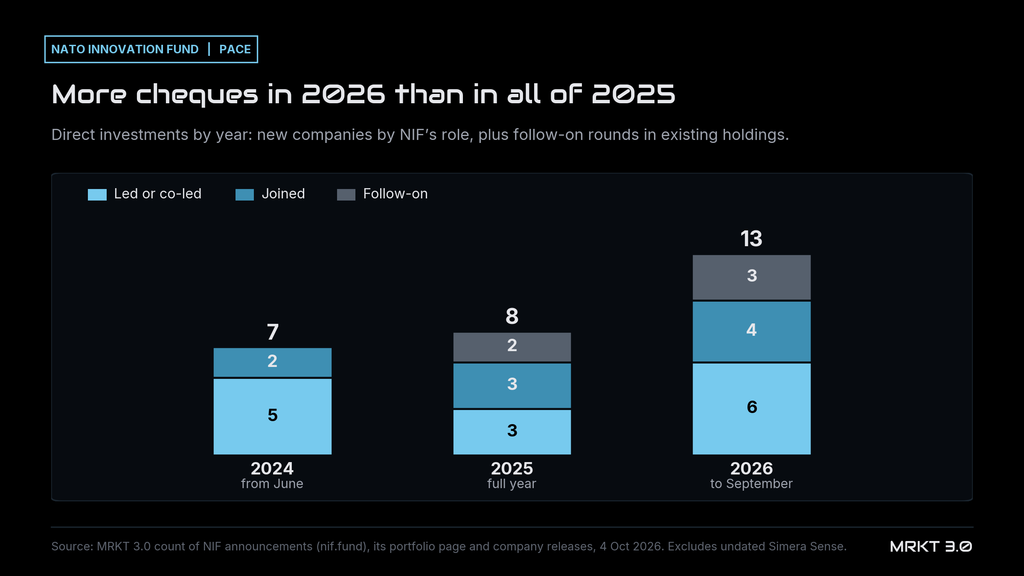
Ten new companies and three follow-on rounds by the end of September, already more first investments than in all of 2025. Four deals show the range.
In June, NIF said it was doubling down on Stark in a €500 million round. Reports show that Sequoia and Founders Fund led it, and Stark put its valuation at €3.2 billion. NIF had first backed Stark in a $62 million round in 2025.
In September, it joined a $140 million Series C for Basecamp Research, a London company that designs medicines with AI. S32 led the round, and NVIDIA took part. NIF argued that the work matters to the Alliance for health, industrial resilience and biomanufacturing.
The same month brought two firsts. NIF co-led an €11 million seed round in TERASi, its first Swedish company, which makes radio links that are hard to jam or detect. Days earlier, it led a €6 million Series A in Iceland’s Laki Power, its first Icelandic company, whose sensors monitor high-voltage power lines.
Among its other new 2026 investments, NIF co-led a €30 million Series A for TYTAN Technologies, which builds interceptor drones. It also led a €15 million round in Kelluu and a $15 million one in RevEng.AI.
Who Sat Next to NIF in the Stark Round?
Mostly private money, led by two American firms. Besides Sequoia and Founders Fund, the round included Project A, Advent, Döpfner Capital, 201 Ventures and Air Street Capital. Air Street is Nathan Benaich’s London fund, where he alone makes the investment calls, and it lists Stark in its latest portfolio. NIF is also an investor in 201 Ventures’ fund, so the two are partners twice over.
The same pattern runs through the portfolio. In-Q-Tel, the venture investor funded by US intelligence agencies, sat beside NIF in Stark’s 2025 round, in RevEng.AI and in TERASi. In other words, the United States does not fund NIF, yet American money keeps turning up in its deals.
Which Countries Get NATO Innovation Fund Money?
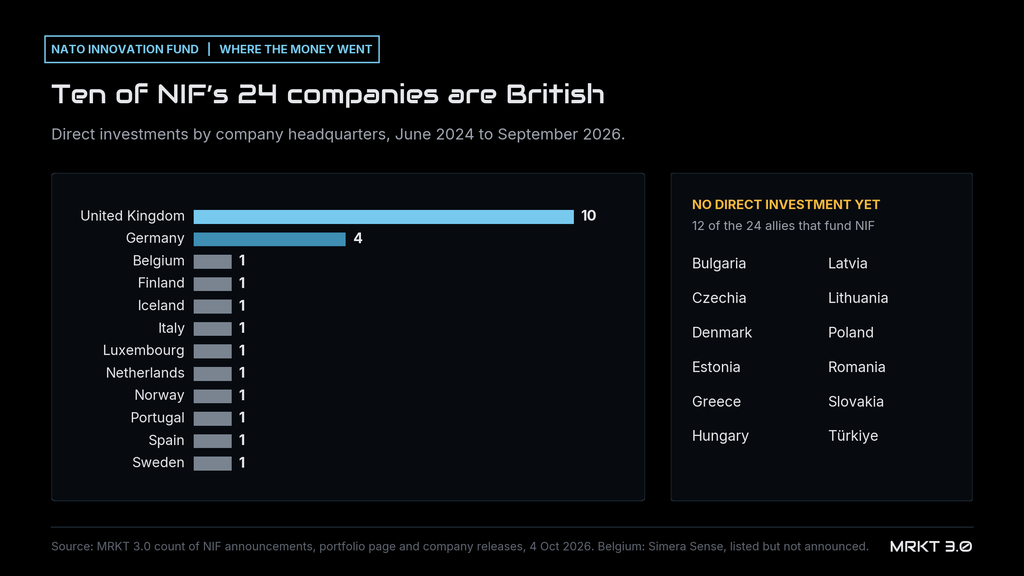
UK companies make up 10 of NIF’s 24 holdings, and Germany comes second with four. The other ten sit one apiece in ten countries, from Portugal to Iceland.
That leaves 12 of the 24 backers with no direct investment yet, among them Poland, Türkiye and Hungary. Poland and the Baltic states do get NIF money, but only through the venture funds it backs there.
Does the NATO Innovation Fund Lead Its Deals?
Of the 23 first investments it has announced, NIF led or co-led 14 and joined the other nine. That fits its stated preference to lead. The rounds it joins tend to be the biggest ones, such as Basecamp’s $140 million Series C and Isar Aerospace’s €270 million Series D, and it does not say how much it put in.
The pace has picked up this year. NIF made seven first investments between June and December 2024 and six in 2025. In the first nine months of 2026, it made ten, plus three follow-ons.
What Will the NATO Innovation Fund Not Do?
The fund does not issue government grants or run application programmes; it buys equity on commercial terms. Grants are the job of DIANA, NATO’s accelerator, which gives startups €100,000 and up to €300,000 more in a second phase.
It is not the EIC Fund either. The European Commission owns that fund, which invests €0.5 million to €30 million in companies picked through the EU’s EIC Accelerator and STEP Scale Up schemes. Nor is it the Scaleup Europe Fund, which EQT runs.
Public money tends to bunch at the two ends. EU-Startups’ ranking of Europe’s most active investors, which our map of who backs European AI draws on, put the EIC Fund in 16 rounds and High-Tech Gründerfonds in 13 between 1 January and 20 July 2026. The Scaleup Europe Fund sits at the other end. NIF is meant for the middle, from seed to Series B, yet in Stark’s round it sat next to Sequoia.
How Can a Startup Get Money from the NATO Innovation Fund?
By being based in one of its 24 backer countries and pitching it directly. NIF says a company must be headquartered in one of those nations and work in deep tech, from energy and materials to AI, autonomy, quantum, biotech and space.
Expect a long relationship. NIF prefers to lead, asks for board involvement and keeps “heavy reserves” for later rounds. DIANA can also be a side door: Aquark went through NATO’s accelerator before NIF led its €5 million seed round. Founders in the 12 countries without a direct deal can try the funds NIF backs instead, such as Expeditions in Warsaw and BSV Ventures in the Baltics.
Author: Akos Szima
See Also:
What Is the Scaleup Europe Fund? Who Backs It, and How Startups Get In
Which VCs Are Actually Backing European AI in 2026?
Who Is Nathan Benaich? The London VC Behind the State of AI Report
How We Checked This:
We went through NIF’s newsroom and portfolio page on 4 October 2026, plus company and investor releases where NIF did not post. We counted each company once, at its first announced investment, and treated later rounds as follow-ons. Countries are the headquarters at that first cheque. TEKEVER was Portuguese then. Reuters described it as British-headquartered in September 2026. Simera Sense, listed but never announced, counts as a holding but is left out of the yearly figures. Round sizes are the company’s or NIF’s, not NIF’s own cheque. NIF does not disclose those.
Frequently Asked Questions
No. DIANA is NATO’s accelerator and gives startups grants of €100,000, with up to €300,000 more. The NATO Innovation Fund is a separate €1 billion venture fund that buys equity, and it has backed at least one DIANA company, Aquark.
Dame Fiona Murray, an MIT professor, since September 2025. Klaus Hommels, the founder of Lakestar, chaired it from 2023 and now leads its strategic advisory council.
No. The fund is backed by 24 NATO allies, and the United States, Canada and France are not among them. American investors still join many of its rounds.