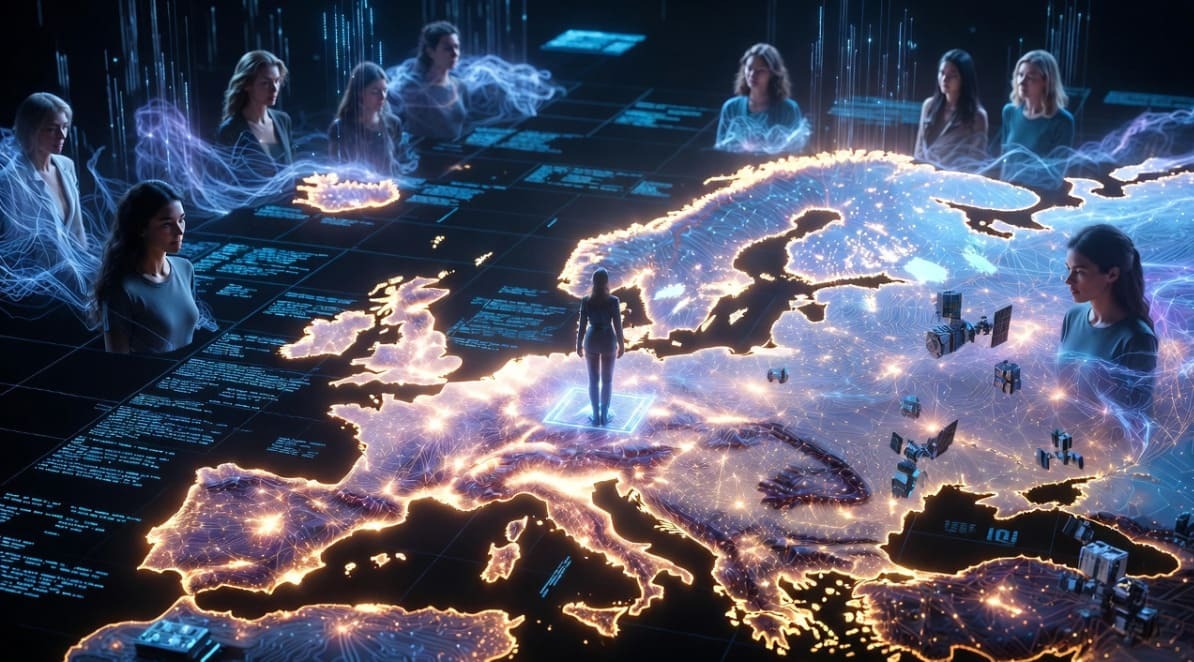
Technological power has long been concentrated in male-dominated institutions. Europe’s AI ecosystem still carries that legacy.
All-female founding teams secure just 1–2% of European venture capital, while female-founded startups (including mixed teams) claim around 13% overall. This imbalance persists despite surging AI investments across the continent.
In this pivotal moment, the EU has elevated technological sovereignty to a strategic priority. Beyond core regulation (EU AI Act, Digital Omnibus, European Innovation Act), the bloc is fueling significant initiatives to increase innovation and attract the greatest minds. Several target women directly to address gender gaps in deep tech and AI, such as WomenTechEU, which celebrated its impact with cohorts raising €53.8M in private funding at a recent final event:
With International Women’s Day 2026 under the theme “Give To Gain,” Europe is leading an inclusive, values-driven sovereign AI future.
The ten women featured in this article are at the forefront of that vision. They give their deep expertise and bold thinking to pioneer sovereign infrastructure, uphold principled ethics, and create transformative advances that strengthen Europe as a whole.
Who will be Europe’s top minds leading AI in this century? Below we outline some of the most promising.
Here are the 10 women shaping Europe’s AI future in 2026
Nuria Oliver (Spain)
Nuria Oliver leads the Transparency Working Group developing the EU’s General-Purpose AI Code of Practice, a vital voluntary framework that assists providers in fulfilling the EU AI Act requirements for transparency, documentation, and copyright protection. As co-founder and director of ELLIS Alicante, vice-president of the ELLIS network, and a human-centric AI specialist with a PhD from MIT, she crafts the guidelines that empower Europe to own its AI destiny.
Inma Martinez (Spain)
Inma Martinez co-chairs the steering committee and chairs the Multi-stakeholder Expert Group at the Global Partnership on AI, influencing global responsible AI development, while advising Spain’s State Secretariat for AI on national priorities. Martinez focuses on commercialization, sector applications such as agriculture, and the responsible integration of AI across industries. She shows that aligning innovation with high standards positions Europe to thrive in the AI era.
Claudia Nemat (Germany)
Claudia Nemat is currently an ABB Board Director, as well as being the chairperson of the Quantum Advisory Council at IQM. Previously, Nemat orchestrated Deutsche Telekom’s massive AI transformation during her 14-year board tenure (ending 2025). Her track record shows how to scale enterprise AI under tight regulation, exactly the expertise Europe needs for building independent AI factories and data sovereignty at industrial scale.
Sabine Klauke (France)
Sabine Klauke, Chief Technology Officer at Airbus, integrates AI into essential operations such as predictive maintenance, autonomous systems, and safety-critical aerospace solutions in a tightly regulated industry. She pushes for practical, innovation-supportive application of the EU AI Act to maintain Europe’s edge. Her efforts ensure regulation becomes an enabler of sovereign industrial strength.
Alessandra Sala (Italy)
Alessandra Sala, Global President of Women in AI and Senior Director of AI & Data Science at Shutterstock, drives the development of inclusive and reliable AI systems. Through her leadership of the AI and Multimedia Authenticity Standards Collaboration and co-chairing of UNESCO’s Women for Ethical AI platform, she tackles deepfake risks and strengthens compliance pathways under the EU regulation. She is forging the safeguards that allow Europe to innovate boldly while remaining ethically grounded.
Sjoukje Zaal (Netherlands)
Sjoukje Zaal holds the role of European CTO for Data & AI at Capgemini while heading the Microsoft Cloud Center of Excellence. In her role, she guides ethical AI strategies and major data/AI/multi-cloud projects for global clients. Her work transforms EU regulatory frameworks into actionable, compliant architectures.
Helena Samsioe (Sweden)
Helena Samsioe founded and leads GLOBHE, the world’s largest global drone-data marketplace, connecting over 11,800 operators across 147 countries to supply high-resolution, localized data for AI-powered digital twins. Her platform supports critical applications in climate monitoring, infrastructure inspection, and humanitarian aid. Samsioe is equipping Europe with the trustworthy, on-the-ground intelligence needed to build sustainable and independent AI capabilities.
Patricia Scanlon (Ireland)
Patricia Scanlon pioneered ethical voice AI for children’s literacy through SoapBox Labs, which was acquired by Curriculum Associates. As Ireland’s inaugural AI Ambassador and Chair of the national AI Advisory Council, she influences strategies that embed trustworthiness, equity, and human values into AI governance across Ireland and the EU. She ensures sovereignty is measured not just by power, but by people.
Elena Heber (Germany)
Elena Heber, co-founder and Managing Director of HelloBetter, develops and scales clinically proven digital mental-health therapies enhanced by AI. Recognized as a 2026 European Prize for Women Innovators semi-finalist, she expands access to evidence-based care in a highly regulated field. Heber shows Europe how to turn regulatory constraints into opportunities for sovereign, impactful health innovation.
Alesia Braga (Germany)
Alesia Braga leads product and technology as Group Chief Product & Technology Officer at Cint. At the Stockholm-based market research tech leader, she oversees platforms delivering high-quality, privacy-compliant consumer data networks. Braga’s work fuels unbiased, diverse datasets critical for ethical AI training and Europe’s data sovereignty efforts.
Momentum Building: Recognition and Infrastructure
These leaders are not operating in isolation. Their contributions are amplified by a growing ecosystem that actively spotlights and supports women in AI.
The European Prize for Women Innovators is the EU’s flagship award for women-led innovation. The 2026 edition celebrates breakthroughs in areas such as healthcare AI, with 18 semi-finalists announced in February and winners to be revealed at the European Innovation Council Summit in June.
Funding mechanisms like Open Horizons provide up to €55,000 in equity-free grants, mentoring, and corporate pilot opportunities for women-led deep-tech startups (including AI), with open calls continuing in 2026 to bridge funding gaps and enable real-world scaling.
These mechanisms increase visibility, build networks, and strengthen the talent pipeline, vital elements often under-emphasized amid hardware and policy debates.
Europe’s Real Competitive Edge
In 2026, AI sovereignty will not be secured by data centers or legislation alone. It will be determined by who designs, deploys, and governs the systems that shape economies and geopolitics.
Europe already has the talent to stand shoulder-to-shoulder with the United States and China. The decisive question is whether it fully invests in fairness, inclusion, and the activation of that talent.
The ten women profiled here make it unmistakable: sovereignty is not an abstract goal, it is operational reality. As Europe continues to widen the circle of who steers its AI future, it does not just keep pace. It sets the standard.
Author: Grace Sharp
See Also:
Europe’s 10 Most Valuable AI Startups to Watch in 2026