
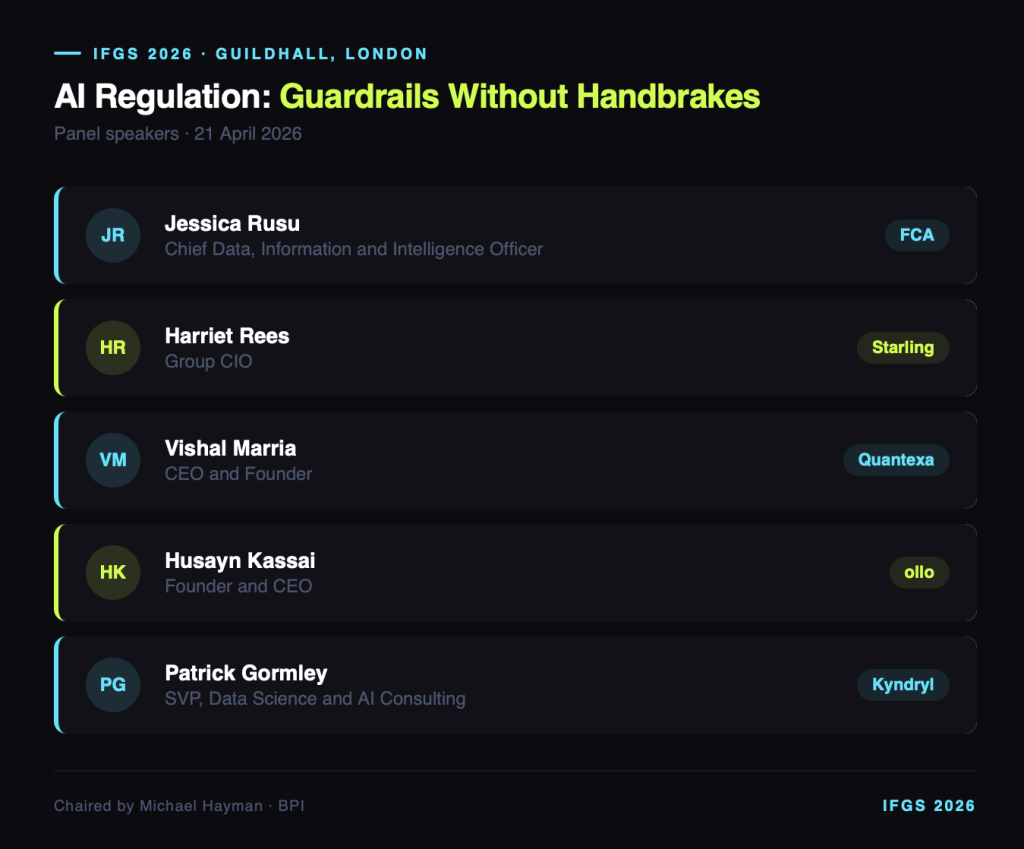
From extinction risk to payday loan warnings, the ‘AI Regulation: Guardrails Without Handbrakes’ panel at IFGS2026 was one of the sharpest conversations of the day.
There is something about the Guildhall that makes big conversations feel weightier. Walking into the Old Library at IFGS2026, you get the sense that the people in this room are not just talking about the future of finance. They are deciding it.
This year, artificial intelligence is everywhere at the summit. It is in the panel titles, the hallway conversations, the agenda. Last week, the government launched its £500m Sovereign AI Fund, described as a “first-of-its-kind” state-backed bet that British AI can scale to global competition. Today, the question in the room was whether the regulatory framework can keep pace, and whether British firms are ready to move.
The Regulator in the Room
The session opened with a direct question about pace. If you’re sitting there thinking things are moving too fast, what’s the message?
Jessica Rusu was straightforward about how the FCA is operating. Pro-innovation is in the strategy because technology moves faster than any rulebook can.
“We will absolutely take action if we think a firm hasn’t engaged and built robust controls, because our firms are on the front line. They’re protecting consumers from fraud, and they should be adopting AI and using it for that benefit.” Rusu explained.
On fraud, Rusu kept it simple. Understanding that AI is one of the most important tools for firms to protect themselves against financial crime is crucial. The individuals and organizations committing these crimes are not waiting for the UK’s regulators to catch up.
Rusu nailed this point when she asserted that “the criminals won’t stop to ask the question as to whether or not there’s a guardrail.”
Freedom to Experiment, With Oversight
As chief information officer for Starling, Harriet Rees focused on the collaboration between the UK’s financial services and regulation. She explained that the sandboxes and freedoms firms enjoy today didn’t come from thin air. They came from years of industry and regulator working through it together. Rees did a good job of reminding us:
“The regulatory environment in the UK has absolutely allowed people the freedom to both experiment and then start to scale. But that’s not been with no oversight and no involvement from the regulators,” she explains.
One of the key points in her talk was discussing how AI gets covered in the press. Most headlines are negative. But the financial services sector, she said, has a real chance to put this technology in front of consumers in ways they can actually feel.
Rees commented that, “lots of press that you read about AI naturally leans towards the doom scenario. But realistically, there is a huge amount of opportunity in the technology we now have in our hands.”
For this system to work, she explained, firms need to talk openly about where AI has gone wrong, not only where it has worked. Without this honesty, the industry will struggle to learn fast enough.
Is AI Governance the Enemy of Innovation?
Quantexa’s Vishal Marria wanted to correct something. AI isn’t new. Machine learning, deep learning, predictive models have been reshaping organisations for decades. Generative AI is the latest step, not the starting point. The real question for any boardroom, he said, isn’t whether to use AI. It’s whether the data underneath it is good enough to trust.
“The old cliché of garbage in, garbage out… How do you ground [these models] in trusted data to ensure you’re taking a non-deterministic model?” He explained.
Marria was also refreshingly blunt on something people rarely say out loud. Britain undersells itself: “we’ve got to stop talking downward… the NHS… the Treasury data, all the great academia we have in this country… we don’t talk about it enough” The room seemed to agree with this view.
When Compliance Becomes the Blueprint
Patrick Gormley gave the most practical account of what AI adoption looks like inside regulated firms. The journey, he said, follows the same pattern almost everywhere. First comes education. Then experimentation. Then proof of concept. And then firms hit the real wall: security, followed by risk and compliance. At that point the demands are non-negotiable.
Risk and compliance is “all very interesting, but for you to operate this at scale in my organisation… we need full auditability, transparency, observability. We can have no hallucinations.” He commented.
Does that kill the innovation? Gormley said no. It forces you to raise your game.
He ended with a number that landed. One Central European bank he works with is making AI agents central to its global strategy because 60% of its total cost base is tied to regulation. AI won’t remove that burden. It will make meeting it faster, cheaper and more accurate.
The Real Risk Is Public Trust, Not Regulation
Husayn Kassai built Onfido during the first wave of UK FinTech and is now leading ollo. He came with the founder’s perspective and a challenge for anyone in the room who thought regulation was the problem.
The worry he keeps hearing from AI founders, that UK regulation is holding them back, is simply not true in his view. He has a standing challenge for anyone who raises it:
“So the question is to any AI founder who says that they’re worried about AI regulation is can you give me one example. Because I don’t want to lose sleep either and there’s none. There’s some hype and some noise but it doesn’t bear any truth. We are not holding anyone back on AI regulation here, full stop.”
Instead, what actually keeps Kassai up at night is different. A high-profile AI fraud story. A large-scale abuse case. A collapse in consumer confidence. He pointed to payday loans as a warning. That scandal damaged trust in an entire category of financial services. A similar moment in AI could set the whole sector back years.
“My concern is not that AI is holding us back. My concern is that unless we get this right, like we did with FinTech, it’s going to permanently damage public perception. And we only get one shot at this.” Husayn stressed.
What Comes Next
The panel didn’t reach consensus but it reached something more useful.
Across five very different perspectives the same recognition kept surfacing: the technology is working, governance has to keep up, and the window for getting it right is narrowing fast.
The machinery is already moving. The FCA’s Mills Review reports to its Board this summer. The Treasury Committee wants practical AI guidance published by end of 2026. The Sovereign AI Fund is making its first investments. And just last week, Anthropic announced it is expanding its London office to accommodate 800 people, following OpenAI’s own move to open a permanent base in the city.
The global AI industry is voting with its feet on where it wants to build. London keeps coming up as the answer.
It is exactly the kind of conversation that has made IFGS the place where the UK’s financial future gets debated seriously.
Reported live from IFGS 2026, Guildhall, London. 21 April 2026.