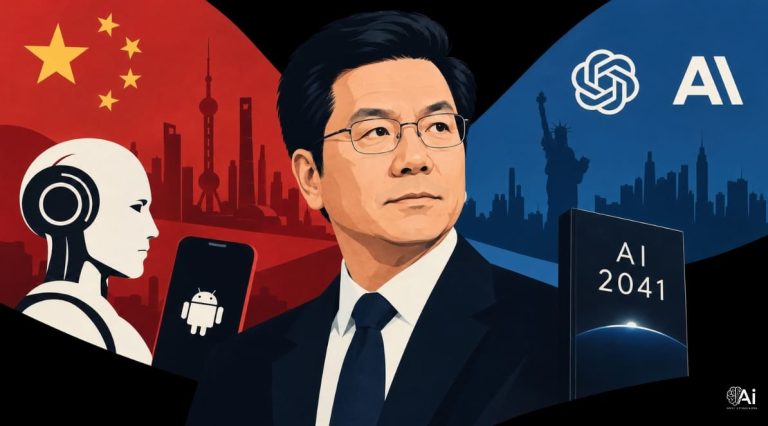

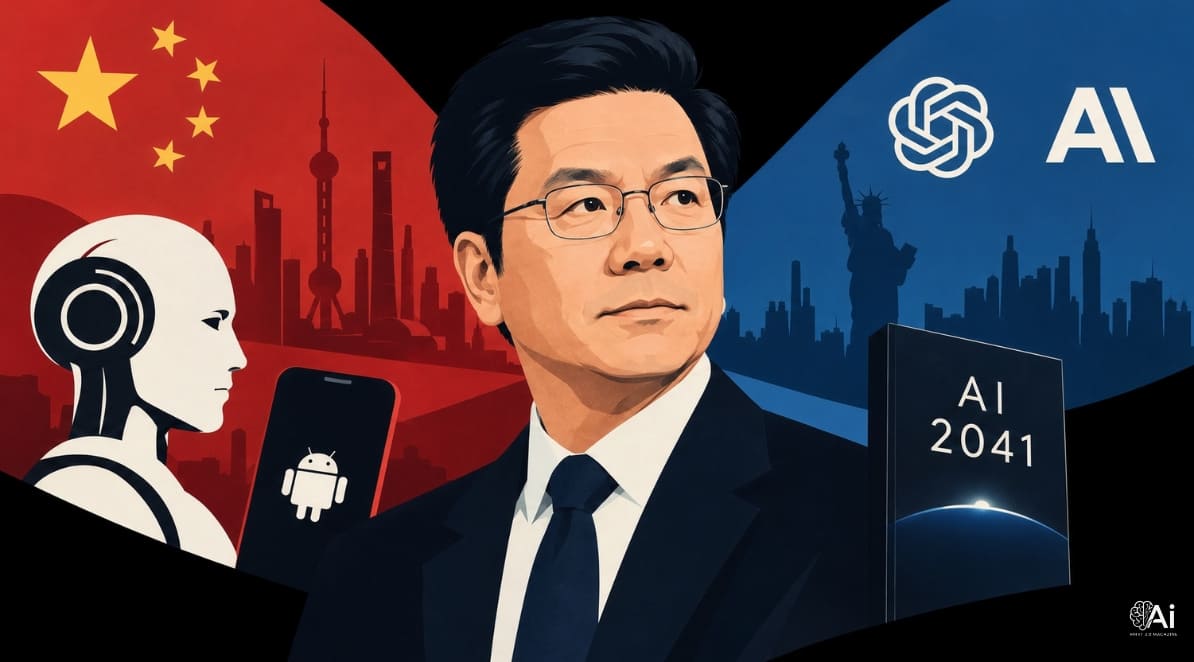
Kai-Fu Lee is the person Western executives call when they want China explained without flying to Beijing. In early September he told Bloomberg that Chinese models will win on reach and lose on profit. OpenAI and Anthropic built the iPhone. The Chinese labs built Android: nearly as good, six months behind, a fraction of the price.
That is why American companies are downloading them. It is also why officials have discussed limits on Chinese open models. In July the FCC already blocked new foreign-made humanoids and robot dogs, a rule aimed at China. Models may be next.
Lee is an authority on AI because he has been on every side of it. He ran Google China, wrote the book that taught the West to treat Beijing as an AI peer, backed one of the Four Dragons, China’s last-decade vision giants, then founded 01.AI. That company has not released a new open model since 2024. He left the race he spent a decade advertising.
Kai-Fu Lee and the Chinese state
Lee was born in Taipei in 1961. His father was a Sichuan-born legislator who had gone to Taiwan. Lee took a Columbia degree and a Carnegie Mellon doctorate, built Microsoft’s Beijing research lab, and in 2005 became president of Google China.
He is not a Communist Party official. There is no public record that he is a Party member. In 2011 he gave up US citizenship and said he wanted to “get back to [his] roots.” What he kept was Taiwanese nationality. He did not become a mainland citizen. He did stay in Beijing.
In 2013 he used Weibo to criticise China’s internet controls and to back journalists at Southern Weekend in a fight with censors. He called the blocking of GitHub a blow to Chinese competitiveness. The platform locked him out for three days. He did not become a dissident. He founded a venture firm, then an AI company, and kept taking the public slots Beijing offers people who sell Chinese tech as inevitable.
Lee has long argued that China can move faster in AI because it is less tangled in legal process and shared moral limits. In September he told Bloomberg that street cameras are a trade-off: crime falls, video is recorded. “In China, they would.” He was describing the system he works in, not running it.
In 2021 Lee published AI 2041: Ten Visions for Our Future with the novelist Chen Qiufan. Each chapter is a short story, then an essay by Lee. The argument running through those essays is that the danger is not the technology. It is the human being who deploys it.
“Technology is inherently neutral,” he wrote. “It’s people who use it for purposes both good and evil.”
A review in the Los Angeles Review of Books said Lee treats AI as an innocent tool while he invests in the companies that build it.
Kai-Fu Lee, Trump and US tech
Lee learned the industry in the United States. Apple, Silicon Graphics, Microsoft, then Google. When he left Microsoft in 2005 to open Google China, Microsoft sued him. A federal judge let him recruit in Beijing and speak to officials, and barred him from search and speech work until the case ended. He already knew how American companies fight over China.
In 2018 Lee published AI Superpowers: China, Silicon Valley, and the New World Order. It was a primer for readers who still thought of Chinese technology as imitation. Lee’s case was that Beijing had the data, the engineers and the will to implement AI at a scale Silicon Valley would not match. The book made him the interpreter: a man trained in American labs, based in Beijing, willing to say China was no longer behind.
Things did not go as he hoped. Biden and then Trump squeezed China’s access to high-end chips. Lee’s answer is that the controls undervalued Chinese engineers. DeepSeek and the open models that followed are his exhibit. His other answer, given to Bloomberg this month, is that American companies will still make more money. China will take the volume.
He can still explain China to an American audience. The companies that trained him are now being asked to treat Chinese models as a security problem. That is the position he occupies. It is not a verdict on Donald Trump.
Kai-Fu Lee and Megvii
Lee did not found Megvii. Three Tsinghua graduates, Yin Qi, Tang Wenbin and Yang Mu, started the company in 2011. Its product, Face++, sold facial recognition to phone makers, payment firms and security customers. Yin Qi had interned at Microsoft Research Asia, the Beijing lab Lee built. Sinovation Ventures, the Beijing fund Lee started in 2009, invested in 2013. Lee later said the firm had also introduced Megvii to early partners, including Ant and Meitu. By 2019 Megvii was valued at about $4 billion and counted as one of China’s Four Dragons.
The trouble arrived the same year. In May 2019 Human Rights Watch said Face++ code appeared in IJOP, a police app used to flag people in Xinjiang. Megvii wrote to HRW. HRW then added a note to that report: the Face++ code in the login function was inoperable, and Megvii “seems not to have collaborated” on the version of the app they examined. In October 2019 Washington added Megvii to the Commerce Department’s Entity List anyway, as part of a group of Chinese surveillance and AI firms it said enabled the Xinjiang campaign.
Lee’s own collision with the company came in September 2020. In a Beijing speech he said Megvii had collected facial data through those early partners. Ant, Meitu and Megvii said no user data had been shared. Lee apologised and called the remark a slip.
He has since said little about Megvii in English interviews. When Bloomberg asked this month about facial recognition and reports of its use in Xinjiang, he said Sinovation does not invest in surveillance and pointed to civilian uses and consent rules.
Kai-Fu Lee and 01.AI
Lee founded 01.AI in Beijing in May 2023. The first product was a family of models called Yi. In November that year the company released open versions that anyone could download. For a short period it sat with DeepSeek and the other Chinese labs in the open-model race. The last open coding model, Yi-Coder, came out in September 2024. A larger model, Yi-Lightning, followed in October as a paid product. After that the public releases stopped.
In early 2025 the company stepped back from training its own frontier models. Lee’s pitch changed with it. 01.AI now sells systems to governments and large companies: models that run on the customer’s premises, in the customer’s language, under the customer’s rules. The company calls this sovereign AI. In Kazakhstan it helped build AlemLLM, a Kazakh-language model, and in June 2026 formed a joint venture, Q.AI, with a former vice minister as chief executive. Lee sits on the country’s AI council.
The enterprise product is now called TrueNorth, launched in July 2026 as a “decision hub” for bosses, investors and sales teams. Lee has said signed orders were 500 million yuan in 2025 and more than 1.5 billion yuan by May 2026.
That is 01.AI now. It still carries the name of a model lab. But it no longer releases public models.
Kai-Fu Lee and sovereign AI
Sovereign AI is the name governments now give to a simple demand: a model that runs on their soil, in their language, under their rules. They do not want to rent an American system they cannot inspect. They also do not want to depend on a file anyone can download. Lee is selling the middle option. 01.AI will install the stack, train a local model, and leave the client with something it can call its own.
That is a different product from the one he advertised in 2018. AI Superpowers told Western readers that China would win by moving faster and cheaper. The Yi models were the exhibit: open, bilingual, good enough. Sovereign AI is the opposite pitch. The customer is not a developer on Hugging Face. It is a ministry, a state energy firm, a president’s AI council. Control matters more than a leaderboard.
It also fits the rest of his record. He has spent his career explaining Chinese technology to people who will not live under Chinese rules, and selling systems to people who want those rules on their own terms. Facial recognition was the first version of that problem. A national model is the current one. In both cases he says the tool is neutral. The buyer decides the use.
Washington now treats Chinese models as a security issue. Beijing treats compute and data as a state project. Between those two facts there is a market of countries that want AI without joining either camp. That is the market Lee is in.
Author: Andy Samu
See Also:
Chinese LLMs in 2026: The Complete Map – MRKT3.0
Is DeepSeek-V4-Flash Overtaking American AI Models? – MRKT3.0