
A neocloud is a cloud company built mainly to rent out AI chips, mostly NVIDIA’s, by the hour or on contracts that run for years. CoreWeave, Nebius, Lambda and Crusoe are the best known, and their list prices undercut Amazon, Microsoft and Google: an H100 hour costs $3.99 at Lambda against $11.06 on Google Cloud.
| What it is | A cloud company built to rent out AI chips (GPUs) |
|---|---|
| Examples | CoreWeave, Nebius, Lambda, Crusoe, Nscale, Fluidstack |
| Biggest | CoreWeave: 1.5GW of power running. June 30, 2026 |
| How it earns | Hourly GPU rental and multi-year take-or-pay contracts |
| How many | About 200 worldwide |
| Main risk | Debt taken on to buy chips before the contracts pay off |
What Does “Neocloud” Mean?
Neocloud means “new cloud”: a provider built for AI from the start, unlike the older, general-purpose clouds of Amazon, Microsoft and Google. The word spread after SemiAnalysis, a chip research firm, defined it in October 2024 as “a new breed of cloud compute provider focused on offering GPU compute rental.” SemiAnalysis says on LinkedIn that one of its researchers coined it.
Gartner now uses the term too, for “cloud providers built specifically for AI and high-performance workloads.”However, the companies themselves often avoid it. CoreWeave’s website calls it “The Essential Cloud for AI”, and Nscale’s IPO filing describes “a full-stack AI hyperscaler.”
Why Did Neoclouds Appear?
Neoclouds appeared because the demand for AI chips outran the big clouds. When the rush for NVIDIA GPUs began in 2023, companies with power and chips to hand could sell capacity faster than Amazon, Microsoft or Google could build it. Several were crypto miners at the start, such as Crusoe and IREN.
Even the hyperscalers rented in. Microsoft had committed more than $60 billion to neocloud companies by November 2025. Google, for its part, guarantees part of Fluidstack’s rent at sites run by three bitcoin miners: TeraWulf, Cipher and Hut 8. NVIDIA, meanwhile, backed several neoclouds with its own money.
How Is a Neocloud Different From AWS, Azure or Google Cloud?
A neocloud sells one main thing, time on AI chips, while a hyperscaler sells hundreds of services around them. Microsoft’s own guide for start-ups sets out the trade-off. Neoclouds offer lower hourly prices, faster access and bare-metal servers. However, they leave databases, identity and monitoring to the customer. Microsoft also says they suit firms that need compliance certifications less well.
| Neocloud | Hyperscaler | |
|---|---|---|
| Main product | GPU capacity, often whole servers | Hundreds of cloud services |
| Price | Flat price per GPU-hour, usually lower | Higher list prices, bundled discounts |
| Chips | Almost all NVIDIA | NVIDIA plus their own, such as Google’s TPU |
| Customers | AI labs and a few big buyers | Every kind of business |
| Money to build | Debt, backed by contracts | Cash from their other businesses |
Are Neoclouds Cheaper Than AWS or Google?
Neoclouds are usually cheaper than AWS and Google, at least on list prices. On November 4, renting one NVIDIA H100 for an hour cost $3.99 at Lambda, $4.50 at Nebius and about $6.16 at CoreWeave. By comparison, it cost about $6.88 on AWS, $11.06 on Google Cloud and $12.29 on Azure.
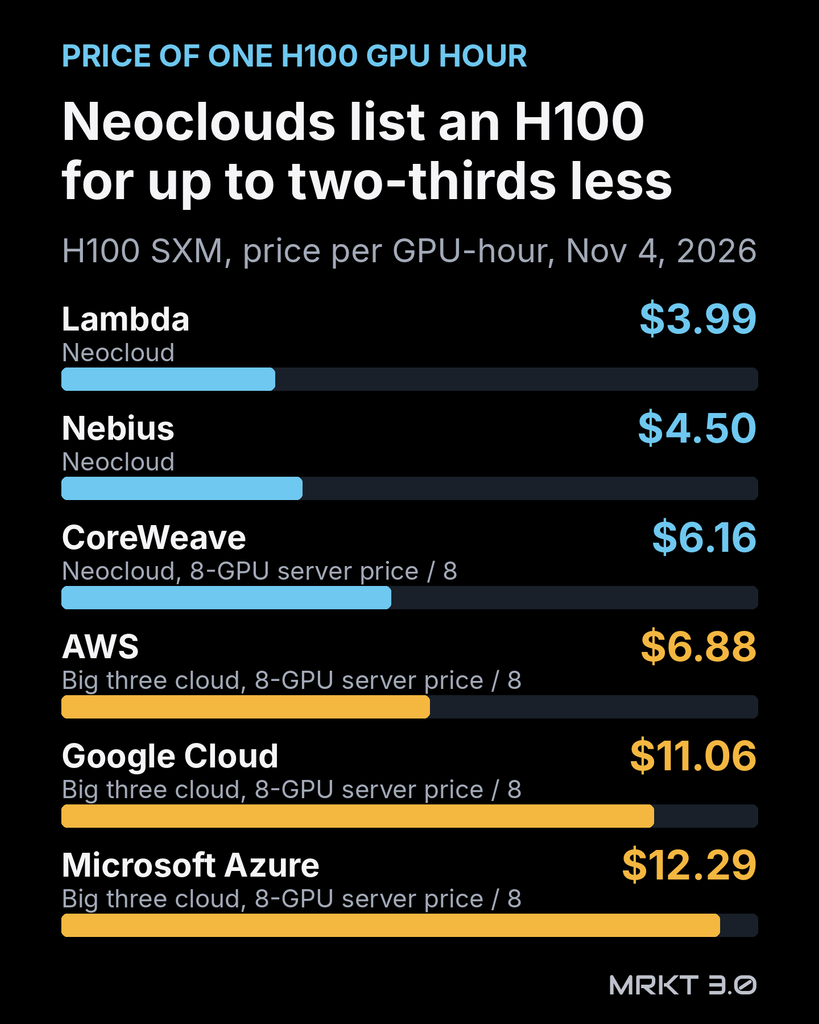
These are on-demand list prices per GPU-hour for the H100 SXM, the version sold in eight-GPU servers. Where a provider prices only the whole server, we divided by eight. Azure also rents a single H100 NVL, a slightly different chip, for about $6.98 an hour. Large customers also sign contracts below these prices. Download the prices with a source for each (CSV).
How Do Neoclouds Make Money?
Neoclouds make money from long contracts rather than hourly rentals. CoreWeave reported a revenue backlog of about $104 billion at the end of June. Nscale, similarly, listed $103.4 billion of contracts in its IPO filing, although only $2.6 billion of that was active.
Short rentals pay more. Nebius told shareholders in August that its big second-quarter deals were worth “$20-25 million per MW” of capacity a year. For short contracts of three to six months, by contrast, it saw “a price opportunity in the $40-50 million per MW range” and had just signed its first.
The model runs on borrowed money. A neocloud buys the chips up front, often with loans secured on them, and repays as the rent comes in. That works only if the chips keep earning. CoreWeave, for example, writes its GPUs off over six years, while the investor Michael Burry has argued their useful life is two to three years.
How Big Is the Neocloud Market?
Gartner expects neoclouds to win 20% of a $267 billion market for AI cloud services by 2030, or about $53 billion a year. Others go further: the bank William Blair puts neocloud revenue at about $25 billion in 2026 and between $200 billion and $300 billion by 2031.
Who Are the Biggest Neoclouds?
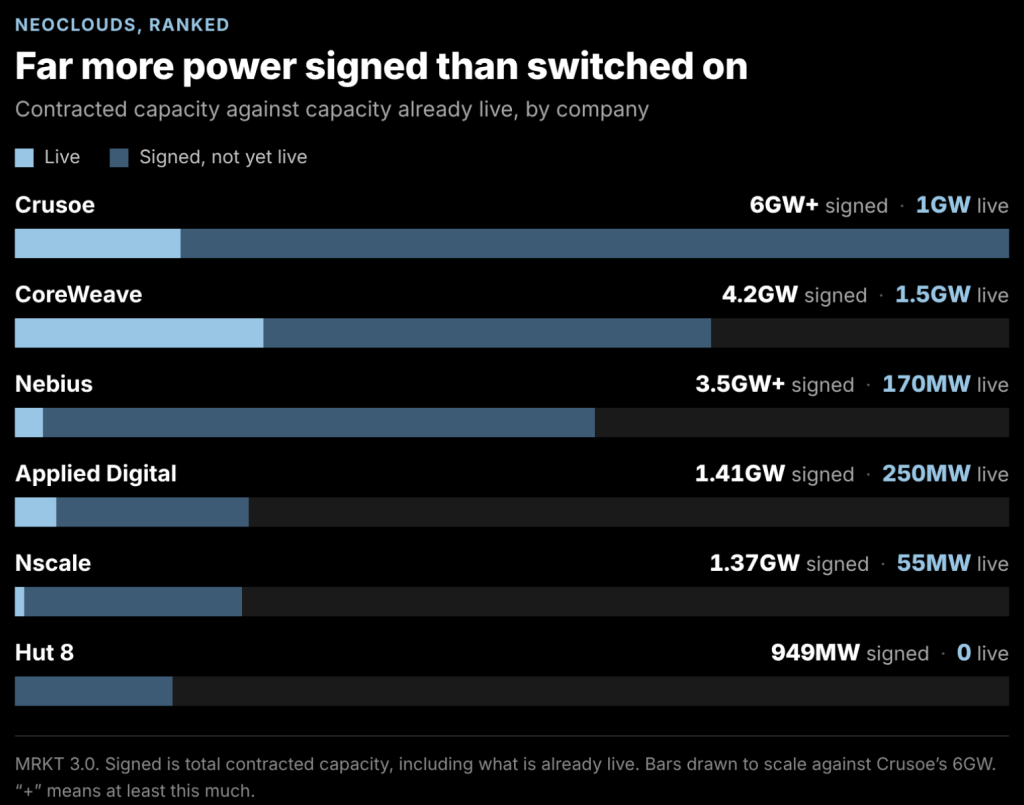
CoreWeave is the biggest neocloud, with about 1.5GW of power running at the end of June 2026. On power actually live, our ranking of the ten biggest puts Crusoe (1GW, self-reported), Core Scientific (437MW) and Applied Digital (250MW) next. The last two mostly lease data centres to CoreWeave. Nebius follows, with about 170MW at the end of 2025. SpaceX reports 1.7GW, but it does not say how much of that it rents to others, so we leave it out.
Is a Bitcoin Miner a Neocloud?
Some are. A miner that buys GPUs and rents them out runs a neocloud, as IREN does for Microsoft. By contrast, one that leases buildings and power to others, such as Core Scientific or TeraWulf, is a landlord to neoclouds.
SemiAnalysis draws the same line between miners that rent out “Powered Shell / Colocation” and those that offer “Wholesale Bare-Metal” GPUs. However, Roundhill’s neocloud ETF and Synergy Research’s market figures count both kinds. As a result, the same company can be a neocloud on one list and a landlord on another.
Are There Neoclouds in Europe?
Yes, and two of the best known are European: Nebius, based in Amsterdam, and Nscale, based in London. Fluidstack was founded in Oxford but is now headquartered in the US. It builds capacity for Anthropic and has announced a 1GW site in France.
Smaller ones include Verda, formerly DataCrunch, in Helsinki, which raised $189 million in September at a valuation of at least $1 billion. There are also Sesterce in Marseille and Taiga Cloud, the GPU cloud of Northern Data, which Rumble took over in June.
Will Neoclouds Survive?
Not all of them are likely to survive. Gartner expects more than 80% of neocloud providers to stop operating independently by 2030. The cause, it says, is cost pressure and the lack of a business model that sets them apart. Elon Musk also predicted on October 25 that the “200+ neoclouds” face “guppy-level death and consolidation.”
The risks show in the accounts. At the end of June, CoreWeave carried about $35 billion of debt plus $16.5 billion of lease liabilities. Its largest customer brought in 36% of second-quarter revenue. In mid-October, its bonds also traded at yields of about 15%, a level that usually signals distress.
NVIDIA is the other side of the case. It owns stakes in CoreWeave and Nebius, and agreed in 2025 to buy $6.3 billion of CoreWeave’s unsold capacity through April 2032. Crusoe’s chief executive, Chase Lochmiller, said on October 27 that “a lot of this angst is overblown.”
Can You Invest in Neoclouds?
Yes. CoreWeave, Nebius and IREN trade on Nasdaq, along with companies that grew out of bitcoin mining, such as Core Scientific, Applied Digital, TeraWulf and Hut 8. Roundhill also runs a neocloud ETF, NCLD. Crusoe, Lambda and Fluidstack are private, while Nscale has filed to list in New York; our IPO tracker follows each listing.
Author: Akos Szima
See Also:
What Is Nebius? The AI Cloud Now Worth More Than CoreWeave
Europe Is Hosting an AI Build-Out It Cannot Afford to Fund
Largest Data Centres in the World: The Gigawatt Club (2026)
How We Checked This:
Definitions come from SemiAnalysis, Gartner and Microsoft, and company figures from filings and results. Prices are each provider’s on-demand list price on November 4, 2026; AWS and Azure prices come from the Vantage price tracker. Prices change often, and large customers pay less.
Frequently Asked Questions:
Neo means new. The research firm SemiAnalysis popularised the word in October 2024 for cloud companies built from scratch to rent out AI chips, as opposed to the older clouds of Amazon, Microsoft and Google.
About 200. Elon Musk spoke of “200+” in October 2026, and SemiAnalysis, which rates GPU clouds, tracked 209 of them in November 2025.
Yes, and the biggest, with 1.5GW of power running at the end of June 2026. The company avoids the word and calls itself “The Essential Cloud for AI.”
This article is based on company filings, published prices and research reports, and is not investment advice. MRKT 3.0 has no commercial relationship with any company named above.