
Developers running long agent tasks just got a cheaper option that keeps far less context sitting in expensive memory. On October 17, DeepSeek published the weights for V4.1-Flash-1017.
The update is a small revision of the existing Flash model. It is a multimodal Mixture-of-Experts system with a 552-billion-parameter backbone. It activates only 8 billion parameters per token while reading input and 16 billion while writing the reply. Context length stays at one million tokens.
Will the lower memory cost and open weights be enough to shift more production workloads away from closed American models, or will the reliability gaps keep it as one efficient option among many? Let’s take a look.
How Much Hardware Does the Model Save?
The biggest hardware advantage sits in the key-value cache, the temporary memory the model uses to remember earlier parts of a long conversation without recalculating everything from scratch. DeepSeek introduced the reduction with the September V4.1-Flash release.
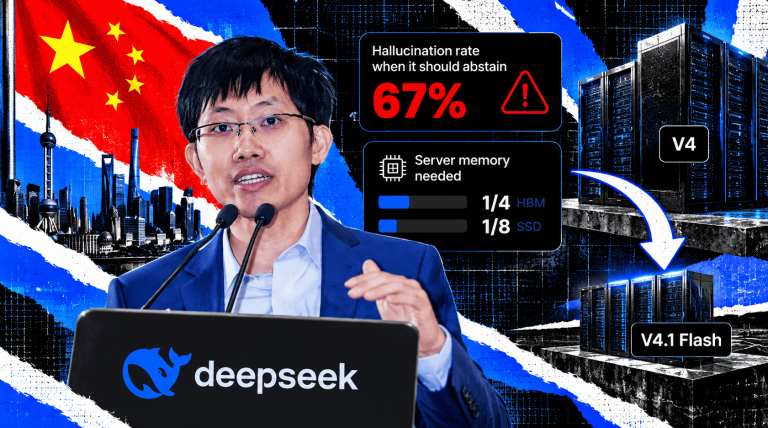
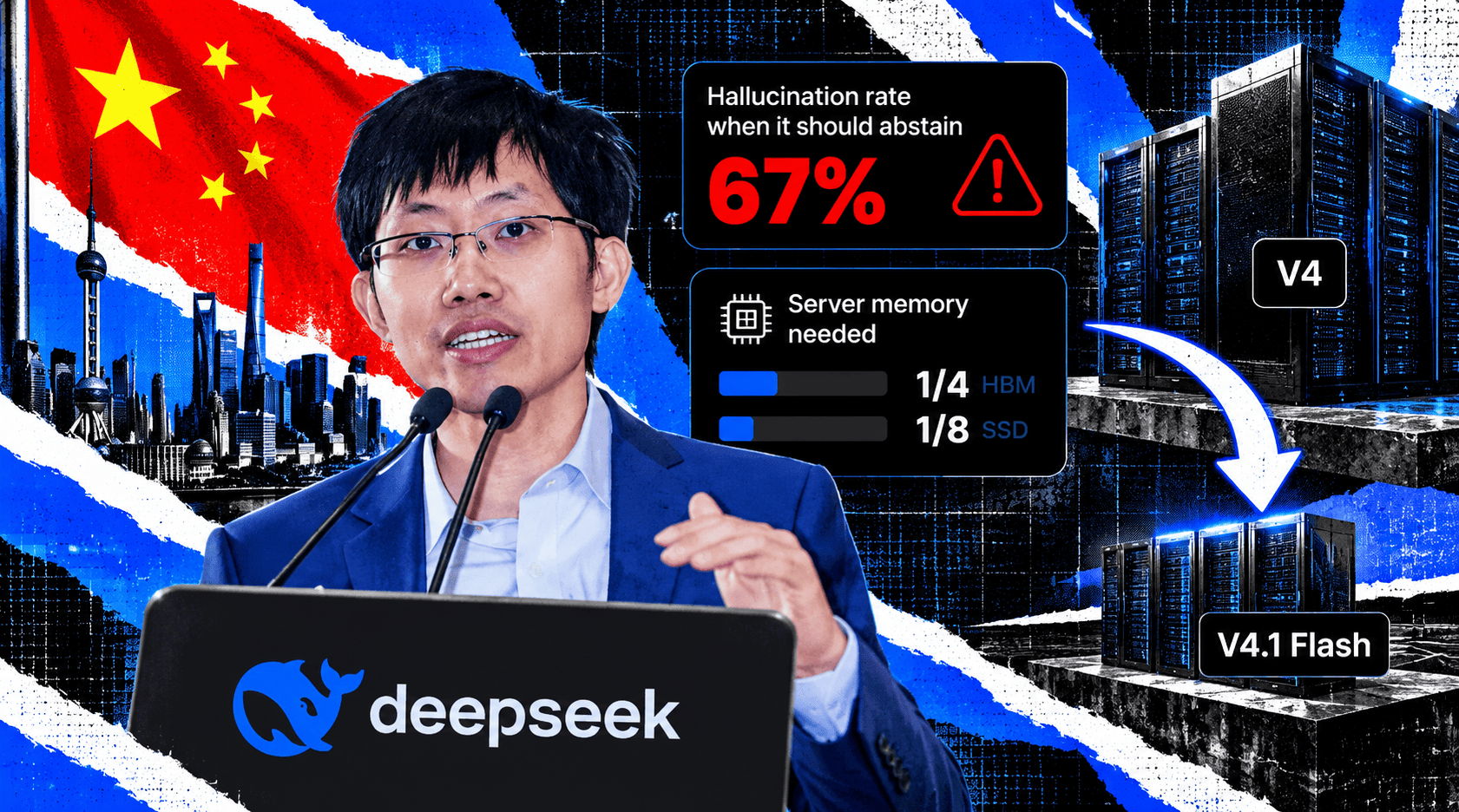
Its technical description puts the global cache that stays in high-bandwidth memory at 890 bytes per token. That is roughly one-quarter the HBM footprint of the previous Flash version. A separate optimisation drops the persistent cache stored on solid-state drives or ordinary host memory to about one-eighth the prior size.
The savings come from two design choices already present in V4.1-Flash: Compressed Sparse Attention 2, which reuses keys and selection indices across layers, and FP4 caching. The October 17 1017 update retains this footprint while improving coding and agent scores at the same low price.
How Cheap Is the Model to Run?
On Arena’s Agent Arena leaderboard (7,498 real-use sessions) the update ranked first among open-weight models, with median costs reported between roughly $0.18 and $0.20 per task.
API prices also stay low. Off-peak rates are $0.15 per million input tokens and $0.60 per million output tokens. Cached input tokens drop to $0.003 per million. DeepSeek also charges $0.75 (about 5 yuan) per 1,000 successful calls to its Search and Fetch API. Per-request billing for Claude Code and Codex integrations begins on 31 October 2026 at 16:00 UTC.
Where Does Reliability Break Down?
Artificial Analysis tested the model on its Omniscience benchmark for factual knowledge and willingness to abstain. The non-hallucination rate reached 33%. That is a large jump from the prior version’s 4%, but it still means the model hallucinated on roughly 67% of the questions where the correct move was to give no answer.
Accuracy moved from 43% to 46%. The overall Omniscience Index rose from –5 to +5. On the same factual set the model still lagged many proprietary competitors. DeepSeek has not issued a public response or described any mitigation plan for these results.
The efficiency gains show up most clearly on coding and agent tasks, where the cost of a successful run is the number that matters most.
Not Yet a Shift
So, the big question remains: will this model be enough to challenge America’s closed-weight models?
For now the answer is mostly no. The lower memory cost and open weights make V4.1-Flash-1017 a genuinely attractive efficient option for coding and long-running agent workloads. However, the 67% failure rate on cases that call for abstention (even after the large jump from 4%) is still large enough that most production teams are unlikely to move high-stakes workloads off closed American models on the strength of this checkpoint alone.
Author: Grace Sharp
See Also:
Is DeepSeek V4.1 Flash Faster Than Qwen3.8 Flash?