
Currently 85% of OpenAI users live outside the United States. While a specific breakdown by region has not been released, it’s clear a good chunk of that user base resides in Europe. Presently, 75% of OpenAI’s revenue comes from consumer subscriptions, while enterprise accounts for most of the rest.
CEO Sam Altman not so long ago spoke of $1.4 trillion spending commitments in the coming years. However, according to a CNBC article, the company now aims to spend $600 billion by 2030, while growing its total revenue to $280 billion.
To achieve its goals, OpenAI will have to grow its revenue from approximately $13.1 billion in 2025 to $280 billion in 2030, an exponential leap. It’s an all hands on deck kind of task. But with Europe developing its own sovereign AI and AI infrastructure, can OpenAI rely on Europe to help sustain its lofty revenue goals?
A Trickle, Then a Flood: OpenAI’s Massive Funding Edge
While AI startups in Europe have begun to compete with American firms, OpenAI still enjoys a huge funding advantage. Amidst OpenAI’s recent $110 Billion funding round by Amazon, Nvidia, and SoftBank, it’s perhaps instructive to recap its funding history.
In March of 2019, OpenAI, then a registered nonprofit, created a capped-profit subsidiary to attract investment. Investment came a half year later when Microsoft committed $1 billion to OpenAI in an exclusive partnership. Subsequently, Microsoft renewed its partnership with OpenAI in 2021 and 2023, adding up to a $13 billion investment.
Then, in March of 2025, OpenAI closed a $40 billion funding round, the most in history at the time for a private company. $30 billion came from Japan’s SoftBank, the remaining $10 billion from a syndicate of investors.
Nowadays, that $40 billion figure seems quaint, as OpenAI has recently raised $110 billion in private funding from Amazon and others. The funding came amidst Microsoft loosening its grip on the ChatGPT maker, allowing OpenAI to diversify its compute providers.
For Microsoft’s troubles, they currently own 27% of OpenAI. This could mean a financial windfall for Microsoft should OpenAI go public. In the meantime, Microsoft gets 20% of OpenAI’s revenue, before expenses, until 2032. That means that despite OpenAI burning through mountains of money and racking up astronomical losses year after year, Microsoft gets its cut of topline revenue. Beyond that, OpenAI runs on Microsoft’s Azure and has paid billions to use Microsoft’s cloud service.
Critics have labeled this circular financial arrangement derisively as the “cloud laundry.” However, it’s not the only circular financial arrangement of which OpenAI is a part. In fact, much of OpenAI’s funding relies on circular investments, in which companies, after a fashion, pay OpenAI to use their products.
Sovereign AI and European Startups Challenge OpenAI
Although bullish on AI in general, HSBC predicts that by 2030, OpenAI will suffer a $207 billion shortfall. If the numbers presented in the CNBC article are accurate, that number is actually low.
While OpenAI’s revenue will increase substantially from advertising, paid subscriptions, enterprise AI, and possibly branded OpenAI electronics, the cost of data center leases and cloud computing will still significantly outpace revenue.
So what is OpenAI’s plan to beat the odds? As articulated by Altman, it seems fairly straightforward: OpenAI must secure market dominance in the next four to five years, while beating back well-funded competition and doing so before all the GPUs they’ve paid for become obsolete.
The problem for OpenAI is that the competition is getting bigger and better. Google’s AI, Gemini, has an extremely profitable parent company funding it. In addition, Google, like Apple, has an ecosystem that keeps its users locked in to its products. OpenAI doesn’t.
Meanwhile, Chinese open-source AI is rapidly advancing. Several models have entered the market, some being adopted into business in neighboring countries in Asia that prefer the lower cost open-source option.
Then there are the European startups. France’s Mistral AI is one. While still a fraction of OpenAI’s valuation, the startup has grown significantly since its inception. Part of this is due to political support and the French business sector not wanting to be beholden to an American company.
In a 2025 TV interview, French President Emmanuel Macron advised:
“Go and download Le Chat, which is made by Mistral, rather than ChatGPT by OpenAI.”
Europe also maintains strict data privacy regulations (GDPR). While OpenAI has sought to adhere to these regulations, many French businesses have shown a preference for AI sovereignty and to do business with Mistral AI as a result.
Meanwhile, several pushes to develop AI and build data centers are happening in Scandinavia, Germany and elsewhere in Europe. In each case, AI sovereignty is seen as a paramount concern. While Europe cannot compete with the scale of American operations, loyalty to national AI firms can eat into OpenAI’s enterprise revenue.
Currently, 75% of OpenAI’s revenue comes from consumer subscriptions. However, forecasts see enterprise revenue accounting for half of all OpenAI’s revenue. That would mean that by 2030, $140 billion would need to come from enterprise contracts.
If European firms prefer doing business with European AI businesses, this could spell trouble for OpenAI’s ambitious revenue goals. Meanwhile, a Deutsche Bank report published in October of 2025 described ChatGPT consumer subscriptions flatlining in the second half of 2025.
A Push for Diversification
In a hard push for increased revenue, OpenAI is currently developing several products beyond its generative AI chatbot. One such endeavor is AI hardware, such as electronics and wearables. In May of 2025, OpenAI bought IO Products, a recent AI hardware startup, for $6.5 billion in an all-stock deal.
IO Products is led by Jony Ive, the chief designer of early iPhones, brought on to run the newly formed division. Proprietary OpenAI speakers and eyeglasses are currently in development, a plan perhaps encouraged by Meta’s enormous success in 2025 with its AI glasses, selling over 7 million pairs.
However, OpenAI glasses won’t hit the market until 2028, at the earliest. In the meantime, the company will need to seek other avenues to increase revenue.
And Then There Were Ads
In October of 2024, at a talk at Harvard, Altman said that he hated ads and that running ads to boost revenue was a “last resort.” At one point, he mused, “Ads plus AI is sort of uniquely unsettling to me.”
Since then, his opinion has changed. Perhaps the thought of going bankrupt was also uniquely unsettling? It’s a bit unclear how ad placements on ChatGPT were not always on the table as a source of revenue. Maybe Altman believed Enterprise AI or the subscription model would grow more quickly.
Only 5% of ChatGPT’s 800 million users pay for a subscription. Recognizing that customers like using AI for free and can’t be cajoled into paying a subscription, Altman now thinks an ads-based mode makes sense.
Last Resort: 2026 Revenue Challenges
Does this mean we’re officially in the “last resort” phase of OpenAI? It’s March 2026, and the free version of ChatGPT is starting to feature advertisements. Whether that means something significant for future revenue or an increase or decrease in customer engagement, time will tell.
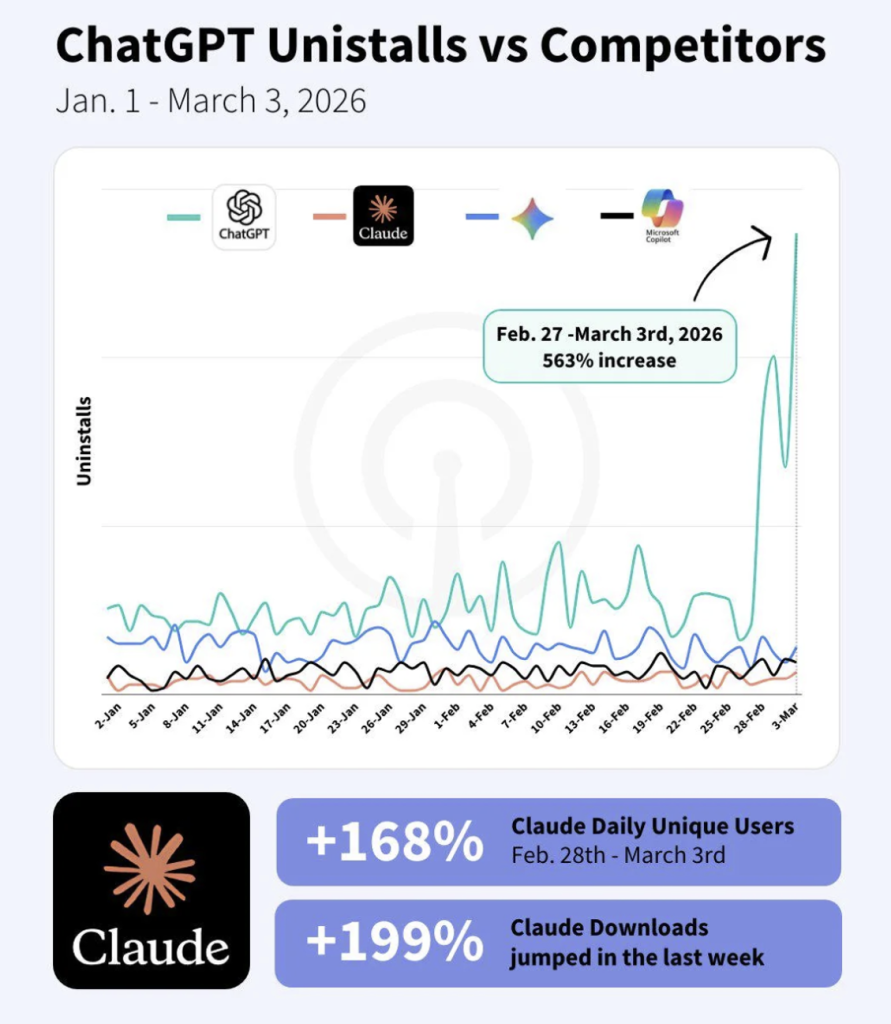
Meanwhile, OpenAI is facing a backlash due to OpenAI’s deal with the Pentagon, in which “uninstalls” have spiked 563% since January. In the same time period, rival Anthropic enjoyed a 199% increase in downloads of its chatbot Claude.
In the eleven years of its existence, OpenAI has morphed into drastically different versions of itself, going from a research nonprofit funded by donations to a for-profit company partnering with Microsoft, to a Public Benefit Corporation eyeing an IPO.
In the meantime, competition has only increased, in Europe and elsewhere. Perhaps exponential revenue growth and new partnerships will pay for OpenAI’s huge infrastructure commitments. But with Europe increasing its own presence in the AI space day by day, it won’t be easy.
Author: Tim Tolka, Senior Reporter
The editorial team at #MRKT3.0 has taken all precautions to ensure that no persons or organizations have been adversely affected or offered any sort of financial advice in this article. This article is most definitely not financial advice.
See Also:
The EU’s Sovereign AI Push: Claiming Tech Independence
Anthropic Defies Pentagon: Trump Bans Claude AI in Military Dispute