Tesla’s Optimus, a general-purpose humanoid robot engineered byElon Musk’s team, has gripped global attention as his boldest venture yet. Yet critics and industry watchers increasingly call it overhyped: repeated delays in full autonomy and high-volume production, heavy reliance on teleoperation in viral demos rather than true end-to-end AI, and a stretched “world-changing abundance” narrative amid execution hurdles and rising competition from more grounded rivals. Meanwhile, the humanoid AI robotics arms race is shifting focus to Europe.
From a quiet, unsuspecting German town, NEURA Robotics just dropped three massive AI-driven bombshells in under two weeks. The impressive list includes a €1 billion funding round, a chip-level deal with Qualcomm, and the launch of Europe’s largest physical AI training center.
This is no longer a hype-fueled ‘watchlist’ contender. NEURA is executing at breakneck speed, scaling production, locking in partners, and positioning Europe to claw back sovereignty in a field dominated by American and Chinese giants.
Could this be the Tesla Optimus challenger we’ve been waiting for? Let’s dive in.
The Father of Europe’s Cognitive Robotics: Meet David Reger
David Reger, CEO and founder of NEURA Robotics, frustrates competitors by being years ahead. After spending much of his career in Swiss high-tech automation, Reger moved to the German town of Metzingen, where he eventually launched NEURA in 2019. At the time, the world barely noticed cognitive robotics. Now, it can’t look away.
As a German Founders Award winner, Reger’s mission is to “expand human potential” by giving people time back for what truly matters. His vision? Safe, intelligent machines that work alongside humans in industry, services, and homes. Reger does not want to build robots that just follow scripts; he wants adaptive machines that can see, hear, feel, and learn from experience.
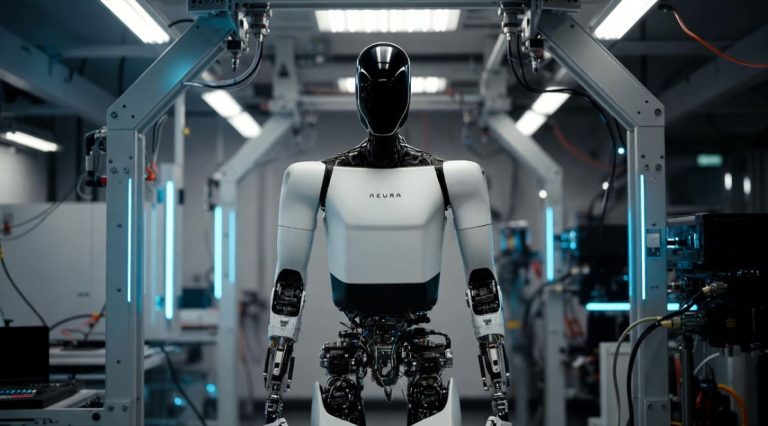
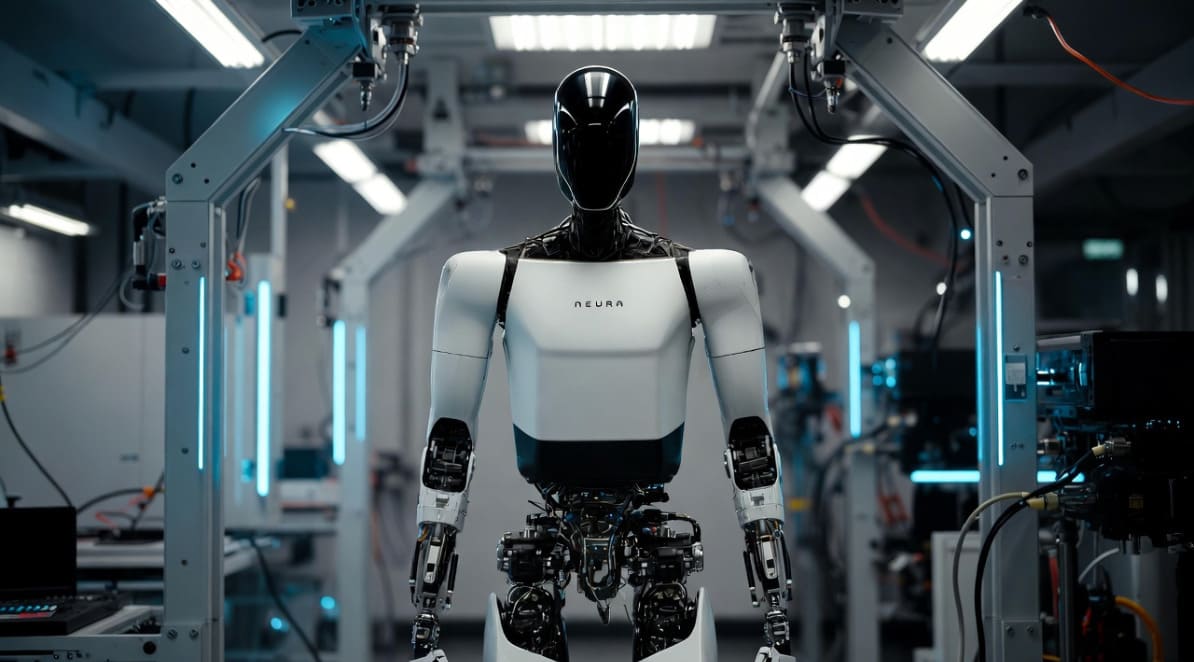
That layered philosophy powers NEURA’s edge: proprietary AI fused with breakthrough sensors for genuine perception and decision-making. The flagship is the 4NE-1 humanoid (“For Anyone”), Europe’s first series-production-ready cognitive robot, sleekly designed in collaboration with Studio F.A. Porsche. Already rolling off German production lines, it stands 1.8 meters tall, weighs 80 kg, and starts at €60,000 per unit. 4NE-1 proves cognitive robotics isn’t just hype, it’s happening.
€1 Billion Tether Round Values NEURA at €4 Billion
Bloomberg reported on March 4, 2026, that NEURA Robotics is closing a €1 billion ($1.2 billion) funding round, backed in part by Tether Holdings SA (the issuer of USDT, the world’s most widely used stablecoin). The deal values the AI startup at about €4 billion post-money, with hints of more capital to follow.
This comes after a €120 million Series B in January 2025, led by Lingotto Investment Management (Exor NV) alongside Volvo Cars Tech Fund and others. The fresh funds target scaling AI-powered humanoid robots for real work, not just lab toys.
The vision is appealing, until you recall the November 2025 rumors pegging NEURA at €8 to €10 billion. March’s final €4 billion lands well below those hype levels, with the reality suggesting the market isn’t handing out robot premiums blindly.
Tether, which posted a $13.4 billion profit in 2024, has been on a frontier tech spending spree, from AI startups to brain-computer interface firms like Blackrock Neurotech. CEO Paolo Ardoino has publicly stated his belief in a future populated by “trillions of AI agents and billions of robots.” NEURA slots right into that bold thesis.
Crypto money fueling humanoid bots might raise eyebrows, but it’s a telling sign: physical AI is now attracting capital from every corner. Traditional venture capital alone can’t cover the billions needed for actuators, fleets, and scale. For NEURA, this is a safe play, locking in firepower to accelerate production and outpace the competition.
Qualcomm Chose NEURA to Build the Standardized Robot Brain
Nine days after the funding announcement, on March 9, NEURA and Qualcomm announced a strategic collaboration to build the next generation of robots and physical AI. The partners are jointly developing the “brain and nervous system” for humanoid and general-purpose machines.
The anchor is Qualcomm’s new Dragonwing IQ10 Series processors. These chips handle mixed-criticality systems, managing high-level AI reasoning while simultaneously maintaining real-time motor control. NEURA’s 4NE-1 humanoid and MiPA service robot will serve as the official reference designs.
Reger stated clearly: “this collaboration marks a major step toward making physical AI real: open, scalable, and trusted.” Qualcomm’s Nakul Duggal added that robotics demands instant, local decisions, exactly where their edge in AI and connectivity shine.
The setup pairs Dragonwing chips for low-latency control with NEURA’s Neuraverse platform for simulation, training, and fleet management. The result is humanoids that perceive, reason, and act safely in factories or homes, free from constant cloud reliance.
The true value lies in standardization. Humanoid robotics currently lacks a common interface for AI software across hardware platforms. This partnership addresses that head-on.
Qualcomm gains real-world testing through NEURA Gyms. NEURA gains semiconductor credibility without developing chips in-house. It is a clean, mutually beneficial exchange.
NEURA Powers Europe’s Largest AI Robot Gym
Just one day after the Qualcomm partnership, on March 10, NEURA Robotics and the Technical University of Munich (TUM) and its Munich Institute of Robotics and Machine Intelligence (MIRMI) launched the TUM RoboGym (powered by NEURA).
This joint €17 million investment (with NEURA contributing roughly €11 million), creates Europe’s largest scientific training center for physical AI. Located at the TUM Convergence Center near Munich Airport, the 2,300 m² space will host humanoid fleets for real-world training starting mid-2026. All data feeds into Neuraverse, NEURA’s hardware-agnostic learning platform.
TUM MIRMI Professor Lorenzo Masia stated that “European sovereignty is extremely important in times of geopolitical competition between East and West.”
Reger has emphasized the point repeatedly: hardware is no longer the bottleneck in intelligent robotics. Access to realistic, large-scale training data is. The RoboGym closes that gap for NEURA, giving Europe a sovereign path to scale truly capable, adaptive machines.
Key Partnership’s Fueling Growth: Bosch Is Already In
2026 started with another strong signal. In January, NEURA and Robert Bosch Robotics GmbH signed a strategic partnership to jointly collect real-world work, movement, and environment data inside Bosch facilities and co-develop AI-based software for industrial humanoids.
Bosch’s Head of Intellectual Property, Peter Svejkovsky, confirmed the deal includes potential supply of robotic components and motor production for humanoids, manufacturing scale NEURA doesn’t yet have alone.
The order book already exceeds €1 billion. That includes an approximately €300 million framework agreement with Schaeffler, as valued by industry sources, from November 2025. Reger’s stated target is five million robots delivered by 2030, for industry, services, and households.
Why NEURA Leads Europe’s Humanoid Robot Race (For Now)
The global humanoid robot market sits at about $2.92 billion in 2025 and is forecast to hit $15.26 billion by 2030 at a 39.2% CAGR. That is a massive runway, fueled by labor shortages and AI breakthroughs. However, the race is brutal. Tesla (Optimus), Boston Dynamics (Hyundai), Figure AI, and China’s rapidly scaling AgiBot all move fast with deep pockets and bold timelines.
NEURA Robotics stands out with three edges: sovereign, high-quality training data from RoboGym, Qualcomm-powered edge AI brains for safe deployment, and Neuraverse as an open ecosystem.
While US and Chinese players dominate headlines, Europe has lagged in scale. NEURA flips that script. The company provides EU-compliant data, local German manufacturing, and cognitive intelligence that avoids foreign cloud dependency. Hardware costs are dropping fast, but the real moat is realistic data and safe scaling, NEURA is building both at speed.
Will NEURA deliver on its promises?
The €4 billion valuation, well below the €8–10 billion initially rumored, tells you institutional capital is still watching, and is not yet ready to choose a winner. Yet, NEURA has entered 2026 with impetus rarely seen in Europe’s AI scene. From building hardware and software in house, it is generating sovereign European training data at scale. Combining this with the company’s active chip manufacturing and impressive list of partners, NEURA is getting the attention it should deserve.
The infrastructure is solid, but hardware firms often falter at scale. That is exactly where NEURA will be tested next.
Author: Richardson Chinonyerem
See Also:
Anthropic Defies Pentagon: Trump Bans Claude AI in Military Dispute