
Finland has built one of Europe’s most reliable production lines for turning research into AI companies. Whether it can keep them is another matter. The country that produced Supercell, Wolt and Silo AI watched all three pass into foreign hands, and the class of 2026 is raising money under the same shadow.
Why Does Finland Produce So Many AI Startups?
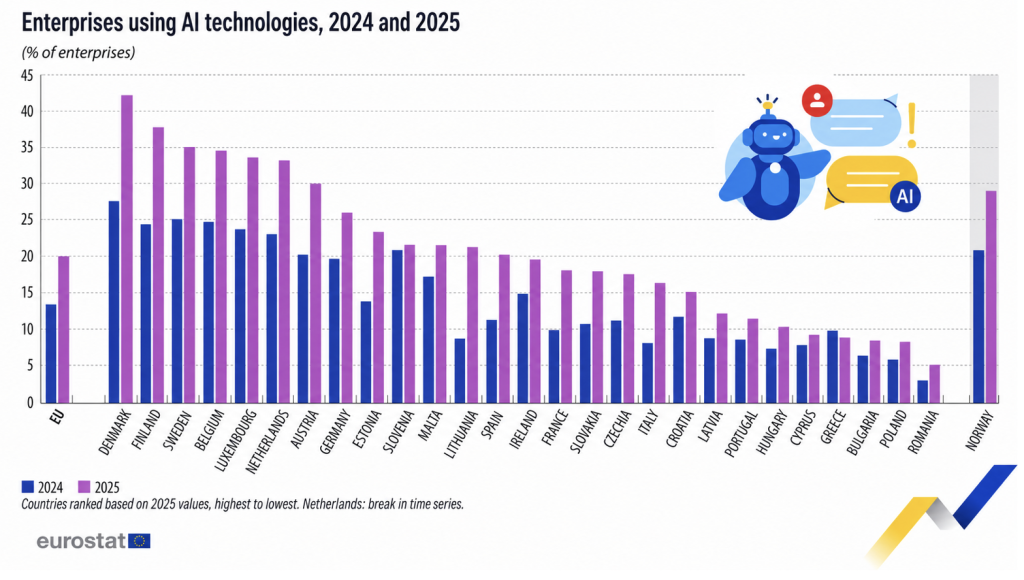
It starts with demand at home. Finland has the European Union’s second-highest rate of business AI adoption. In 2025, 37.8% of Finnish enterprises with at least ten employees used an AI technology, according to Eurostat. Only Denmark ranked higher, at 42%, while the EU average was 20%. Finland’s rate rose by 13.5 percentage points in a year, the bloc’s second-largest increase.
But demand doesn’t build companies. Finland’s AI startup pipeline comes from a recognisable system, a machine with four moving parts:
- Compute – the LUMI supercomputer, the EuroHPC machine hosted by the IT Centre for Science (CSC) in Kajaani.
- Research and founders – Aalto University and the state research institute VTT.
- Grants and loans – Business Finland.
- Equity – the state-owned investor Tesi, formally Finnish Industry Investment Ltd.
Denmark reached the top of this league on enterprise discipline and broad adoption, a pattern MRKT3.0 traced in the first edition. Finland’s distinguishing feature is the infrastructure beneath it.
However, the following list is deliberately broad. It is not pure-play AI software but quantum, sensing and defence companies that show how Finland’s wider compute and research system turns into commercial AI, which makes it broader than our earlier ranking of Europe’s most valuable AI startups.
That said, let’s meet the Finnish AI startups worth watching in 2026.
What Do IQM and Silo AI Prove About Finland’s AI Exits?
IQM (founded 2018, €127.7 million PIPE) began trading on the Nasdaq Global Select Market on 2 July under the ticker IQMX. The Aalto and VTT spinout did not complete a conventional initial public offering (IPO). It went public through a merger with a special purpose acquisition company (SPAC), with the deal assigning IQM a pre-money equity value of about $1.8 billion. The concurrent private investment in public equity (PIPE) and the SPAC’s remaining trust funds produced about €198.7 million in net proceeds. IQM is also listed in Helsinki and kept its headquarters in Espoo, Finland. The company says it has sold 23 quantum computers, with Reuters reporting about $35 million, roughly €30 million, in 2025 sales.
Silo AI (founded 2017, acquired for about €613 million, or $665 million) provides the more direct AI exit comparison. The Silo AI AMD acquisition was an all-cash acquisition completed in August 2024. The Helsinki-based applied AI company had built enterprise AI systems and trained its open Poro and Viking language models on LUMI.
A sceptic can read the two outcomes in opposite ways. Silo AI became American-owned. IQM used American capital markets but retained its Finnish headquarters and a Helsinki listing. One is evidence of Finland’s ability to produce assets for global buyers. The other tests whether a Finnish company can use foreign liquidity without moving its centre of gravity.
How Is Peter Sarlin Recycling the Silo AI Exit?
A key event after the Silo AI sale was how QuTwo’s Peter Sarlin recycled his exit into two companies, QuTwo and NestAI.
QuTwo (founded 2026, €25 million angel round) reached a €325 million (approximately $380 million) post-money valuation in May. Its investors include Yuri Milner, Xavier Niel, Supercell chief executive Ilkka Paananen, Hugging Face co-founder Thomas Wolf and Legora co-founder Max Junestrand.
Sarlin told TechCrunch that he had rejected venture-capital and strategic cheques for now because QuTwo wants a five-to-ten-year horizon. His stated reason for the unusual structure was conviction rather than caution: “We are on a mission to build the globally leading AI company for the next paradigm, given that Europe did not succeed in building the AI company for this era.” The company is developing software that can direct work across classical, hybrid and quantum systems.
NestAI (founded 2025, €100 million strategic investment) is Sarlin’s other post-Silo venture. Nokia and Tesi invested a combined €100 million in November 2025. Juha Lehtola, Head of VC and Growth Investments at Tesi, said the fund sees NestAI “emerging as a foundational technology partner” for Europe’s most sensitive security work. NestAI applies physical AI to unmanned vehicles, autonomous operations and command-and-control systems. Nokia paired the partnership with a dedicated defence incubation unit, while NestAI now reports 200 AI experts.
The diaspora effect is visible, but it needs a clear explanation. Sarlin’s family office incubated both companies, and his post-exit network helped form them. That is not the same as saying his own Silo proceeds supplied all €125 million.
Is Verda Finland’s Sovereign Infrastructure Bet?
Verda, formerly DataCrunch (founded 2020, roughly €100 million equity-and-debt financing), raised its latest package in April 2026 from byFounders, the Varma pension fund, a group of Nordic firms, and, once again, Tesi. Verda operates an AI cloud built in Europe and runs Finnish data centres on renewable electricity.
CEO and founder Ruben Bryon says Verda is “building the next generation of AI cloud infrastructure for pioneering teams across the globe. This funding allows us to double down on development and accelerate our expansion across Europe, the US and Asia.”
The market gap is measurable. Synergy Research estimates that Amazon, Microsoft and Google hold 70% of Europe’s cloud market, while European providers collectively hold about 15%. Verda presents European ownership and control as an answer to that dependence. The limit is just as clear: its service runs on NVIDIA hardware, like the NVIDIA GB300 NVL72.
European cloud sovereignty can reduce dependence at the provider and data-control layers without creating an independent semiconductor supply chain. The same tension runs through the EuroHPC build-out, including the Gaia AI Factory in Krakow.
Where Does NATO Money Meet Finnish AI?
Kelluu (founded 2018, €15 million Series A) became the NATO Innovation Fund’s first direct Finnish investment in April 2026. The company builds autonomous, hydrogen-lift airships for persistent surveillance and data collection. The fund says the aircraft have completed 12-hour missions, operated at minus 33 degrees Celsius and flown through sustained global navigation satellite system (GNSS) jamming. During NATO’s 13-nation Steadfast Dart 26 exercise, Kelluu sent live video and geolocation data into the Maven Smart System. These are company and investor-reported performance claims, not independent test results.
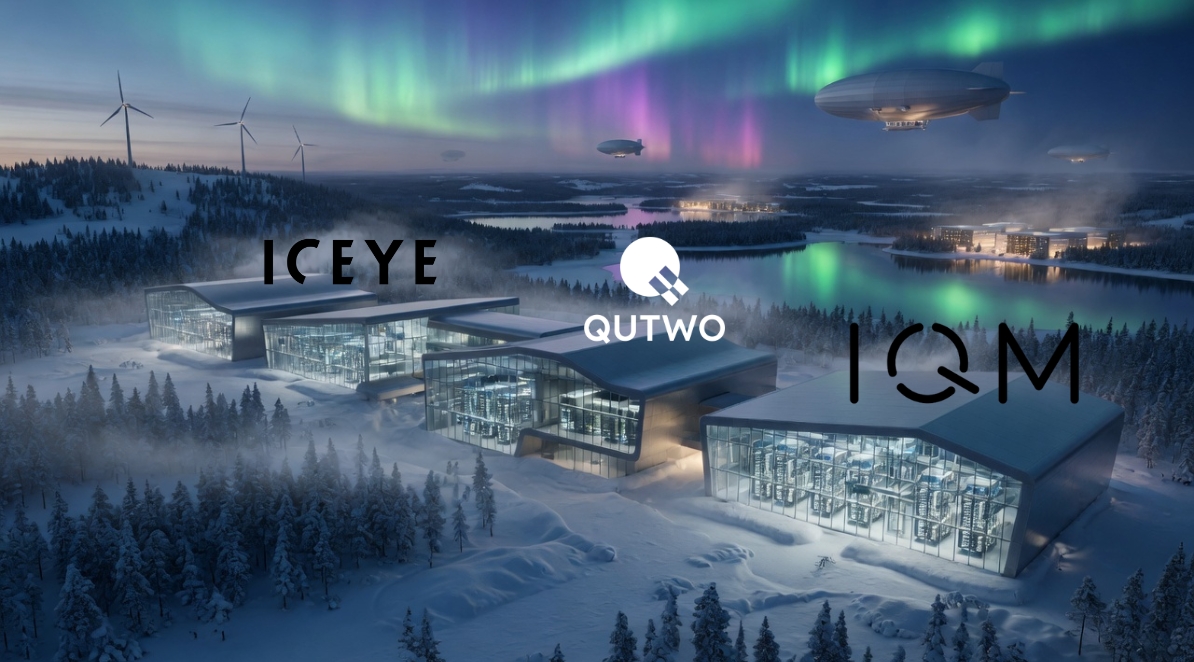
ICEYE (founded 2014, €450 million primary Series F) is the reference point. Its June financing valued the satellite company at more than €10 billion; a secondary placement took the total transaction above €1 billion. ICEYE says seven European governments have procured its sovereign satellite systems. Finland’s Ministry of Defence separately authorised a €158 million remote-sensing system for the Finnish Defence Forces. Kelluu is testing whether investors will apply a similar premium to persistent surveillance below the Karman line.
Which Smaller Finnish AI Companies Are Worth Watching?
QMill (founded 2024, €4 million seed) develops algorithms and an AI-powered circuit-compression service for present-day quantum hardware. Its original Business Finland grant was €1 million; the company now reports nearly €2.7 million in grants in total.
Skyfora (founded 2019, €6.5 million financing) turns GNSS receivers in telecom infrastructure into atmospheric sensors. Its June 2026 package combined equity with non-dilutive Business Finland funding, and its data is designed for high-resolution AI weather forecasting.
Aiforia (founded 2013, €6.4 million directed share issue) applies deep learning to digital pathology. Thelatest listed scale-up financing was completed in June 2026.
Clock&Cloud (founded 2023, €1.5 million pre-seed) converts open-source geopolitical signals into company-specific risk and supply-chain analysis. The company is led by former Finnish Defence Forces officer Riku Hellgren and identifies Siemens as a customer.
What Is the Case Against Finnish AI Startups?
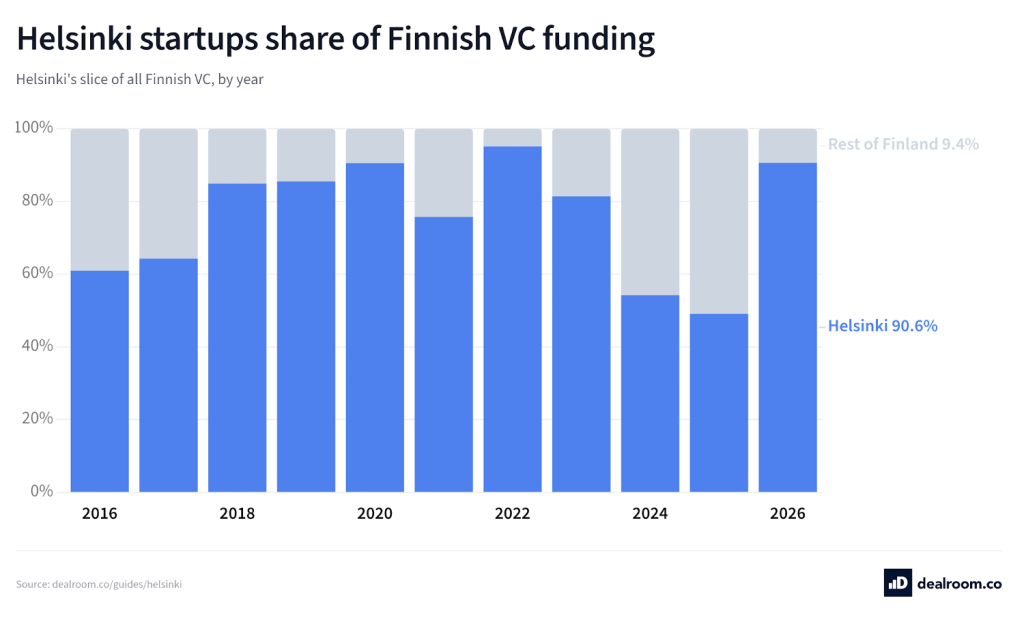
First, capital is geographically concentrated. Dealroom’s Helsinki ecosystem data puts the region’s share of Finnish venture funding at 90.6% in 2026, up from 61.4% in 2016. The 2026 figure covers the first half of the year and should be treated as a current snapshot, not a settled full-year result.
Second, the final 2025 data shows strong funding. The Finnish Venture Capital Association reports that startups raised about €1.9 billion from all investor types, while VC and growth funding rose 60% to €765 million. The weakness lies in distribution. Oura‘s €777 million round and IQM’s €275 million Series B round supplied about 55% of the total. The number of Finnish companies receiving VC or growth funding fell 14%, and the number receiving seed funding fell 40%.
Third, several of Finland’s best-known technology companies became foreign-owned, including Supercell through a Tencent-led consortium, Wolt through DoorDash and Silo AI through AMD. Those deals returned capital and created experienced founders, but they also moved control abroad.
Why Does Finland Keep Losing Its Biggest Wins?
The same institutions recur. Tesi backed IQM, NestAI, Verda, Kelluu and ICEYE. Business Finland supported QMill, Skyfora and Aiforia. LUMI supplied computing capacity to Silo AI and QMill, while Aalto helped produce IQM and ICEYE.
Finland has built one of the most reliable AI company production lines on the continent, one supercomputer, one university, two state chequebooks, and it has solved everything about building AI companies except keeping them. Edition three of this league should probably ask which country is doing the buying.
Author: Richardson Chinonyerem