
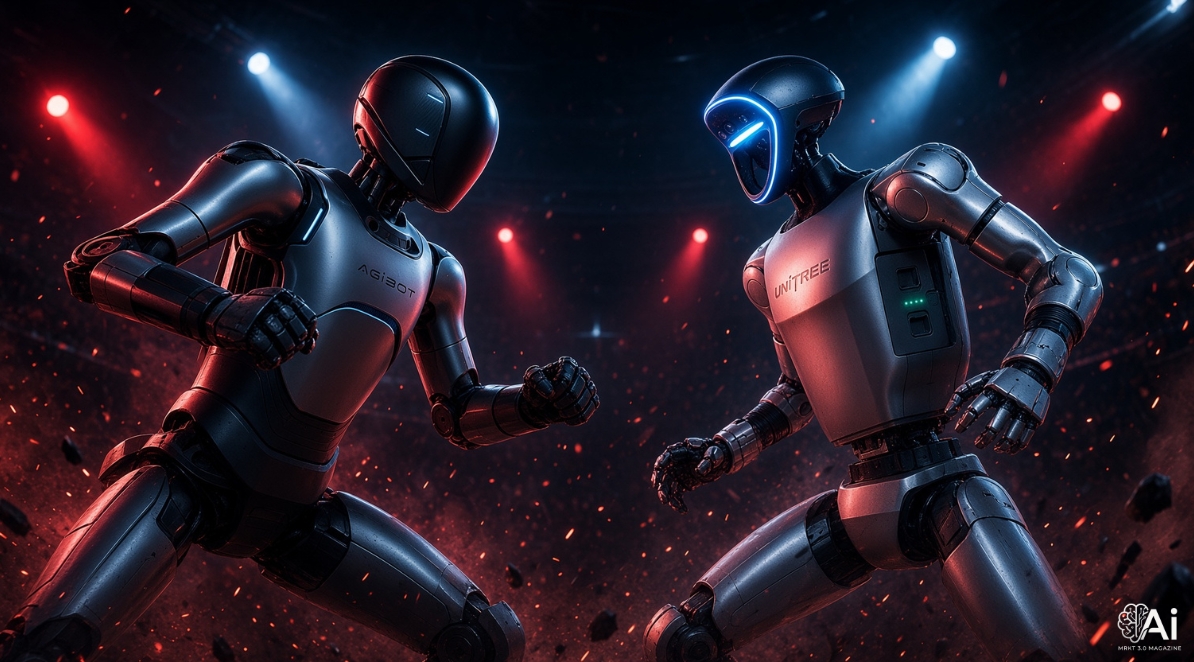
According to Smart Analytics Global’s latest Robotics 360 data, the humanoid robot market did not merely grow in the first half of 2026; it lurched. Shipments nearly quadrupled year-on-year while the competitive ranking flipped. AGIBOT, previously second, is now the clear leader.
What Actually Happened in the Rankings?
AGIBOT shipped approximately 8,400 humanoid robots, a 562% jump that lifted its global share from 25% to 44%. Its portfolio (full-size bipedal A-series, half-size X-series and wheeled G-series) proved broader than most rivals.
Unitree still grew a healthy 170% to 5,900 units, but that was not enough to hold the top spot. Together the two Chinese firms controlled roughly 75% of worldwide shipments.
Galbot, UBTECH and Leju trailed far behind with a few hundred units each. The rest of the market remains a long tail of smaller players.
Why the Sudden Acceleration?
The sudden acceleration was mainly due to two big changes.
First, industrial and commercial applications crossed 70% of total shipments, up from about 50% a year earlier. Robots are moving from research labs and demo stages into factories, warehouses and structured workplaces.
Second, the ecosystem is overwhelmingly Chinese. China accounts for more than 97% of units shipped, and more than 85% of demand originates there. AGIBOT is now scaling its European presence in the UK and Germany. The expansion is anchored by a strategic partnership with automotive supplier Minth Group, a Robot-as-a-Service leasing model, and local showcases including a partner conference in London and a Munich launch.
What Does This Mean Going Forward?
Smart Analytics Global expects full-year 2026 shipments to approach 60,000 units and industry revenue of roughly $1.6 billion. By 2030 the same analysts project half a million units.
However, there are complications with this projection. A market this China-centric faces rising geopolitical and regulatory friction as humanoids become more capable and more human-like. The same firms racing to scale industrial deployments will eventually have to answer questions about overseas market access and the rules governing highly anthropomorphic machines.