

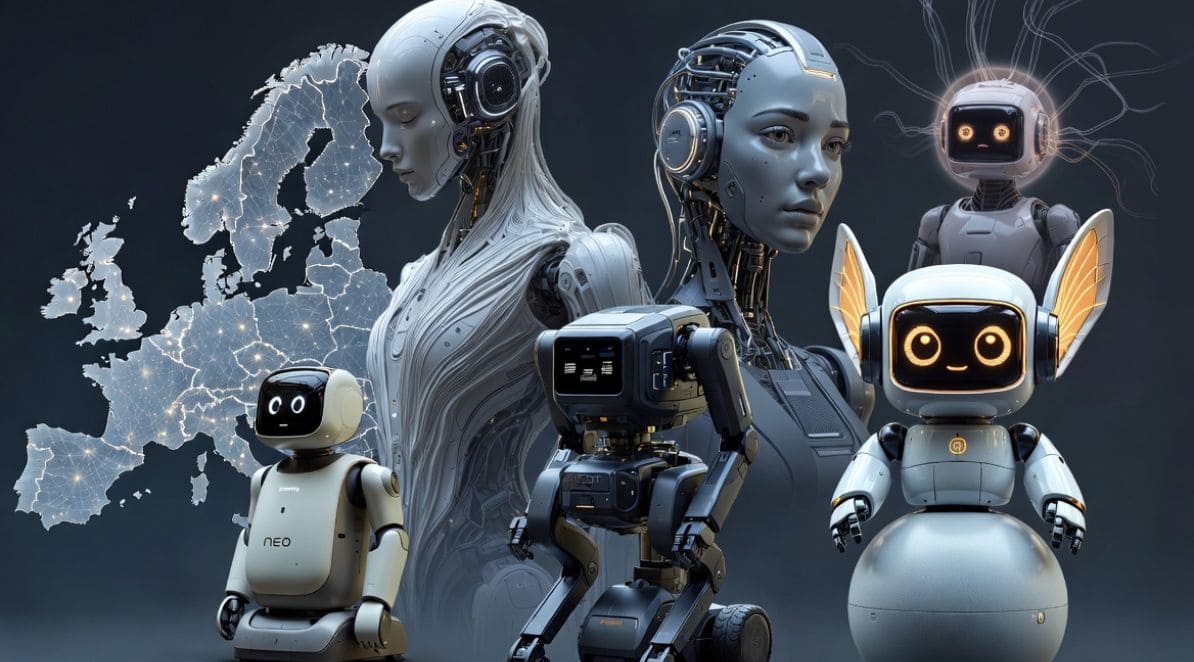
Something shifted in European robotics this year. BMW put humanoid robots on a production line in Leipzig. Neura Robotics pulled in serious money and a partnership with Amazon. A Norwegian startup opened pre-orders on a $20,000 robot for your living room.
For a continent that spent the AI boom being told it was behind, 2026 is the year Europe’s robots started to feel real. And, in a few cases, genuinely famous.
However, it seems fame and usefulness rarely live in the same machine. The robots doing the most work are nearly anonymous. The ones with the most followers seem unable to perform basic tasks. So we ranked Europe’s humanoids by influence: how famous they are, how much they actually do, and what each one says about where the continent really stands in the global humanoid race.
Here are the five shaping the conversation in 2026. Plus two famous names that, it turns out, aren’t really European at all.
Who Is Europe’s Most Influential Robot in 2026?
By real footprint, it’s Germany’s Neura 4NE1 and Sweden’s Hexagon AEON, both already moving from demo reel into actual factories. By sheer online fame, the title goes to robots that aren’t even built in Europe, like Warsaw’s viral Edward Warchocki. In 2026, Europe’s most useful robots and its most famous ones are almost never the same machine.
1. Neura 4NE1 (NEURA Robotics) 🇩🇪
Europe’s best funded answer to Tesla’s Optimus is Germany’s NEURA Robotics, which is the continent’s largest humanoid company. NEURA has raised over €1 billion in total funding, while securing a primary cloud partnership with Amazon Web Services and preparing to open a €17 million training facility, the TUM RoboGym, at Munich Airport. Its 4NE1 humanoid is built around touch and force feedback, not vision alone.
Founder David Reger told the stage at Berlin’s Deep Tech Momentum this year: “physical AI is actually the most important step in humanity.”
If any European robot becomes a household name in industry, this is the one.
2. Ameca (Engineered Arts) 🇬🇧
Built by Cornwall’s Engineered Arts, Ameca is the eerily expressive robot face you’ve seen blinking, frowning and pulling startled looks in clips that resurface online every few months. It’s a fixture of tech showcases and university labs, with a modular design that switches between greeting, guiding and research.
What it can’t do is walk anywhere useful or lift much of anything. It’s a brilliant interface bolted onto very little muscle. It’s also proof that Europe leads the world at one thing in particular, making robots feel human, even while it trails badly on the heavy lifting.
3. NEO (1X) 🇳🇴
Norwegian startup 1X (backed by OpenAI, more than $125 million raised) has opened pre-orders on NEO, billed as the first consumer-ready home humanoid, at around $20,000 or $499 a month. It even has a Bluetooth speaker built into its chest, which 1X happily markets as a “mobile entertainment system.”
Early units will be limited, supervised, and in many cases operated remotely by a human. NEO drags the humanoid debate out of the factory and into the living room, straight into Europe’s favourite territory… privacy.
4. AEON (Hexagon) 🇸🇪
Built by Sweden’s Hexagon (backed by NVIDIA and Microsoft), the wheeled AEON is already being tested on BMW’s line in Leipzig, including high-voltage battery and EV assembly, the kind of job where human workers currently sweat inside heavy protective gear. A broader test runs through 2026 ahead of a summer pilot.
No legs, no viral fame, no personality. Just a robot quietly doing a real shift, which is what influence looks like when you measure it in deployments instead of followers.
5. Mirokaï (Enchanted Tools) 🇫🇷
Enchanted Tools’ Mirokaï is anime-inspired, glides around on a single ball instead of legs, and is aimed squarely at hospitals and hospitality. Where most humanoids are designed to work, Mirokaï is designed to be welcomed: friendly face, soft movements, deliberately unthreatening.
If robots are going to share our hospitals and hotels, being likeable isn’t a frill. It’s a feature. France is betting on it.
Honourable Mentions: Big in Europe, Built Elsewhere
Edward Warchocki, Poland (sort of). The most talked-about robot on the European internet is a Chinese Unitree G1, handed a cheeky Polish personality by two Warsaw creators. He runs his own Instagram, squared up to security at the Copernicus Science Centre, and went viral herding wild boars across a car park. European soul, Chinese chassis, and more reach than anything above him on this list.
Sophia. Not European at all. She’s from Hong Kong’s Hanson Robotics, with more than 240,000 Instagram followers and a UN title. Yet she turns up at every European conference anyway. The influencer who doesn’t actually live here.
What Europe’s Robots Really Tell Us
Put the list together and a pattern jumps out. The robots with the most fame can barely do a day’s work. The robots doing the most work are nearly anonymous. Europe is brilliant at making robots that are expressive and likeable, and it’s still racing to catch up on robots that are productive.
That gap is the whole European AI story in miniature. Strong on talent, design and ethics. Still proving it can build and deploy at scale. Humanoids, as Bloomberg has noted, are one of the few frontiers where Europe genuinely isn’t trailing China, which is exactly why this matters.
The next big test for Europe’s robotics ecosystem is already scheduled. The Masters & Robots 2026 conference returns to Warsaw on 20–21 October 2026. Expect the most useful and industrially relevant robots to feature prominently in the discussions, while the viral stars continue dominating social media.

See Also:
Europe’s 7 Million Worker Shortage: How NEURA’s Robots Offer a Solution
Who Is Edward Warchocki: the Robot Taking Over Warsaw
China Controls 90% of the Robot Market. Their Robots Can’t Walk.
Frequently Asked Questions
It depends what you mean by best. For funding and ambition, Germany’s Neura 4NE1 leads, backed by a €120 million round and a partnership with Amazon. For real deployment, Sweden’s Hexagon AEON is further ahead, already being tested on BMW’s production line in Leipzig.
Europe’s main humanoid makers include Neura Robotics in Germany, 1X in Norway, Engineered Arts in the UK, Hexagon in Sweden, Enchanted Tools and Pollen Robotics in France, and PAL Robotics in Spain, the veteran of the group, building research humanoids in Barcelona since 2004.
1X’s NEO, billed as the first consumer-ready home humanoid, opened pre-orders at around $20,000 to buy, or roughly $499 a month on subscription. Early units are limited, supervised and often operated remotely by a human, so this is an early adopter product rather than a finished household appliance.
By online reach, it’s Edward Warchocki, a Chinese built Unitree G1 robot given a Polish personality by two Warsaw creators. He runs his own social accounts and went viral chasing wild boars across a Warsaw car park, making him more recognisable than any robot Europe has actually built.