
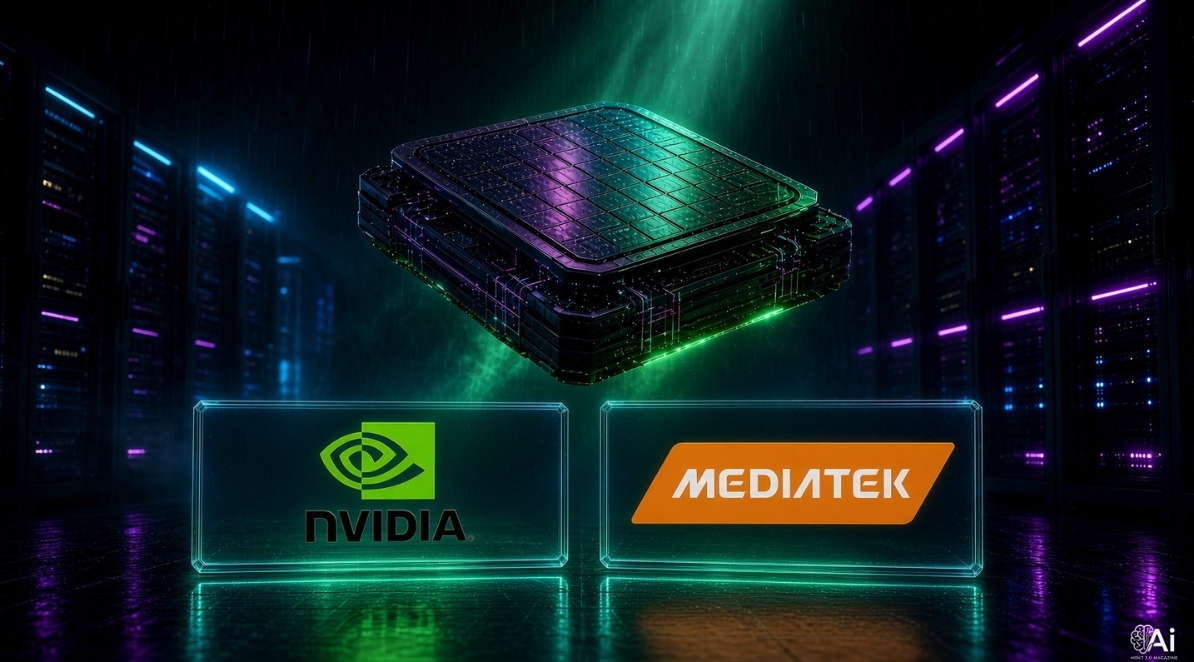
On 31 August NVIDIA said it would buy about $3.5bn of MediaTek convertible bonds. That is nearly all of a record $3.9bn zero-coupon issue MediaTek had also opened to other investors.
MediaTek is Taiwan’s largest fabless chip designer and the firm behind the Dimensity processors in a large share of the world’s mid-range smartphones. For the past two years it has been moving into custom data-centre chips, the same business Broadcom and Marvell have used to grow.
The money is not really the main point here. The condition is. In the same agreement, MediaTek will adopt NVLink Fusion, the NVIDIA platform that lets other companies design their own accelerators and still plug them into NVIDIA’s rack-scale systems.
The Threat NVIDIA Absorbed
The lasting case against NVIDIA has always been that its biggest customers would build their own chips to escape its margins. Google, Amazon and Microsoft have each now done that.
NVLink Fusion answers the threat by absorbing it. A custom accelerator, an XPU in the industry’s shorthand, only reaches the rest of a data centre through an interconnect. The interconnect these chips are increasingly built to use is NVIDIA’s own.
When asked about circular financing, Jensen Huang, NVIDIA’s founder and chief executive, told Bloomberg TV the arrangement was not circular, “because obviously they do their own business and we do our own business.” That puts a generous gloss on the reverse.
NVIDIA was also not the only company to invest. MediaTek confirmed that Alphabet joined the same bond issue. Alphabet’s TPUs were the first proof that a large buyer can walk away from NVIDIA silicon altogether.
There is an elegance to financing the designer that will help rivals build their alternatives, then making sure those alternatives can only reach the data centre through your fabric. It is a far defter play than trying to out-engineer every hyperscaler at once. It also costs a fraction of an acquisition, and it draws none of the antitrust scrutiny that buying MediaTek outright would invite.
Where That Leaves Europe
For a European industry that keeps promising itself sovereign compute, the deal is an uncomfortable measure of how little of the stack is actually being built at home.
The gigafactory ambitions written into the AI Continent plan assume infrastructure the region does not yet control, and the interconnect, the memory architecture and now the custom-silicon on-ramp all trace back to a single American vendor. That dependency is the one this publication examined when it mapped the region’s home-grown model builders earlier this year. It is also the same pattern we wrote about when NVIDIA reportedly agreed to buy Hugging Face last week (still to be confirmed by the companies themselves).
None of this makes the bull case dishonest. NVLink Fusion does make custom silicon easier for companies that could never have built the surrounding engineering on their own. A semi-open standard tends to serve buyers better than a closed one. However, the bond is only worth what NVIDIA paid if NVLink Fusion becomes the default fabric of the AI data centre. That makes the investment less a bet on MediaTek than a bet on NVIDIA’s own dominance, paid for by NVIDIA itself.
See Also:
NVIDIA and MediaTek Deepen Long-Standing Partnership to Build AI Edge to Cloud Computing Platforms