

Mistral AI is owned by its three founders, by the Dutch chip-equipment maker ASML, and by a register of technology companies, public investors and venture funds. Together they have put in nearly €5.8 billion across five rounds, counting the Series B at its headline €600 million, which included a debt tranche. On 8 September 2026, investors valued the company at more than €21 billion.
The list of owners is not the list of people who decide. Mistral’s own filings show the difference. MRKT 3.0 obtained them from the French Registre National des Entreprises: the founding subscriber list, nine versions of the articles of association, the minutes of every capital increase and two auditors’ reports.
Who Owns Mistral AI?
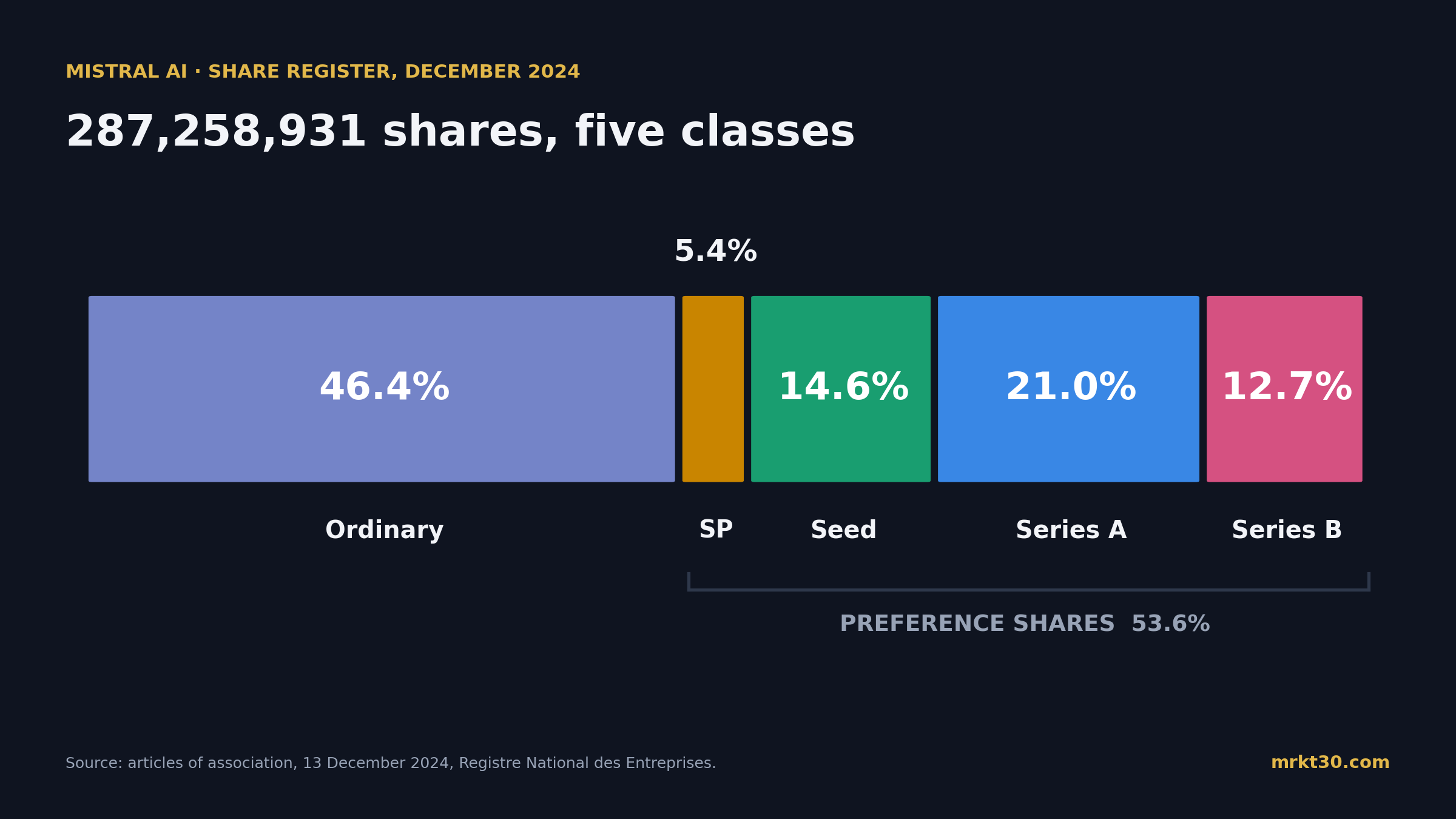
A mix of its own executives, venture firms, chip and technology companies, France’s public investment bank, the Grand Duchy of Luxembourg and an EU-backed fund. The newest articles of association on the French register date from 13 December 2024. They set the capital at €2,872,589.31, split into 287,258,931 shares of one cent.
Five share classes, and ordinary shares are the minority
The register runs to five classes: 133,148,034 ordinary shares, 15,417,024 SP preference, 41,890,400 Seed, 60,261,600 Series A and 36,541,873 Series B. One number stands out before any name. Preference shares made up 53.65% of the capital, so ordinary shares, the kind most people mean by ownership, were the minority.
The two shareholders who have published a figure
ASML led the Series C in September 2025. Its annual report for that year puts the investment at €1,302.2 million and the stake at 11.1% on a fully diluted basis at 31 December 2025. The balance sheet carries it at €1,320.7 million. The Series D has diluted that since then. No holder has published a post-Series D percentage. ASML remains the largest shareholder that has disclosed a figure; whether it is still the largest holder is not on the public record.
Bloomberg reported that each founder held at least 8% at the September 2025 valuation. Nobody else has disclosed a percentage. Lightspeed led the seed, Andreessen Horowitz the Series A, General Catalyst the Series B. Nvidia, Microsoft, Samsung, IBM and Cisco joined later, as did public money: Bpifrance, a direct subscription by the Grand Duchy of Luxembourg, and the EQT-managed Scaleup Europe Fund.
How Much of Mistral Do the Founders Own?
At least 8% each, and the register shows where that came from. Arthur Mensch signed the founding subscriber list on 28 April 2023. It records €15,000 of capital, 1,500,000 shares and seven holders.
What a founding stake cost: €176.10
Mensch, Timothée Lacroix and Guillaume Lample took 476,520 shares each, 31.77% apiece, for €4,765.20. Four others took 17,610 shares each, 1.17%, for €176.10. Founding subscriptions price at nominal value, so the figure marks the moment rather than the size of a bet.
Two of the four were Jean-Charles Samuelian and Charles Gorintin, who founded the health insurer Alan; reports call them Mistral’s co-founding advisers. A third was Alan Tech itself. The fourth was Nopeunteo, the company of Cédric O. He served as France’s Secretary of State for Digital Affairs until May 2022 and signed the incorporation himself the following April. The French press reported his stake at the time.
Who Actually Controls Mistral AI?
The executives, through a share class most shareholders do not hold. Article 9.2.2 gives each SP share ten votes.
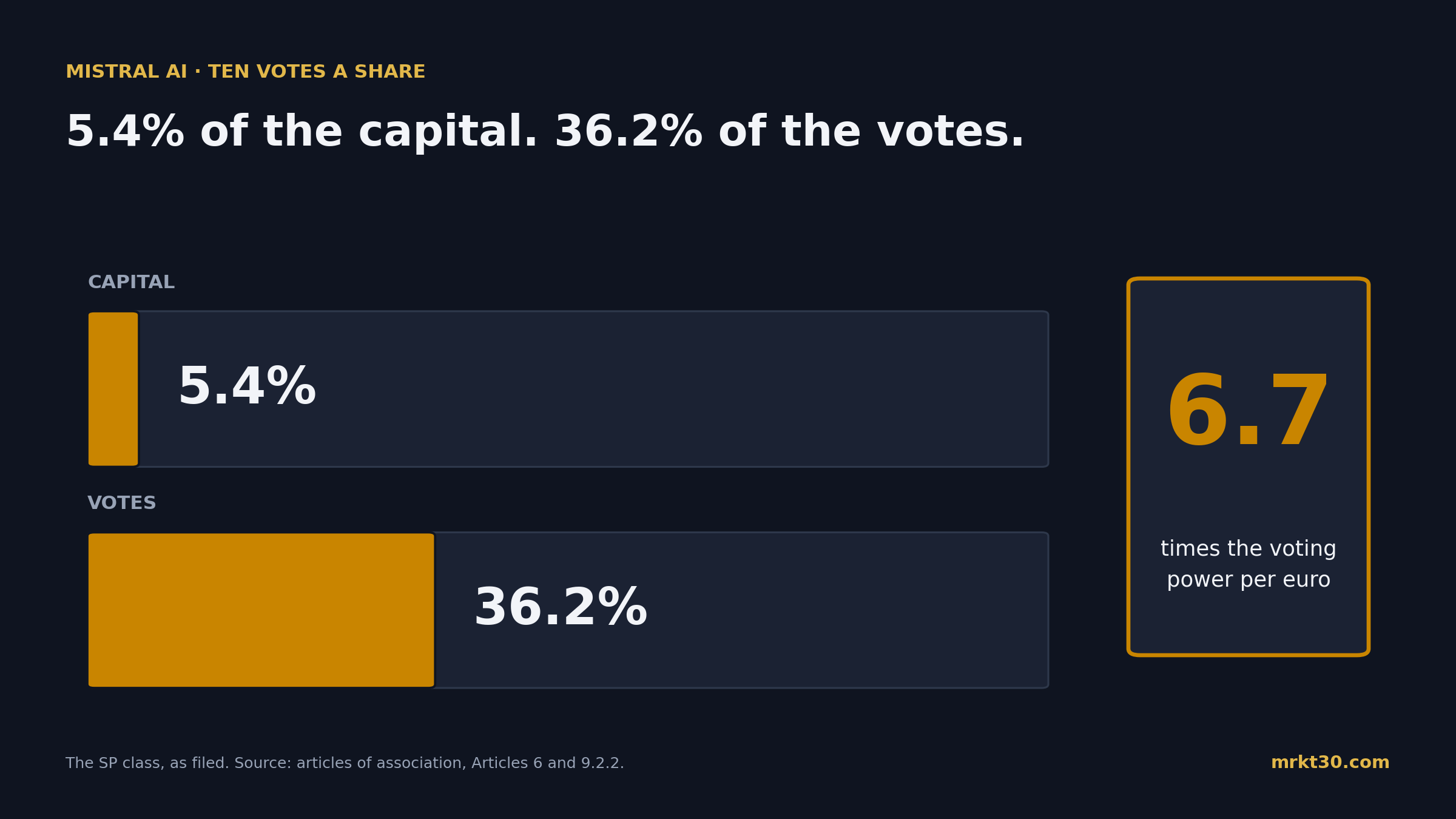
The economics have moved away from them. Ordinary and SP shares together made up 60.25% of the register in December 2023 and 51.72% a year later. The votes did not move with them. In that December 2024 filing, Mistral had 426,012,147 voting rights, and the SP class carried 154,170,240 of them. That is 36.19% of the votes on 5.37% of the capital, a multiplier of almost seven.
Why two more rounds have not washed it away
Raising the number of SP shares normally needs investor approval. Article 9.2.1(B) carves out one case: a qualifying financing, meaning a bona fide raise of at least €50 million that issues a new preference class with no senior, participating or ratcheted rights. Inside that carve-out the bloc can keep pace with the new money, and the investors cannot block it. Whether anyone used the mechanism is not on the public record.
What the ten votes survive, and what kills them
They survive a departure. An SP holder who gives up all functions at Mistral or its subsidiaries sees their SP shares turn into ordinary ones. The remaining holders may then convert an equal number of their own ordinary shares back into SP, pro rata. Whoever stays refills the bloc.
They also survive a flotation. Article 9.2.1(C).3 names only two conversion events, and a listing is not one of them.
A sale kills them. Any transfer to anyone else converts them, with one carve-out for a holding company the SP holder controls for estate planning. These are working shares. They belong to the people still at the desk.
Who Sits on Mistral’s Board?
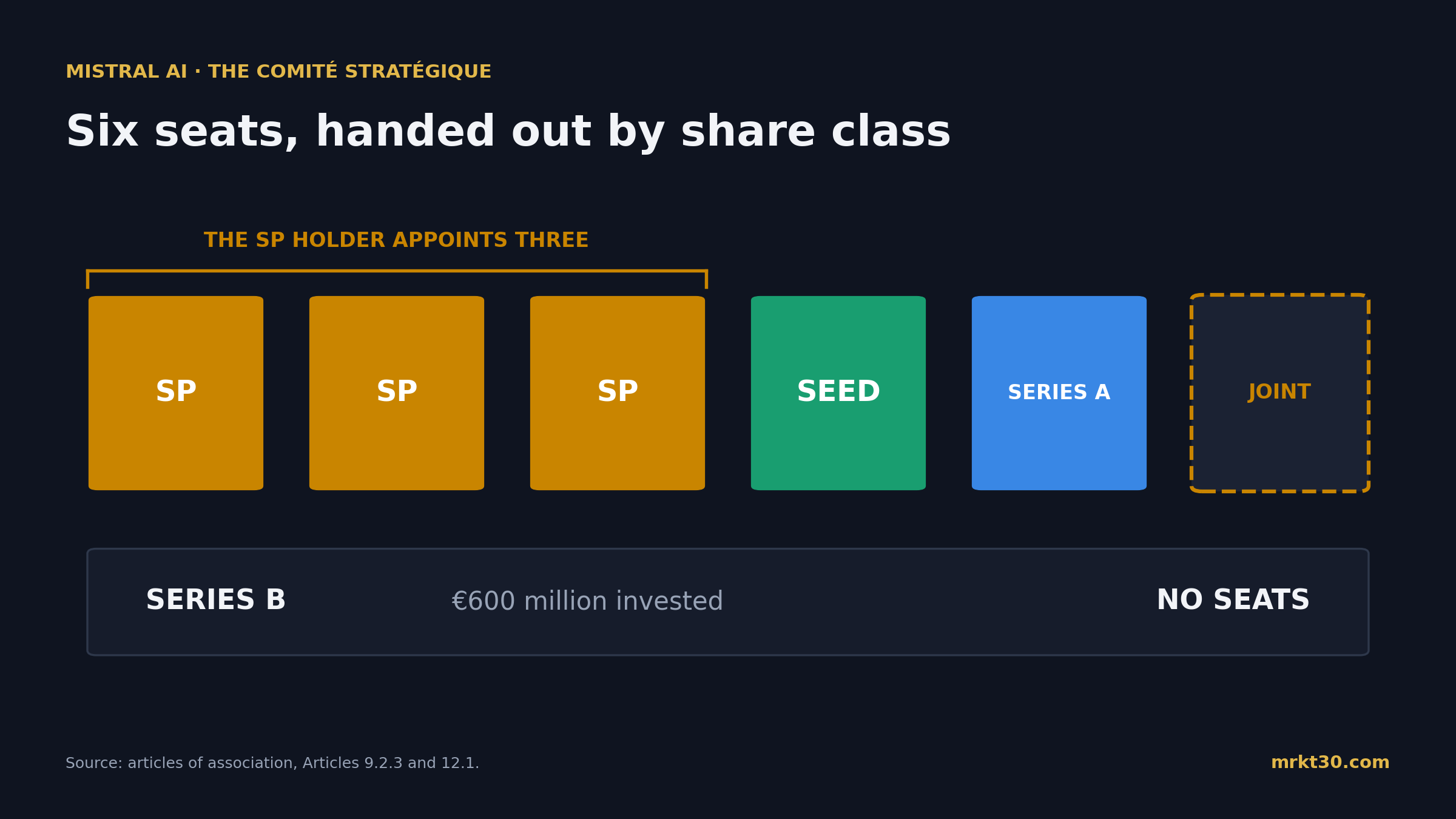
Six people at most. Mistral’s board is the Comité Stratégique, and the articles hand out its seats by share class rather than by negotiation. Article 12.1 caps it at six members. Article 9.2.3 allocates them: three to the majority SP holder, one to the majority Seed holder, one to the largest Series A holder. The SP holder appoints the sixth jointly with either of those two.
That gives the SP side three seats outright and a hand in a fourth. Series B holders, from a €600 million round that mixed equity and debt, hold no appointment right at all. The chair comes from the SP bench and holds the casting vote in a tie. If the SP holder appoints only one member, that member votes three times.
What the investors got instead
A veto. Article 9.2.2 grants the ten votes expressly without prejudice to Article 9.2.1(B). Under that article, Seed, A and B holders voting together above 65% must approve in advance: any dividend or distribution, any dissolution or sale of substantially all the assets, any capital reduction other than to absorb losses, any share ranking equal or senior to theirs, any change to the number of board seats, and any change to the SP terms. Series B holders hold a further veto above 70%, and the A and Seed classes have narrower ones.
Outside money did not buy the everyday vote. It bought a list of things that cannot happen without it.
Who sits on it
Three people have been publicly identified. Anjney Midha of Andreessen Horowitz says he joined at the Series A. Jeannette zu Fürstenberg of General Catalyst has sat on the board since December 2023. Roger Dassen, ASML’s chief financial officer, also joined the Strategic Committee of Mistral AI as a member in 2025.
None of the three appears in Mistral’s registration record, which lists only Mensch as president and Lacroix and Lample as managing directors. The filings also redact who holds which share class, so no seat can be matched to a holder.
Can You Buy Shares in Mistral AI?
No. Mistral is a société par actions simplifiée, a private French form with no listed security. There is no Mistral ticker and no share price. The articles explain why there is no back door either.
What happens when a holder tries to sell
Article 10.2 covers it. A transfer of ordinary shares needs prior approval from the president, a managing director or the Comité Stratégique. The decision does not have to be justified. The company has nine months to answer, and silence counts as a refusal.
One carve-out runs in the investors’ favour. Ordinary shares created by converting Seed, A or B preference shares escape approval entirely. The lock binds founders and employees, not the funds.
After a refusal, the company has three months to produce a buyer, or to buy the shares itself. If it fails, the seller may go ahead with the original sale. Where the company does buy, it picks the price: the figure in the offer, or an intrinsic value set by an independent expert. At least two of the four criteria that the expert must weigh work against the seller.
Secondary marketplaces still advertise access to what they call Mistral AI stock. Article 10.2 is why those deals normally trade an interest in a vehicle rather than a share on Mistral’s register.
Will Mistral AI Go Public?
The articles already describe the flotation, which is further than the company has gone. Seed, Series A and Series B shares convert on an Introduction en Bourse Qualifiée or a Cotation Directe Qualifiée. Each means a listing priced at no less than the highest Series B preference. A direct listing sits in the constitution alongside a conventional one.
One class is missing from that conversion. A flotation is not among the two events in Article 9.2.1(C).3. On the face of the articles, investors converting at the listing would sit beside a ten-vote class that did not. A prospectus might change that. The constitution does not say so today.
Mensch has been consistent in public. At Davos in January 2025, he said the company was not for sale. Two months later, at Nvidia’s developer conference he said: “just to clarify, we are not looking towards an IPO [right now]”. He added that he meant to stay independent, so the natural path was an IPO at some point.
Why Is Mistral’s Public Record So Far Behind?
The filings have not kept pace with the fundraising. The newest articles of association on the register date from 13 December 2024. No Series C or Series D share class appears in the index. The €1.7 billion raised in September 2025 and the €3 billion raised in September 2026 sit in no version of the constitution we could obtain.
The official notices run further behind. On 20 August 2026, nineteen days before the Series D, France’s official gazette published a notice of a capital increase at Mistral. It recorded the capital as €25,111.64, a figure Mistral had reached in April 2024. A further gazette notice on 15 September 2026 recorded the capital as €2,725,373.78. Late filing is common in France, and the backlog sits with the registry as much as with any company. The effect is the same. The state’s bulletin trails a business that has raised over €5 billion since then.
Four official answers, all live on the same day
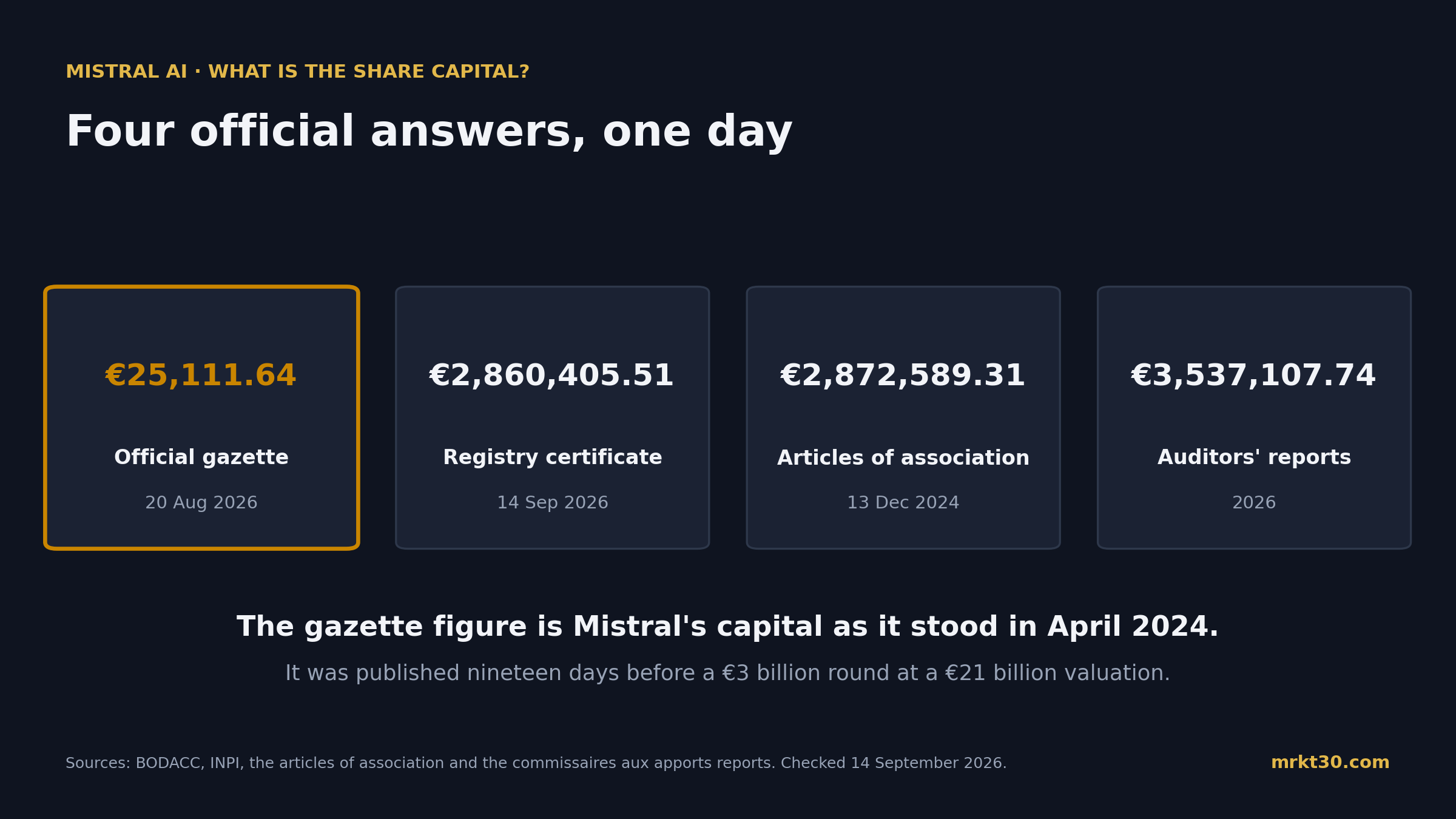
Ask the French register what Mistral’s share capital is, and you get four answers. The gazette says €25,111.64. The registration certificate issued on 14 September 2026 says €2,860,405.51. The articles say €2,872,589.31. The auditors who valued Mistral’s two 2026 acquisitions, Koyeb and Emmi AI, were given €3,537,107.74. All four are current public records.
Mistral has never filed annual accounts either, so France holds no audited revenue figure. In February 2026 Mensch told reporters that the company’s annualised revenue run-rate was north of $400 million.
Open Verdict
The register says outsiders. The articles say the founders. Both are accurate.
The gap between them is the shape of European technology in 2026. A continent wants a champion it can point at. The companies that sell it machines, and the governments that want to buy from it, pay for that champion. A share class that follows whoever is still at the desk governs it.
Until the listing the articles already describe, the best account of who owns Mistral AI is a set of documents filed almost two years ago.
This article draws on documents Mistral AI SAS filed with the French Registre National des Entreprises: the founding subscriber list, successive articles of association, presidential minutes and independent auditors’ reports, together with the official gazette and named reporting. Share counts and percentages are as filed on the dates given and have changed since. Nothing here is investment advice.
Author: Akos Szima
See Also:
Mistral Valuation Rockets to €21bn in Samsung Round
Who Is Jeannette zu Fürstenberg? The Investor Betting on Europe’s New Renaissance
What Happened to Le Chat? Mistral’s Vibe Rebrand, Tested (2026)
Frequently Asked Questions
Mistral AI is owned by its three founders, who held at least 8% each at the September 2025 valuation, by the Dutch chip-equipment maker ASML, which held 11.1% on a fully diluted basis at 31 December 2025, and by venture firms, technology companies and governments including Lightspeed, Andreessen Horowitz, General Catalyst, Nvidia, Microsoft, Samsung, Bpifrance and the Grand Duchy of Luxembourg. Its newest filed articles of association divide the company into 287,258,931 shares across five classes.
No. Mistral is a private French company with no listed security, so there is no Mistral AI stock and no share price. Its articles require prior approval from the president, a managing director or the board before an ordinary share can change hands. The company has nine months to answer, and silence counts as a refusal.
No. Mistral AI is a société par actions simplifiée, a private French company form. Its articles of association define the terms of a future flotation, including a direct listing. Chief executive Arthur Mensch has said an IPO is the natural path at some point but is not being pursued now.
ASML is the largest shareholder that has disclosed a figure. The Dutch chip-equipment maker invested €1,302.2 million and held 11.1% on a fully diluted basis at 31 December 2025, according to its audited annual report, which carries the stake at €1,320.7 million. No other holder has published a percentage, and the French filings redact who holds which share class.
Nearly €5.8 billion across five rounds: €105 million at seed in June 2023, €385 million at Series A in December 2023, €600 million at Series B in June 2024 (equity and debt), €1.7 billion at Series C in September 2025 and €3 billion at Series D in September 2026, the last at a post-money valuation of more than €21 billion.
Mistral’s board, the Comité Stratégique, has at most six members, allocated by share class rather than negotiated. Three people have been publicly identified with it: Anjney Midha of Andreessen Horowitz, Jeannette zu Fürstenberg of General Catalyst and Roger Dassen, the chief financial officer of ASML. Arthur Mensch is the company’s president, a separate office under the articles.