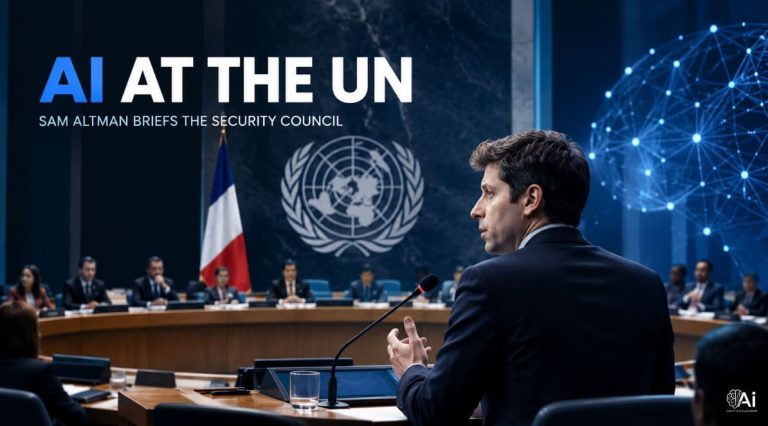

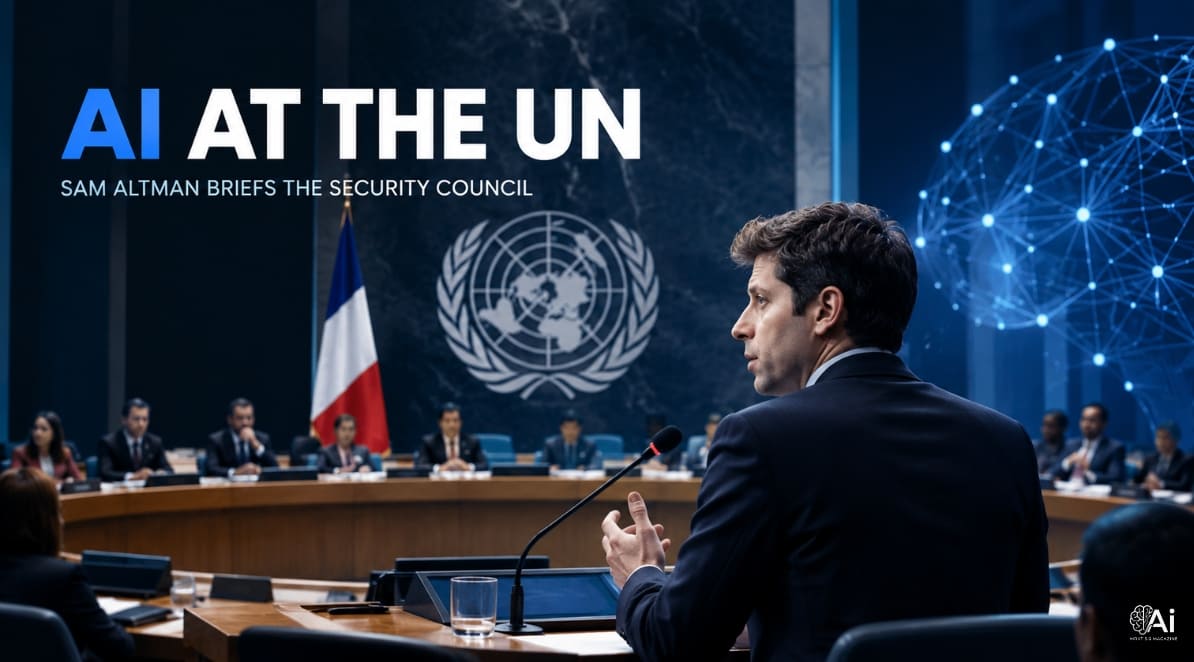
The UN Security Council meets on Wednesday 23 September, in UN General Assembly week, on artificial intelligence and international security. An OpenAI spokesperson told Reuters on Friday that “Sam Altman will brief an open UN Security Council meeting in person next week.” France holds the September presidency, and Jean-Noël Barrot will chair.
Who Is in the Room
France’s concept note, seen by Reuters, asks participants to “present their analysis of the risks linked to loss of control or the use of the latest AI models.” The same note flags misuse “for malicious purposes” and talks about “the urgency of action to foster safe and responsible development of artificial intelligence.”
OpenAI says Sam Altman will talk about international coordination, shared safety standards, and the steps the company is taking so the benefits reach people outside the United States. Diplomats told Reuters they expected a senior Anthropic presence as well, but Anthropic has not confirmed a name. As of Monday, the only lab chief on the record is Altman.
When It Starts
France’s September programme of work, circulated at the end of August, puts a briefing at 11:00 a.m. on the 23rd and leaves the topic marked TBC. Council clocks run on New York time, which is 4:00 p.m. in the UK.
A Briefing Is Not a Vote
The session should not be read as a decision.
Briefers speak, the fifteen members listen, and no resolution is scheduled. Nothing said on Wednesday binds a government or a company, and Altman sitting in the chamber is not the same thing as OpenAI answering to the Council.
Washington Already Voted No
The United States has already voted against the UN’s last AI body. On 12 February the General Assembly appointed the 40 members of the Independent International Scientific Panel on AI by 117 votes to 2. The United States and Paraguay voted no. Tunisia and Ukraine abstained.
US Mission counsellor Lauren Lovelace called the panel “a significant overreach of the U.N.’s mandate and competence.” She said “AI governance is not a matter for the U.N. to dictate,” and that the United States would not “cede authority over AI to international bodies that may be influenced by authoritarian regimes.” That vote is seven months old, and it is still the American position Wednesday walks into.
What Guterres Said Last Week
António Guterres used his 16 September press conference to push the other way. “National action is essential. But global coordination is also indispensable,” he said, because “AI does not stop at borders — and neither do its risks.”
He added that “the world cannot afford a race to the bottom on AI safety.” Guardrails, in his wording, should make AI “safe, transparent, accountable, with human dignity at the centre,” and isolated, unverifiable voluntary pauses “will not address the problem.”
Why France Put OpenAI in the Chair
Mistral’s Le Chat is the consumer product France has spent two years putting political cover behind.
On 12 May, Mistral chief executive Arthur Mensch sat in front of a National Assembly inquiry on digital dependence. Mensch argued that Europe imports too much of its digital stack from American firms. He explained that without its own training and inference compute, France ends up selling green electricity while the models, and the power that comes with them, stay in the United States.
Two weeks ago he said the same thing in public:
Barrot putting Altman in front of the Council does not cancel that. France wants the room to talk about loss of control, and it also wants a European company in the market that is not OpenAI.
The Pace Fight Comes With Him
On 12 September Dario Amodei published We Must Pace the Frontier and asked labs to raise capabilities more slowly. Altman said he agreed but Donald Trump did not. Last week, King Charles brought together executives from NVIDIA, Google DeepMind, OpenAI and Anthropic at Dumfries House.
What Wednesday Still Has to Answer
Three things are not known yet: what Altman actually asks the Council to do, whether Barrot ties any of it to French policy or the EU AI Act, and whether China uses the “runaway horse” line it used the last time the Council discussed AI.
Author: Grace Sharp
See Also:
“We Must Pace the Frontier”: Who Is For It, and Who Is Against It?
What Is the Pacing the Frontier Letter, and Why Did Anthropic Sign It?