
Mistral has retired its most recognisable product at the height of its fame, and the replacement is better than the coverage suggests. On 28 May 2026, Le Chat became Vibe, a three-tab work agent (chat, work, and code) built for enterprises rather than casual users. The rebrand reads as a retreat from the consumer chatbot war with ChatGPT, but the product underneath is more capable than the name change implies, with one alarming exception.
The team at MRKT3.0 ran it through our tests to find where it holds up and where it makes things up.
Why Did Mistral Kill Its Best-Known Brand?
Le Chat was Mistral’s biggest consumer success. The mobile app hit one million downloads in its first 14 days, helped along by an endorsement from France’s President Emmanuel Macron. So why did Mistral retire Le Chat?
Vibe’s pitch is an AI that does work rather than chats. A “Work Mode” connects to Google Workspace, Outlook, SharePoint, Slack and GitHub and runs multi-step tasks, from drafting reports to processing email, once the user approves. There is web search, a canvas editor, a code interpreter, document OCR and image generation. That last one runs on FLUX from Black Forest Labs, the German image lab, which is a little nod to Mistral’s mission of European Sovereign AI.
Mistral explained that the rebrand was focusing on enterprise work agents, which is where a significant proportion of revenue is in the AI industry. But, perhaps the less charitable reading is that the consumer chatbot war against ChatGPT could not be won, so Mistral is moving the fight to ground where distribution matters more than brand. Probably both are true.
Who Pays for Mistral, and What Do They Want?
Mistral has raised about €3.5bn in equity and debt since 2023. The September 2025 Series C brought in €1.7bn at an €11.7bn valuation and made ASML, the Dutch lithography monopolist, its largest shareholder with a €1.3bn cheque. No other frontier lab has a chip-equipment maker at the top of its cap table. Whether that is far-sighted industrial strategy or Europe’s corporate champions closing ranks around a national asset is a fair question, and nobody in Paris seems eager to answer it.
In June, Bloomberg reported that Mistral was in early talks to raise about €3bn at a valuation near €20bn, almost double the Series C figure. Terms were not final when this article went to press, and later reports put the figure higher still. Revenue has meanwhile grown from roughly $20M to more than $400M of annualised run-rate in a year, and the company says it wants $1bn by year-end.
In March, Mistral borrowed $830M, debt rather than equity, to buy 13,800 NVIDIA GB300 chips for a new data centre outside Paris. Banks lending against AI revenue says something about how predictable that revenue has become. It also says something about sovereignty: Europe’s champion runs on American silicon, bought with leverage, and its largest shareholder is the one company whose machines make that silicon possible.
How Good Is Mistral Large 3?
Mistral’s current flagship, Mistral Large 3, is a 675-billion-parameter mixture-of-experts model with open weights under Apache 2.0, a permissive licence at a size where most rivals stay closed. On paper it is among the strongest open non-reasoning models available: about 85.5% on a multilingual MMLU, 93.6% on MATH-500, 92% on HumanEval, and a debut at second place among open non-reasoning models on the LMArena leaderboard.
On GPQA Diamond, a benchmark built to resist memorisation, Large 3 scores about 44%. Open “thinking” models like DeepSeek-V3.2 and Kimi K2 roughly double that. Output speed of about 38 tokens per second is slow for the class. In short, Large 3 is a very good multilingual workhorse and a mid-table deep reasoner.
What Did Vibe Say Happened to Le Chat?
The team at MRKT3.0 were curious about Mistral’s new model, so we ran a short test.
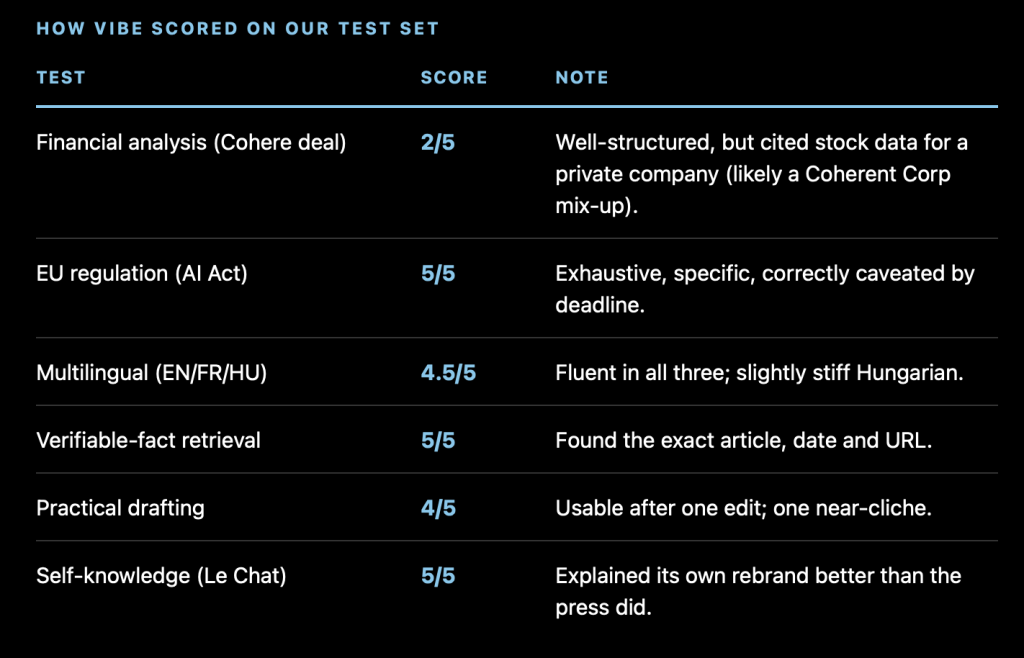
Our standard test set, the same five prompts we put to every model in this series, covers financial analysis, EU regulation, multilingual performance, a verifiable-fact trap and a practical drafting task. These are single-shot impressions rather than averaged runs, so treat the scores as field notes, not lab measurements. For Vibe we added a sixth. We asked it, simply: “what happened to Le Chat?”
We ran the tests on 17 July 2026 on a fresh free account, desktop web. The product itself was the first surprise. Vibe is no longer a chatbot with extras; it is a three-tab workspace (Chat, Work and Code) with scheduled tasks and app connectors pushed hard even on the free tier. The old chat.mistral.ai address still resolves, but the ambition clearly lives elsewhere.
There was one caveat before the scores. On the free tier, Vibe runs Mistral’s Medium-class models rather than the Large 3 flagship whose benchmarks we cite above, so what follows reflects the product a free user actually meets, not necessarily Large 3 at full size.
When asked “what happened to Le Chat?”, Vibe answered:
“Le Chat was rebranded as Vibe. The chat.mistral.ai URL still works, but most features now live in Vibe Work, with a few legacy features (like Agents, Deep Research, Memories) still available in Vibe Chat (legacy).”
Can You Trust Vibe With Real Work?
Self-knowledge is one thing. Handling real research is another, so we kept going.
We asked Vibe what our sister publication Disruption Banking had written about the Mexican peso’s 2026 prospects. Vibe found the exact article, the exact date and the exact URL, and it summarised the 17 to 20 MXN/USD forecast correctly.
Then it stumbled, and not in a small way. When asked to summarise the risks of the Cohere-Aleph Alpha deal for a retail investor, Vibe produced a confident, well-structured answer that included “a $337 stock price” and “a P/E of 334x” for Cohere. Cohere is a private company. It has no stock price and no P/E ratio. The likeliest culprit is Coherent Corp (NYSE: COHR), a US photonics maker whose shares have traded near those levels in recent weeks, though its real P/E is nowhere close to 334x, so Vibe seems to have blended a misread ticker with invented figures. Either way: fabricated financials, delivered with total confidence, in the kind of analysis Mistral sells to banks. We can think of no better argument for the AI Act’s human-oversight rules.
The rest of the answers were solid. On the EU AI Act, Vibe produced an exhaustive, article-by-article compliance briefing, down to deployer obligations under Article 26, the DORA and GDPR overlaps, deadlines and fines; a junior consultant would invoice for less. Our trilingual test, the same question in English, French and Hungarian, came back fluent in all three, with a slightly translated feel in the Hungarian. The founder-email test produced something usable after one edit, though it could not resist opening with “I hope you’re having a good week.”
The split is easy to state. Grounded in live retrieval, Vibe is excellent. Left to recall financial data on its own, it will make things up with a straight face. Keep a human in the loop, ideally one who knows Cohere from Coherent.
Is Compliance Mistral’s Real Moat?
Mistral’s clearest commercial edge does not show up on any leaderboard. HSBC and BNP Paribas adopted its enterprise tier for privacy-sensitive workflows; BMW, ASML and CMA CGM run it in production; Accenture signed a deployment partnership in February. For a European bank, “your data stays in the EU, the weights are inspectable, and the vendor answers to EU law” is a procurement argument no US lab can fully match.
But tech is rarely perfect. The “open” halo is selective as Large 3’s weights are open, but Vibe and several mid-tier models are not, a tension critics have previously called open-washing. Mistral has also leaned into defence work, pushing back in May against Pope Leo XIV’s encyclical criticising military AI. Mensch’s argument was blunt when he explained that Europe cannot show unilateral restraint while its adversaries deploy the same technology. Defence already accounts for a reported 10 to 15% of Mistral’s revenue.
Who Should Use It, and Who Shouldn’t?
So, who should be using Mistral’s Vibe?
Use it if: you need EU data residency and auditability; you work across European languages; you want a top open-weight model you can self-host; or you want a capable free assistant that is not another ChatGPT account.
Skip it if: your workload is hard multi-step reasoning or frontier agentic coding. Open rivals like DeepSeek and Kimi, and the closed US frontier, are stronger there today.
Wait if: the July open-weight flagship lands as promised. It is aimed squarely at the reasoning gap and may change this verdict within weeks.
Is Mistral Worth €20bn?
Mistral is not “the European OpenAI”, and the comparison mostly misleads. What it actually is: among the best open non-reasoning models on the market, wrapped in the industry’s strongest EU-compliance story, carried by the only European lab operating at frontier scale, even if not yet at frontier capability.
At a reported ~€20bn against $400M of run-rate revenue, the price values scarcity as much as software. If the round closes, roughly half the valuation is the model and the product. The other half is the fact that Europe has exactly one of these.
As for Le Chat, it had a good run. A million downloads in two weeks, a presidential endorsement, and a name people still google more often than the one that replaced it. The searches will catch up eventually.
See Also:
Mistral, Europe’s AI Darling, Fails FLI Safety Index