
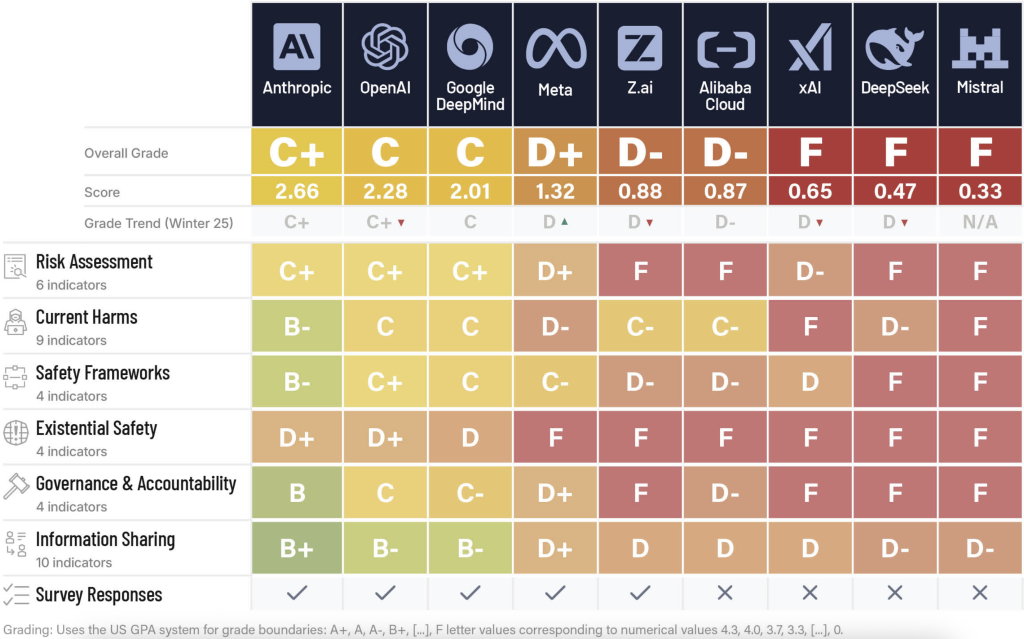
On July 7, the Future of Life Institute (FLI) published its Summer 2026 AI Safety Index, and the results were pretty grim for the world’s leading AI companies. Anthropic topped the table with a C+. OpenAI and Google DeepMind managed a C each. Not one company achieved an A or a B as an overall grade.
And, buried in the bottom row, was Europe’s AI Darling, Mistral AI.
France’s President Emmanuel Macron has actively championed the Paris lab as central to French technological sovereignty. At Vivatech June 2025 he called its NVIDIA partnership “historic” and a “game changer” that will “increase our sovereignty”. Yet, Mistral received an F. It placed last of all nine companies assessed, behind Elon Musk’s xAI and China’s DeepSeek, the other two failures.
Is the company positioned as Europe’s biggest hope of sovereignty secretly its biggest risk? Let’s investigate.
What Did the FLI Index Actually Measure?
FLI’s index is a twice-yearly exercise in which seven independent AI and governance experts, a panel that includes Berkeley’s Stuart Russell and Montreal’s David Krueger, grade companies across 37 indicators in six domains, from risk assessment and current harms to existential safety and transparency. The evidence window closed on 3 June 2026, and the inputs were public materials such as model cards and research papers, plus a survey FLI sent to each company. The full methodology and report are public.
That last detail matters enormously. Five of the nine companies completed the survey. Mistral did not, and neither did xAI, DeepSeek or Alibaba. FLI President Max Tegmark said the organisation contacted Mistral repeatedly and got nothing back.
So, when you look into this bottom trio again, the table is not a ranking of the world’s most reckless labs. It is, to a significant degree, a ranking of who ignored the questionnaire.
Mistral’s own response, when asked about its last-place finish, was that the framework is not suited to its open-source development approach. In a statement to Axios, the company explained:
“a handful of companies deciding, behind closed doors, what’s safe for everyone else is a risk that we would also highlight. Open, independently scrutinized models are the check on that concentration of power.”
Is the F Grade Unfair on Mistral?
Partly, yes.
First, the framework really was built around the closed American frontier lab as its reference case. Indicators reward published safety frameworks, dangerous-capability evaluations and internal governance disclosures of the kind Anthropic and OpenAI produce as a matter of routine. An open-weight developer operates on a genuinely different theory of safety, one where scrutiny comes from thousands of outside researchers who can inspect, fine-tune and red-team the weights directly rather than trusting a lab’s self-reporting. The index has no obvious way to score that, so the approach registers as absence.
Second, FLI isn’t exactly a neutral referee. It is an advocacy organisation founded to reduce catastrophic risk from advanced AI, the group behind the 2023 pause letter, and its panel is drawn from researchers who broadly share that worldview. Its president has spent a decade arguing that the industry is racing towards disaster, and this index found that the industry is racing towards disaster. None of that makes the findings wrong, but a grading exercise run by committed campaigners deserves at least a little scepticism.
Third, the C+ at the top undercuts the F at the bottom. When the best score available describes a company FLI’s own panel criticised over reported military engagements, the scale is telling you that the graders consider the entire industry inadequate. The distance between Anthropic’s C+ and Mistral’s F is real, but it is a difference of degree inside a universal failing verdict, not a line between safe and unsafe companies.
Why Does the Grade Still Matter?
Mistral’s silence was a choice, and the choice reveals the company’s actual theory of accountability.
The company has gone all in on the EU’s binding regime instead. It is a full signatory of the General-Purpose AI Code of Practice, while Meta refused to sign and xAI only signed the safety chapter. Its legal materials and enterprise messaging are built around EU AI Act compliance and European data residency. Mistral has not rejected safety accountability, but it has rejected one version of it: the American voluntary-scorecard model.
That bet faces its first real test on 2 August, when the European Commission’s enforcement powers under the AI Act activate. From that date the AI Office can demand documentation, request model access, and levy fines of up to €15 million or 3% of global turnover.
The question is whether the EU regime will actually deliver scrutiny as demanding as the one Mistral declined to engage with.
The Code’s safety provisions only apply to models above the systemic-risk threshold. Harmonised standards are still being written and member states have yet to designate their enforcement bodies. A company can be fully compliant and still disclose very little about how it tests its models for misuse. Right now, the FLI index remains one of the only independent external assessments of Mistral’s safety practices that exists.
What Europe Should Learn From This
The index’s most defensible finding is not any single grade but the trend it documents.
Companies across the industry, including the ones at the top of the table, have weakened or dropped earlier commitments to pause if their systems approached danger thresholds.
Voluntary safety is eroding everywhere at once, which is precisely the scenario the EU AI Act was designed for Europe built the world’s only binding safety regime for general-purpose AI. However, its flagship lab just failed the world’s most prominent voluntary one, largely by refusing to participate in it. Whether that looks like arrogance or confidence depends entirely on what happens after 2 August.
If the AI Office turns its enforcement powers into real scrutiny of the models Europe actually depends on, Mistral’s bet pays off and the F becomes a footnote. If enforcement arrives late, understaffed and gentle, then a US pressure group’s report card will remain the most rigorous safety examination Europe’s AI champion has ever faced.
That would be the genuinely embarrassing result for not just for Mistral, but for Europe.

See Also:
How Mistral’s ‘Le Chat’ Became Europe’s AI Darling
When Scientists Built a Fake Society Run Entirely by AI, Grok Turned It Into a Crime Scene