
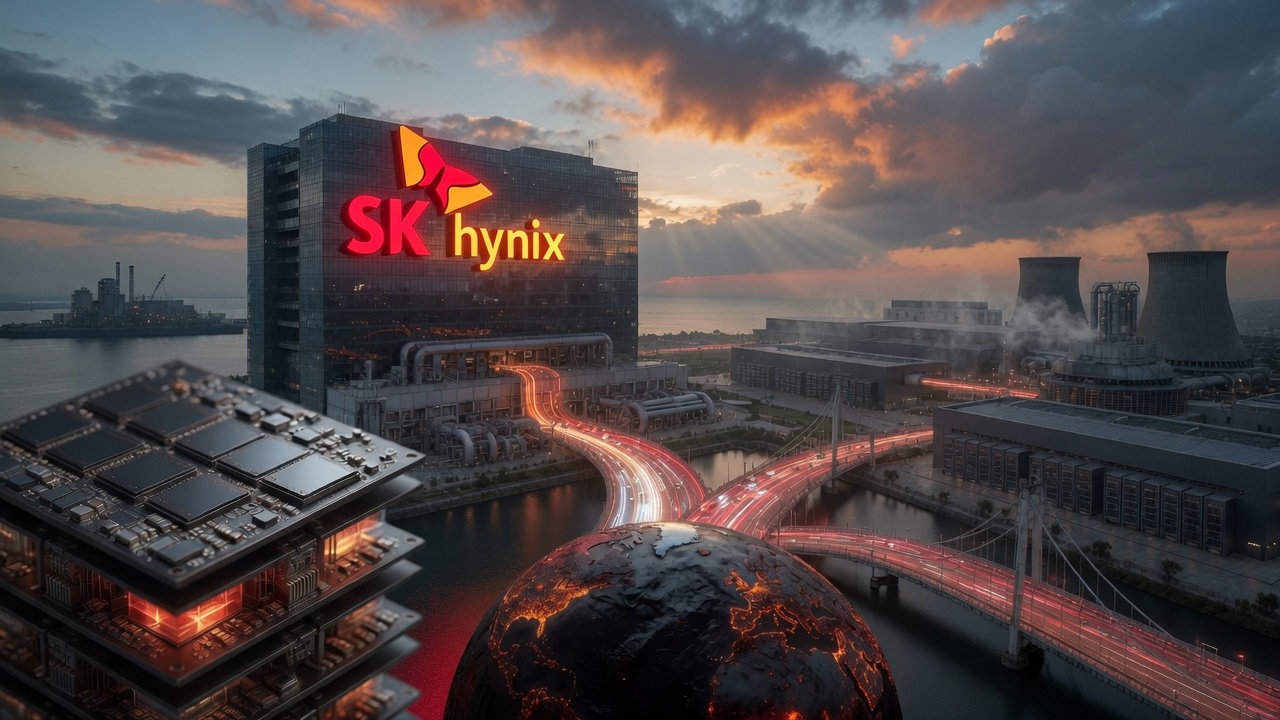
On Friday 10 July, SK Hynix will find out how much American investors will pay for its shares. The South Korean company is raising about $29 billion in what would be the largest listing by a foreign company on the US stock market.
SK Hynix is one of the world’s biggest makers of memory chips. It is the leader in high-bandwidth memory (HBM), the special type of chip that powers AI systems. Together with Samsung, the two Korean firms supply around 80% of the world’s HBM. The only other major supplier is America’s Micron, and even its production is fully booked through 2026.
Why Is SK Hynix Listing on the Nasdaq?
SK Hynix will issue 17.79 million new common shares in the form of American Depositary Receipts (ADRs), with pricing expected on Thursday 9 July and trading commencing Friday 10 July under ticker SKHY. It is the biggest first-time US share sale by a foreign company on record. The stock has delivered extraordinary gains over the past year amid the AI boom, pushing its market value around $1 trillion.
The proceeds will fund major capacity expansions including:
- A new Y1 fabrication plant in Yongin
- The P&T7 advanced packaging facility in Cheongju
- Additional EUV lithography tools
Overall, this money will help SK Hynix produce more HBM chips to meet the huge demand from AI companies.
Samsung’s Record Profits Show How Tight the Supply Is
Samsung posted record results for the first three months of 2026. Operating profit reached $38.8 billion and revenue hit around $90 billion, both all-time highs. The chip division delivered $36.15 billion of the profit, which made up 94% of the total.
Samsung was the first company to start mass-producing HBM4 chips in February for Nvidia’s next AI platform. It has also signed long-term contracts with its customers.
On the earnings call, Samsung’s memory chief, Jaejune Kim, said:
“Based solely on the demand currently received for 2027, the supply-to-demand gap for 2027 is set to widen even further than in 2026.”
Some customers are worried about the impact of shortages and are already placing orders for 2027. From a European point of view, this means the chips Europe needs for its AI plans are already booked by others well into next year.
Samsung’s stock fell slightly after the results, even though it had risen sharply earlier in the year. Investors are no longer asking whether demand is real. Instead, they are now asking how long these high profits can last.
Europe is Falling Behind, Again
Europe has delayed its high-risk AI rules until December 2027. However, this regulatory breathing room doesn’t solve the real problem: the chips Europe needs are already in short supply.
Samsung and SK Hynix have already sold or allocated most of their HBM production for 2026 and 2027 to major customers, mainly in the United States. Europe’s AI Factories will have to compete for whatever limited supply remains.
Europe currently accounts for less than 5% of global AI computing power. While policymakers focus on new rules and funding plans, the companies that control the most critical chips have already committed the majority of their output elsewhere. Public contracts don’t create more chips, they only decide who gets priority when supply is extremely tight.
What This Means for Europe
The SK Hynix Nasdaq listing shows how concentrated control over advanced memory chips has become.
Most of the available supply is already locked in by big customers outside Europe. As a result, Europe’s AI ambitions will be limited not by regulation, but by what chips it can actually secure and when they can be delivered.

See Also:
US Claims ASML EUV Machine in China: ASML Says Impossible
The MATCH Act: ASML’s China Lifeline Just Got a Kill Switch
Why Is TSMC Refusing to Buy the World’s Most Expensive Chipmaking Machine?