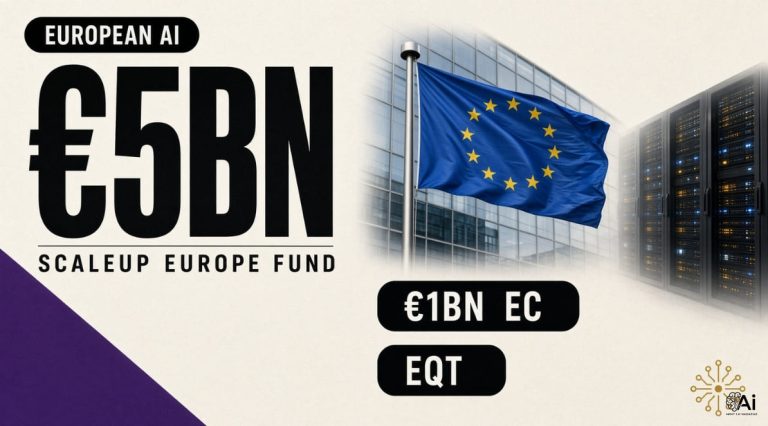

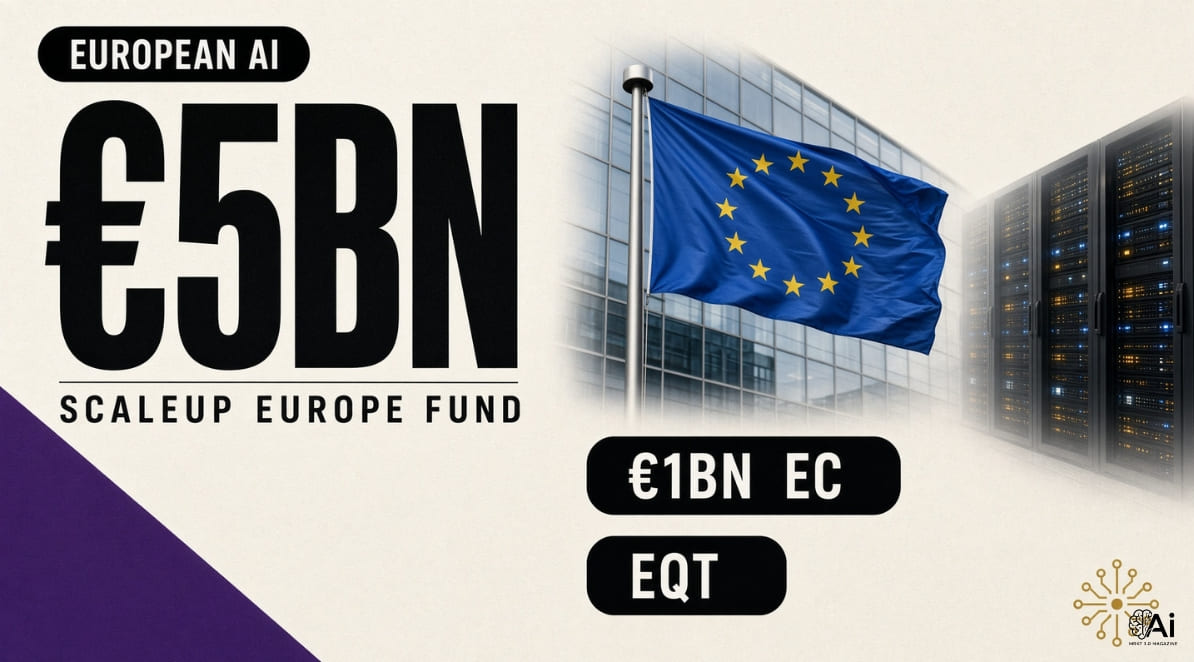
The Scaleup Europe Fund is a late-stage growth fund, targeting about €5 billion, run by EQT and anchored by €1 billion from the European Commission.
It exists because European firms still go to California once the cheque has nine figures on it. Ursula von der Leyen announced the vehicle in her 2025 State of the Union address to put a European cheque in that gap. If you run a tech company in Europe, sit on a cap table next to one of those companies, or write public money into the sector, this is the name that will now appear on term sheets.
What Is the Scaleup Europe Fund?
Novo Holdings, a founding LP, explained that the fund has a “target size of €5 billion and a hard cap of €6–7 billion”. The company continued to state that “the fund is expected to become one of Europe’s largest growth-stage investment platforms focused on supporting companies through growth, late-stage growth and pre-IPO phases.”
It writes large equity tickets, typically €100 million or more including follow-ons, into companies that have already proved the model and need capital to stay and scale.
Importantly, it is not a grant. Nobody applies on the Funding and Tenders portal. It is also not EIC STEP Scale Up, the smaller equity scheme that still runs through Accelerator machinery. The Commission already warned that the two should not be mixed up.
The EIC Fund Board selected EQT as manager in May 2026. The Fund was launched at the EIC Summit on June 3. Legal setup cleared on August 4 with ICEYE being named as the first deal the next day.
Who Puts Money Into It?
Public information names a clear group of founding investors alongside the Commission:
| Backer | Type | What is public |
|---|---|---|
| European Commission | Anchor | €1bn committed |
| EQT | Manager and LP | “Significant” own capital, undisclosed |
| Novo Holdings | Danish investment group | €500m |
| CriteriaCaixa | Spanish holding company | €250m |
| EIFO | Denmark’s export and investment fund | €200m |
| ABP, via APG | Dutch pension fund | €250m (September 24) |
| Allianz | Insurer | Named, amount undisclosed |
| Santander / Mouro Capital | Bank-linked | Named, amount undisclosed |
| Wallenberg Investments | Swedish family holding | Named, amount undisclosed |
| Fondazione Compagnia di San Paolo, Intesa Sanpaolo, Fondazione Cariplo | Italian foundations / bank | Named, amount undisclosed |
EIFO’s own reasoning is also worth commenting on. Peder Lundquist, EIFO’s CEO, explained that “we are helping address a critical gap and ensuring that more of these companies stay in Denmark and Europe.”
What is still unclear is how much of the €5bn has actually closed versus pledged, and whether a later fundraising round opens the vehicle to non-European LPs.
Who Has It Invested In?
Six companies have been publicly named so far:
| Company | Country | Sector | Round |
|---|---|---|---|
| ICEYE | Finland | Satellite intelligence | €1bn Series F, €450m primary, valuation above €10bn |
| Lovable | Sweden | AI coding | $400m Series C at $13.3bn |
| Mistral AI | France | Foundation models | €3bn Series D at more than €21bn |
| The Exploration Company | Germany / France | Space | $450m Series C |
| Tandem Health | Sweden | Clinical AI | $100m Series B; the Fund is described as the sole-lead so far |
| EUCLYD (Craftwerk) | Netherlands | Inference hardware | More than €200m; announced as Series A |
The Fund co-led ICEYE, co-led Lovable’s C, and joined Mistral’s D. It backed The Exploration Company, led Tandem, and co-led EUCLYD alongside Samsung, with former ASML chief Peter Wennink as chairman.
EUCLYD’s “Series A” sits awkwardly next to a fund that talks Series B to pre-IPO. Either the round is mislabelled or the mandate already has an exception. Two of the six names are Swedish. So is EQT. So is Wallenberg.
None of the six needed this Fund to prove they could raise. Samsung, Menlo Ventures and other global funds were often already in the process. So far the Fund is not discovering companies. It is writing large tickets into processes that were already large.
What Can Go Wrong
The first drawback is the book itself. If the next ten deals look like Mistral and Lovable (already famous, already oversubscribed, already sitting next to US or Asian capital) the Fund is crowding into winners, not building a late-stage market.
The second is size. A €100m-class ticket shuts out most European AI companies by design. It is also why this vehicle will not touch the companies that still die between Series A and B.
The third is politics sitting on a commercial process. EQT is supposed to pick deals. The Commission is an LP, not the investment committee. That wall is the point of hiring a private manager. It is also the thing nobody can audit from the outside until a rejected founder, a blocked UK company, or a parliament asks for the pipeline.
The fourth is cash versus slide. Target €5bn, Novo’s cap of €6–7bn, a staged Commission billion, and several LPs with no published ticket. Until there is a close figure, “the €5bn fund” is a headline, not an actual bank balance.
How Do Startups Get In?
There is no EIC grant portal and no EU form to fill in for this fund. Companies go to the Scaleup Europe Fund through EQT, which invites scaling founders and runs sourcing, assessment and the investment decision through its own network, its Motherbrain platform, and the co-investors who bring it deals.
You are in range if these conditions fit your company:
- You are Series B or later, not seed or early Series A.
- You are building in a strategic sector: AI, quantum, semiconductors, robotics, space, clean energy, biotech, medical technology, advanced materials or agritech.
- You are based in, or ready to base in, an EU member state or a country associated with Pillar III of Horizon Europe.
- You need capital at the scale the Commission described: about €100 million and above, including follow-ons, in a large round with other investors.
Who Should Ignore This Fund?
You are wasting your time, and EQT’s, if any of this is you:
- Seed or early Series A. The ticket size rules you out.
- You want a subsidy. This is equity, on commercial terms.
- The pitch is “we are European,” not what you have built.
- You are one of the hundreds of European AI seed companies hoping Mistral is a template. It is not. The Fund backed one foundation-model lab as a strategic name.
- You are a UK founder assuming you qualify. The published rule is EU members and Horizon Europe Pillar III associated countries. Whether that includes the UK is contested. Ask EQT. Do not plan a round on a blog sentence.
The Fund exists because Brussels wants fewer companies leaving for California. It does not exist to congratulate companies that already raised.
What To Watch Next
If they keep landing beside Samsung and Menlo Ventures in rounds that were already full, the Scaleup Europe Fund is crowding into winners, not building the late-stage market Brussels said it wanted. If a few of them show up as the lead in a deal nobody else would anchor in Europe, it is doing the job Ursula von der Leyen described.
Until then, treat it as what it is: a large, privately run equity fund with a Commission billion on the cap table, six public names, and no application form. Most European startups are not the customer. The ones that are already know how to find EQT.
Author: Richardson Chinonyerem
See Also:
Europe’s Top 10 AI Startups 2026: €115B+ Ranked