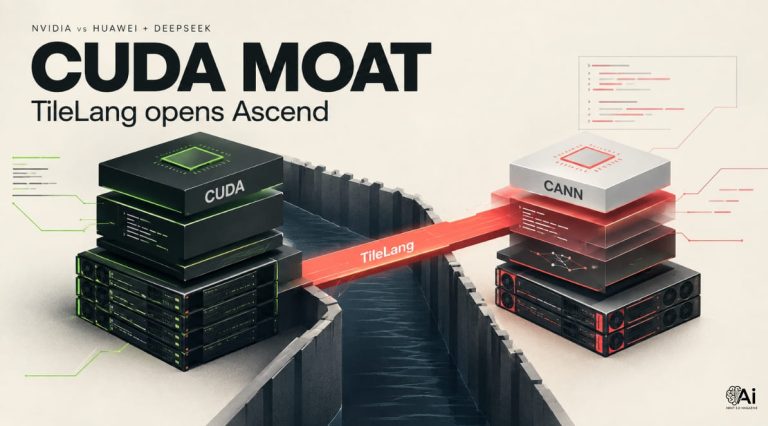

DeepSeek just made Huawei‘s chips easier to program. That only solves the software problem.
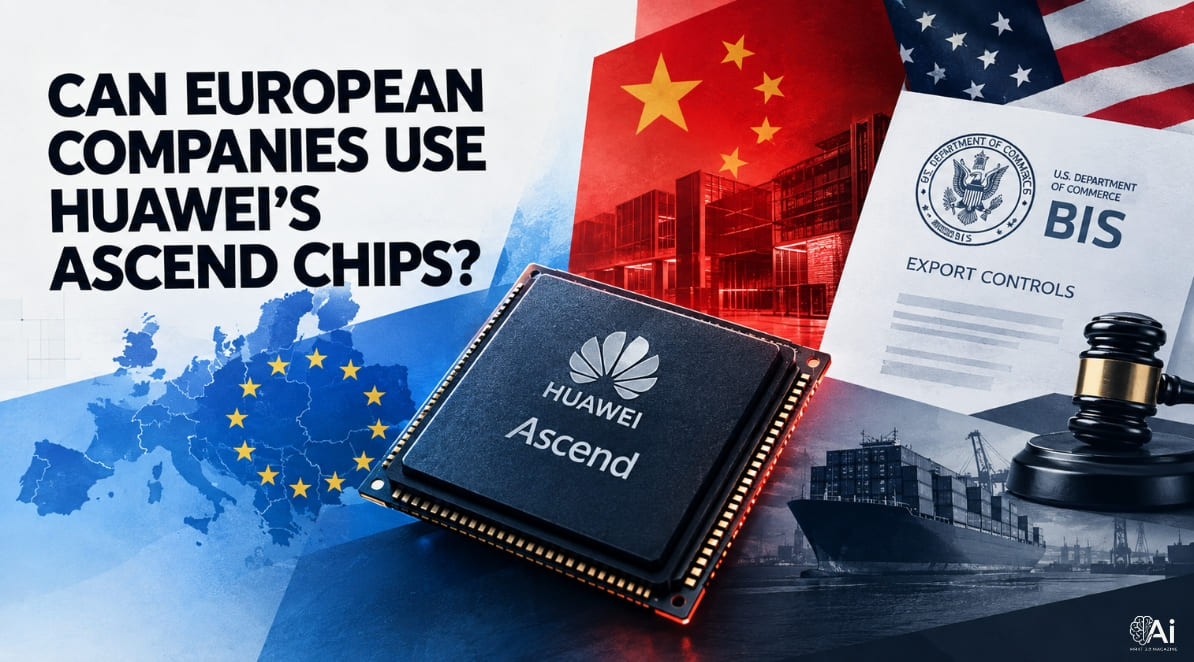
No European law stops a company in Frankfurt or Warsaw from buying an Ascend board. A US rule is what most firms will have to live with, and it reaches past the shipping dock. It reaches the person who switches the chip on.
Why Huawei Ascend Is a Legal Question in Europe This Week
For two years Ascend was a chip you could look at and software you would rather not use. The software side of that changed on September 30, 2026, when DeepSeek released TileLang, a free programming toolkit for Huawei’s platform.
TileLang is aimed at the newer Ascend 950 stack. The US warning names older boards, the 910B, 910C and 910D. They are different chips. The legal risk around a Huawei accelerator is still the same kind of risk.
Once the software is usable, a legal team has to ask the next question: are we allowed to touch the hardware?
Does the EU Ban Huawei Ascend Chips?
There is no EU-wide ban on Huawei’s AI chips. Brussels has never written a rule that names the Ascend 910, 950 or 960.
What the Commission does say is that Huawei and ZTE are high-risk vendors in 5G mobile networks. High-risk vendor is Brussels language for a supplier that some governments treat as a security worry. That label comes from a 2020 playbook called the 5G cybersecurity toolbox.
Member states apply it themselves, and several have taken Huawei radio equipment out of their phone networks. It should be noted that radio equipment is the kit that carries mobile calls, and is not the same thing as an AI chip in a data centre.
In January 2026 the Commission outlined a new Cybersecurity Act that would push high-risk suppliers out of those networks faster. Executive Vice-President Henna Virkkunen told reporters she was not happy with how countries had used the old playbook. That draft is still about phone networks. It does not name Ascend. On paper, a company in the EU can buy the board.
What Is General Prohibition 10?
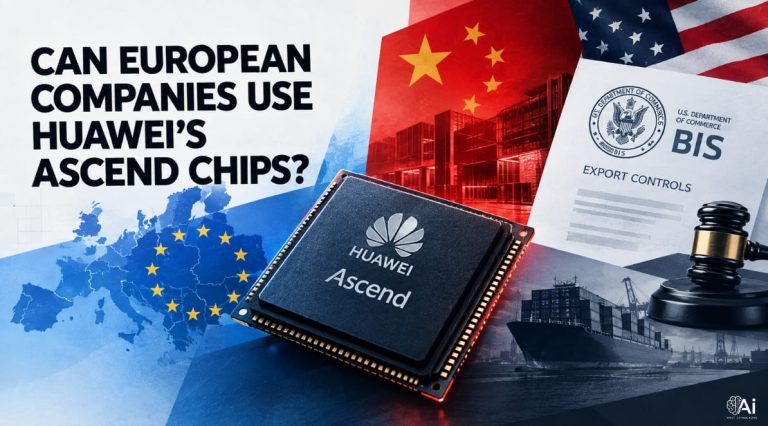
On May 13, 2025 the US Commerce Department’s Bureau of Industry and Security, or BIS, published a warning about Chinese AI chips. BIS is the American office that decides what technology can be sold, and to whom. In that warning it named Huawei’s Ascend 910B, 910C and 910D.
BIS says those chips were probably designed or built in a way that broke US export rules. The specific clause BIS is using is called General Prohibition 10, or GP10. In plain terms, GP10 says: if you have reason to know an item was made or moved illegally under US rules, you may not deal in it. Deal in it means sell it, fund it, repair it, service it, or use it.
That last part really matters in Europe. Most export law is about sending a box from one country to another. GP10 also covers the person who plugs the chip in and starts a model. Law firms that read the same text, including Crowell & Moring, say there is no normal US licence that covers these chips. You would need a special waiver, meaning written permission from BIS.
How can Washington claim a say over a chip sitting in a European rack? Through something called the Foreign Direct Product rule. The idea is if a chip was designed with American software, or built on machines that themselves depend on American technology, the United States still treats that chip as its business, wherever it ends up. BIS says Huawei’s advanced chips were very likely made that way, and that the US licences those steps would have needed were never granted. It then warns that using the chips can pull in “persons and companies in the United States and abroad.”
Do US Huawei Chip Rules Apply to European Companies?
The risk is higher if the company looks American in any way. US staff, US software, US customers, or payments in dollars all give Washington a handle. BIS also says firms should check who the buyer is, get written promises about how the chips will be used, and write down who owns them. It can add a non-US company to the Entity List, a public blacklist that cuts a firm off from American technology, without first winning a court case.
BIS has already shown it will look at people in the middle of a deal, not only the factory or the buyer. In 2026 it opened a probe into Apex Logistics, a Singapore shipping firm owned by Kuehne+Nagel, over suspected loads of Super Micro servers built around NVIDIA chips. Although there was no public charge, the key detail is that they went after the forwarder.
China’s commerce ministry called the May 2025 warning an abuse of export controls. Spokesperson He Yongqian said it was “not conducive to long-term, mutually beneficial, and sustainable cooperation.” A European firm with no US staff, no US software, no US customers and no dollar financing is further from BIS than a chip broker. BIS has warned. It has not published a string of fines against European AI teams for running Ascend. Calling that illegal overstates what a European court can see today. Exposed is closer.
Two other problems sit beside the law. Usable in software is not the same as available in volume in the EU. Huawei has kept most of the new series for the Chinese market, where domestic demand is absorbing the cards and large clusters are already running. Getting the same boards in Europe is hard even if counsel says yes.
Politics is another problem. The 5G label began as guidance and is now being turned into a harder rule. A company that builds on Ascend is betting that AI chips stay outside that fight.
Huawei’s own model weights are a separate product, with a separate risk. The openPangu licence asks users not to run those models inside the EU. That is a contract term on the software. It is not an EU ban on the chips.
What Should European Firms Check Before Buying Ascend?
Before anyone signs a purchase order, write down the American ties. Who would run the cluster. Which software sits in the path. Whether any customer or lender is American. What promises the supplier will make about the end user. And whether a lawyer has asked BIS, in writing, if a waiver exists for that use. If the chip was made without the right US permission, later use needs that waiver. It does not need a normal export licence.
Europe’s answer is that no law stops the purchase. America’s answer is to be careful.
Author: Grace Sharp
See Also:
What Is Huawei Ascend? The CUDA-Free AI Stack, Explained
This article is reporting, not legal advice. US export rules change, and a firm’s risk depends on its own facts. Get a trade-compliance read before anyone buys or switches on a board. Citations were checked against the sources linked above on September 30, 2026.