
Europe’s data-centre boom is hitting roadblocks that can delay or reshape projects even when governments want more capacity.
In early October Finnish authorities ordered a stop to environmentally significant preparatory work at two planned Google sites. Weeks earlier Ireland’s planning body refused a Mayo project after citing electricity supply and climate targets. These are not isolated planning disputes. They test whether Europe can add the computing capacity it says it needs for competitiveness and technological sovereignty without overloading grids, water supplies and local communities.
Last week, MRKT3.0 mapped the same fight in the UK. The European version is broader, covers more countries, and is already affecting schedules on major hyperscale investments.
Where Are the Main Fights, and Who Is Running Them?
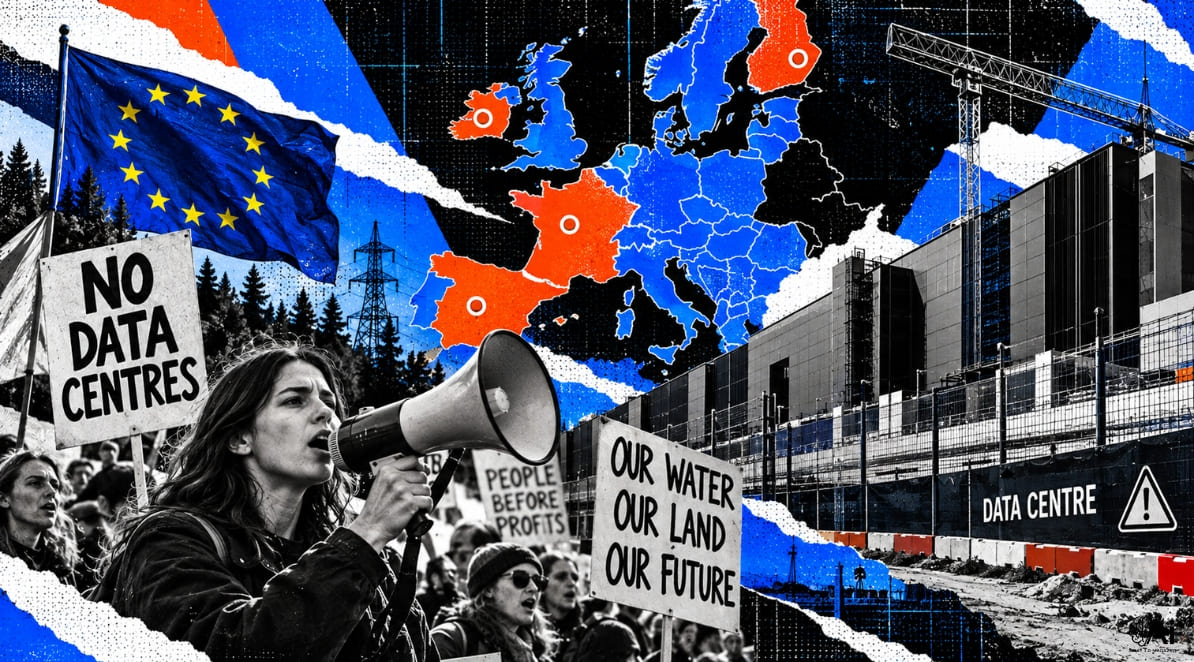
The most active cases sit in Ireland, Spain, France, the Netherlands and Finland. Each has a different mix of local groups, national organisations and project status.
Ireland
Rosi Leonard of Friends of the Earth Ireland has pressed for a moratorium and a framework that prioritises electricity connections by public need. She urged an Oireachtas committee on September 22 to back that approach. In Kildare the Naas Data Centre Awareness campaign, whose spokesperson is Krystle Foley, has opposed rezoning. The Killala refusal is a concrete planning decision. The Naas campaign lost a zoning vote, though a separate Herbata application remains under appeal. The national argument is sharpened by data centres’ 23% share of metered electricity.
Spain
The group Salvemos los Pinares de Venecia is opposing Microsoft’s Puerto Venecia project near Zaragoza. Spokesperson Ángela Ezquerro told reporters that the projects represent “the new capitalism we are facing” and raised particular concern about earth movements involving asbestos. Neighbours and the group lodged 349 paper objections in August and around 500 people marched in September. At Talavera de la Reina the campaign Tu Nube Seca Mi Río has highlighted the prospective water footprint of a Meta campus. That project is further along: Meta’s developer Zarza Networks posted the required planning guarantee in September, so it can move to the next administrative stage.
France
Les Amis de la Terre France established standing in urgent proceedings against a project at Alixan. That case produced a court suspension over the absence of an environmental impact assessment. Around Marseille, Le Nuage était sous nos pieds has joined local committees and France Nature Environnement 13 in challenging a Telehouse proposal, citing wildfire and environmental risks. That challenge continues.
Netherlands
The earlier Zeewolde challenge involved LTO Noord, Mobilisation for the Environment, Stichting DataTruc, Windpark Zeewolde and residents. It remains the clearest completed defeat of a hyperscale proposal. The 2023 Council of State judgment turned on whether the zoning plan was executable, including questions of land ownership, rather than a blanket environmental prohibition.
Finland
The Muhos and Kajaani work stoppages show that environmental assessment timing can affect a schedule even where a government is attracting major investment.
Portugal
Sines is an important cooling and infrastructure story, but the EDP–government dispute over seawater infrastructure is a commercial and legal matter, not a documented grassroots anti-data-centre win. MRKT3.0 has previously examined where Europe can actually place new sites given grid and water constraints.
What Are Campaigners Actually Objecting To?
The objections cluster around electricity, water, land and the timing of environmental assessment.
Irish opponents question grid adequacy, fossil-fuel backup and consistency with climate targets. The Killala decision directly cited the absence of a firm grid-connection agreement, adequate capacity and substantial on-site renewables.
Spanish groups raise water pressure and the siting of large campuses. In Zaragoza the immediate concerns also include earthmoving near protected woodland and alleged asbestos risks. Those are campaigners’ allegations, not findings that an environmental offence has occurred.
France’s Alixan court said an environmental impact assessment was required for a project eventually exceeding 60 MW of electrical demand. Finnish authorities intervened over tree and topsoil clearance before environmental impact assessment procedures were completed. Marseille-area opponents cite wildfire risk, backup generators and proximity to homes.
Where Has Opposition Won, and Where Has It Lost?
Wins are real but limited. Several high-profile cases have produced delays or revised conditions rather than permanent stops.
The pattern is consistent: opposition can force a refusal, a suspension or a redesign, but most projects so far have not been permanently blocked on environmental grounds alone.
What Does the Government Say?
Governments and the European Commission continue to treat additional data-centre capacity as a competitiveness and sovereignty goal, while some national regulators tighten conditions.
The EU’s AI Continent Action Plan calls for at least a tripling of data-centre capacity within five to seven years, alongside AI factories and gigafactories.
Separately, the Commission is consulting on minimum environmental standards. The feedback deadline is December 14, 2026 and a proposal is planned for the second quarter of 2027. We have previously examined the gap between those ambitions and Europe’s financing capacity, and covered the Commission’s earlier move to grade sites on power and water use.
Ireland’s regulator CRU adopted a new connection policy on December 12, 2025. New data centres must provide generation and/or storage, on-site or nearby, matching maximum requested import capacity. This is not a blanket moratorium. Spain’s digital-transformation minister said on October 8, 2026 that the government would press ahead with tighter water and electricity rules, but the decree was still under development. Denmark has already moved ordinary data centres to the back of its grid connection queue.
Why Build Them Anyway?
Data centres support cloud software, financial services, communications, public administration and AI training and inference. The Commission frames more EU computing capacity as a competitiveness, resilience and technological-sovereignty goal. Local ownership of buildings does not automatically create European control of the workloads or platforms they host.
Investment figures are large. Google announced €13 billion of Finnish investment over two years in September 2026. It projects more than 37,000 jobs supported during the 2027–28 construction phase and thousands of permanent jobs later. These are Google forecasts, not observed job creation. Temporary construction employment should not be presented as permanent staffing.
Google says its Finnish expansion will support a 22-year arrangement connected with Loviisa nuclear life extension, wind projects and a planned 94 MW battery near Kajaani. Such investments can add system value, but the question for regulators is whether new generation and network capacity genuinely offset the new load.
Start Campus says its operating SIN01 building at Sines used no potable water for cooling in 2025 and returned 692,942 cubic metres of seawater after cooling. It also reports 41,763 cubic metres of industrial freshwater withdrawn for cooling, so “zero potable water” does not mean zero freshwater. The 1.2 GW campus is still being built and these operational numbers cover SIN01 only.
What Happens Next?
Several processes will test how far opposition can shape outcomes. The EU consultation on minimum performance standards closes on December 14, 2026, with a legislative timetable aimed at 2027. Spain’s draft decree remains under development. Appeal cases continue in Naas. The Alixan merits judgment is still pending. Environmental impact assessments for Google’s Finnish sites must still be completed.
Three questions sit under those cases. Will a developer be required to show a firm grid and generation plan before approval? Can the timing of environmental assessment become a decisive obstacle even where government supports the project? Will residents win binding concessions, or will most disputes end in revised conditions and eventual construction?
Author: Connor Fitzgerald
See Also:
Denmark’s Bill L 23 Puts Data Centres Last in the Grid Queue
What Country in Europe Has the Most Data Centres?
Who Is Fighting Data Centres in the UK?
How We Checked This:
We checked the Central Statistics Office release on Ireland’s 2025 metered electricity, the Grenoble administrative court’s July 10, 2026 suspension decision, the Dutch Council of State’s September 2023 judgment on Zeewolde, Yle and other reporting on the Finnish orders, and primary statements from CRU, the European Commission and the developers involved. Figures on jobs and water use are attributed to the companies that published them.
Frequently Asked Questions:
Local groups and regulators are questioning electricity demand, water use, land clearance and whether projects fit climate targets. Ireland’s data centres already use 23% of metered electricity. Courts and regulators have also paused or refused projects over missing environmental assessments or grid agreements.
Ireland, Spain, France, the Netherlands and Finland currently have the most visible cases. Ireland has a recent planning refusal and a high electricity share. Spain has live neighbourhood protests. France has a court suspension. The Netherlands has a completed hyperscale defeat. Finland has ordered a work halt at two Google sites.
Not permanently. Finnish authorities ordered a halt to environmentally significant preparatory work at the Muhos and Kajaani sites until environmental impact assessments are completed. Google said it would comply and acknowledged falling short of its standards. The underlying projects are not cancelled.
Yes. Meta withdrew from the Zeewolde project in the Netherlands in 2022. In 2023 the Council of State annulled the zoning plan because the municipality had not shown it was executable. Other cases, such as Killala in Ireland, have produced refusals, while several more have only produced delays or suspensions.
The European Commission is consulting on minimum environmental performance standards for data centres. The feedback deadline is 14 December 2026, with a proposal planned for the second quarter of 2027. Separately, the AI Continent Action Plan calls for a large increase in data-centre capacity.